Pumpkin spice, cobwebs and pumpkins can mean only one thing: spooky season is upon us! To celebrate the season, we are going to look at one of the most elaborate and intriguing unsolved mysteries in the history of mankind: the Voynich manuscript.
The manuscript is a medieval codex written on calfskin between 1404 and 1438. It first entered the public eye in 1912, when Polish book dealer Wilfrid Voynich, for whom it is named, purchased it. Roughly 240 pages were made from at least 14 calfskins, with the ink confirmed to be added shortly after the skins were processed. At least 30 pages seem to be missing from the document, and it has likely been rearranged at least once since its completion.
This all sounds pretty run-of-the-mill for medieval codices, until it is revealed that the Voynich manuscript is written in a language that nobody can read that has never been seen anywhere else.
It’s important to note that the words written within the codex are indeed a language (which scholars have dubbed “Voynichese”) and not simply a collection of nonsensical symbols. Patterns have been recognized within the texts. The alphabet follows the patterns of natural language, most notably the adherence to Zipf’s law.
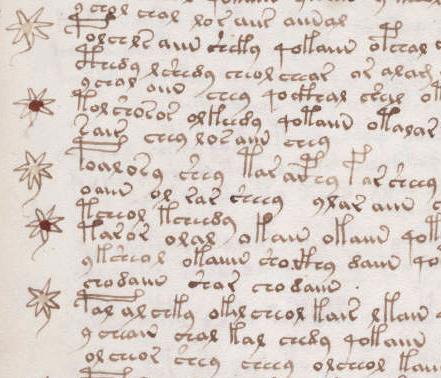
Text detail from Page 119 from the Voynich manuscript. Courtesy photo
Zipf’s law states that within a statistical dataset, an object’s frequency of appearance is inversely proportional to its rank. This probably means nothing to you, so in a nutshell it means the most common item to appear in a dataset is twice as likely to appear as the second most common item, three times more common than the third, and so on and so on.
This applies to linguistics and helps identify naturally forming languages over gibberish. Gibberish languages developed with the sole intention of creating a confusing, nonsensical puzzle don’t often follow Zipf’s law, whereas something like the word “the” in the English language does.
Additionally, the characters contained within the Voynich text appear to follow rules of natural language across 240 pages, which would be inconsistent with a hoax or nonsense language.
One’s first inclination would be to think that this is simply a cipher for Italian or Latin, but one would be wrong. The next most likely possibility is that this is some form of Medieval constructed language. A constructed language is something like Tolkien’s Elvish, Klingon from Star Trek or Dothraki from HBO’s Game of Thrones.
The most curious feature about this hypothesis is that “conlangs,” as they’re called, are often made by a single person, then backed up by written text to help catalog the language and share its structure with other people. In the case of the Voynich manuscript, there isn’t a single other known source reflective of this unidentified language anywhere. Even more curious, the codex shows evidence of having been written by at least five different scribes.
While it’s possible that this is a totally artificial conlang and the reference materials simply disappeared or were destroyed, the fact that it was constructed through an apparent community effort begs the question: why?
We don’t really know the answer to that. Whomever actually knows “why” has been dead for at least half a millennium. Most curious of all, despite it being the singular example of this particular language in human history, it was deemed valuable enough to hold onto for a very long time. One of its first owners may have been Emperor Rudolf II of the Holy Roman Empire in the late 1500s. At some point, it ended up in the personal library of 17th century alchemist Georg Baresch of Prague, who described the codex as “taking up space uselessly in his library.”
Frustrated, yet enraptured by the mystery, Baresch sent copies of the script to the Jesuit scholar Athanasius Kircher, who had published a Coptic dictionary that had supposedly deciphered Egyptian hieroglyphs. This was one of the first attempts to decipher the cryptic text.
By 1912, it ended up in the hands of Wilfrid Voynich. Over the next half-century, the codex changed hands until it landed in the possession of antique book dealer Hans P. Kraus. Unable to sell the strange artifact, he donated it to Yale University in 1969, where it remains to this day.
The codex contains more mystery than strange and potentially indecipherable text. It also features illustrations ranging from the comical to the elaborate. Numerous botanical depictions appear in vivid color throughout the manuscript, some with unusual and alien appearances. There are also figures depicted with a surprising amount of nudity for a late-Medieval text, including simple sketches of what appear to be water nymphs splashing around in green water and a naked man marked with some of the only known language seen in the book as “the widow’s share.”
More complex yet, astrological symbols appear throughout the document with numerous elaborate pages that fold out into large diagrams. A great deal of care was put into this text, yet again supporting the idea that the Voynich manuscript likely was not an overindulgent hoax.
Are you curious to see if you can crack the code of the Voynich manuscript? Yale University has scanned and published the entire document to its digital library. To this day, it has never been definitively decoded and its true purpose remains one of the world’s most curious unsolved mysteries.
Stay curious, 7B.
Want to support independent local journalism?
The Sandpoint Reader is our town's local, independent weekly newspaper. "Independent" means that the Reader is locally owned and operated by people who were born and raised in Sandpoint. The Reader is owned by Publisher Ben Olson, Editor-in-Chief Zach Hagadone and Senior Writer Soncirey Mitchell. Sandpoint Reader LLC is a completely independent business unit; no big newspaper group or corporate conglomerate or billionaire owner dictates our editorial policy. And we want the news, opinion and lifestyle stories we report to be freely available to all interested readers - so unlike many other newspapers and media websites, we have NO PAYWALL on our website. The Reader relies wholly on the support of our valued advertisers, as well as readers who voluntarily contribute. Want to ensure that local, independent journalism survives in our town? You can help support the Reader for as little as $1.
TIMBER WARS: Six-part series, February-November 2022. GO READ IT»
WHERE ARE THE WORKERS?: Five-part series, September-October 2021. GO READ IT»
THE AMERICAN REDOUBT: Seven-part series, November-December 2017. GO READ IT»
STANDOFF AT RUBY RIDGE: 25 Years Later. Five-part series, August-September 2017. GO READ IT»
Curious about what media the locals use? Check our 2018 Local Media Survey. GO SEE »
Sandpoint in Pictures
Filmmaker Jimmy Matlosz of the Idaho Film Company has made a series of mini documentaries about influential Sandpoint locals, including the late Dann Hall and Erik Daarstad as well as icons Diane Michaels and Dan Shook. He is currently working on a series of interviews connected to the history of the Panida Theater. Jimmy is a 30-year veteran filmmaker who's work can be seen at dpmatlosz.com.
Meet the Reader
Ever wonder who makes the Reader happen? Here's a behind-the-scenes look pieced together by summer 2017 intern McCalee Cain in which Ben, Cameron and Lyndsie explain what exactly about the Reader keeps them coming back to their shabby (but well-loved) office each week.