Do you knock on wood or cross your fingers when you want something good to happen — or something bad to not happen? Do you wear a rally cap when your baseball team is losing, or throw salt over your left shoulder after spilling it? We all have our little rituals to conjure good and ward off evil, and those cultural quirks are just the newest spells in a long line of apotropaic magic that humanity has invented to keep itself safe.
“Apotropaic” — from the ancient Greek apotrépō, meaning “to ward off” — refers to rituals, objects and symbols used to repel bad luck, evil spirits, witches, demons and everything else that goes bump in the night. Throughout history, these have been anything from ordinary objects to bawdy or frightening images.
The ancient Greeks and Romans were particularly fascinated with depictions of penises — called phalloi and fascinum, respectively — which could be worn as charms or placed in a home or building to frighten unwanted supernatural intruders. Given that phallic imagery is widely tied to strength, virility and life-giving, it’s not too much of a stretch to think that a symbolic show of force would keep evil at bay.
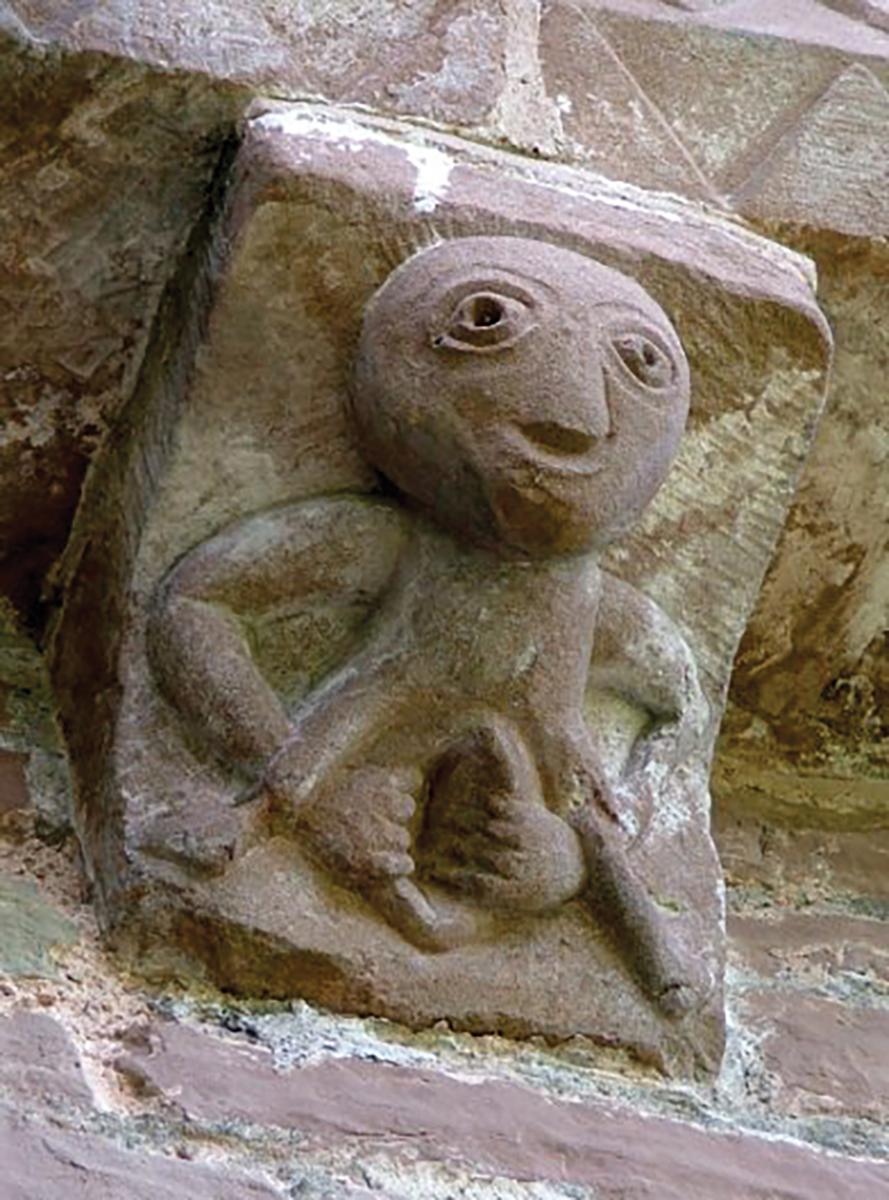
The same goes for images of female genitalia, most famously immortalized in Ireland in the form of sheela na gigs. These stone carvings, similar to other grotesques like gargoyles, can be found above ancient church doors and depict naked women displaying their highly exaggerated vulvas. Though these are widely considered apotropaic, the exact origins remain unknown. Some scholars argue that they are the last vestiges of an older Pagan fertility deity, while others believe they are a condemnation of female sexuality. The name itself gives little away: it may be a variation of the Irish Síle na gcíoch, or “Julia of the breasts,” or a regional term for “old woman.”
A 12th-century sheela na gig on the church at Kilpeck, Herefordshire, England. Courtesy photo
Like the sheela na gig, many stationary apotropaic symbols guard entrances to the home, be it doors, windows or chimneys. Some are meant to ward off evil on sight and so should be displayed prominently. Glass spheres called “witch balls” and geometric symbols called “witch marks” would loudly declare, “No witches welcome,” in historic British homes. From these came more explicitly Christian derivations, including decorative carvings of the letters “V” and “M,” which signified an appeal to the Virgin Mary.
The most famous of these apotropaic symbols in existence today is, of course, the jack-o’-lantern, which has its roots in Celtic Paganism. Practitioners would usually carve root vegetables like turnips or beets and display them around the beginning of winter when, in Gaelic-speaking regions, supernatural beings like the Aos Sí were believed to be especially active.
Other apotropaic symbols worked silently, usually buried or built into the foundations of homes. The most common of these, which have been found around Europe and British territories, are “concealed shoes.” Though the practice died out in the 20th century, homeowners and builders used to take an old shoe — usually one that’s worn out or been outgrown by a child — and place it around the foundation or front door of a building. The Northampton Museum and Art Gallery, which is known for its extensive collection of footwear, keeps a running tally called the “Concealed Shoe Index,” which includes more than 3,000 recorded instances of such shoes around the world. The oldest example, found in the choir stalls of Winchester Cathedral, dates to approximately 1308.
There are also many instances of desiccated cats ritually placed inside walls to battle evil spirits, even in death. And, no, these cats didn’t get stuck behind the drywall during construction. Forensic examination has found that most examples of apotropaic cat mummies were dead and desiccated before being placed in the wall, and may even have been staged to appear more alive. A related, though less common and more expensive practice, saw people bury a horse skull beneath their homes. That feels less apotropaic and more like you’re going to get haunted by a horse.
Finally, English people in the 1600s who had already been beset by evil forces could break out the big guns and craft a “witch bottle.” According to the written and archaeological record, this usually involved peeing into a glass bottle, then filling it with hair, nail clippings, string, wine, herbs, needles or nails and burying it on your property to capture and kill evil spirits.
I’ll stick to jack-o’-lanterns, thanks.
Want to support independent local journalism?
The Sandpoint Reader is our town's local, independent weekly newspaper. "Independent" means that the Reader is locally owned and operated by people who were born and raised in Sandpoint. The Reader is owned by Publisher Ben Olson, Editor-in-Chief Zach Hagadone and Senior Writer Soncirey Mitchell. Sandpoint Reader LLC is a completely independent business unit; no big newspaper group or corporate conglomerate or billionaire owner dictates our editorial policy. And we want the news, opinion and lifestyle stories we report to be freely available to all interested readers - so unlike many other newspapers and media websites, we have NO PAYWALL on our website. The Reader relies wholly on the support of our valued advertisers, as well as readers who voluntarily contribute. Want to ensure that local, independent journalism survives in our town? You can help support the Reader for as little as $1.
TIMBER WARS: Six-part series, February-November 2022. GO READ IT»
WHERE ARE THE WORKERS?: Five-part series, September-October 2021. GO READ IT»
THE AMERICAN REDOUBT: Seven-part series, November-December 2017. GO READ IT»
STANDOFF AT RUBY RIDGE: 25 Years Later. Five-part series, August-September 2017. GO READ IT»
Curious about what media the locals use? Check our 2018 Local Media Survey. GO SEE »
Sandpoint in Pictures
Filmmaker Jimmy Matlosz of the Idaho Film Company has made a series of mini documentaries about influential Sandpoint locals, including the late Dann Hall and Erik Daarstad as well as icons Diane Michaels and Dan Shook. He is currently working on a series of interviews connected to the history of the Panida Theater. Jimmy is a 30-year veteran filmmaker who's work can be seen at dpmatlosz.com.
Meet the Reader
Ever wonder who makes the Reader happen? Here's a behind-the-scenes look pieced together by summer 2017 intern McCalee Cain in which Ben, Cameron and Lyndsie explain what exactly about the Reader keeps them coming back to their shabby (but well-loved) office each week.