Mad about Science: Doppelgängers and weird coincidences
October 21, 2026
By Brenden Bobby Reader Staff
History is full of weird coincidences. Enough people exist for a certain length of time and you are bound to have some expected, albeit unusual, occurrences. It’s just statistics at play.
That being said, some of the coincidences we will look at today seem to defy statistical probability to the extreme. Were these authentic occurrences, or inflated by the human experience? We may never know, as they remain unexplained mysteries to this day.
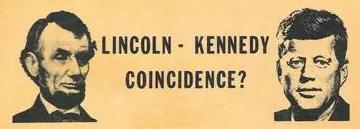
Before exploring the proper doppelgängers, we are going to look at two presidents with some weird coincidences that appear once you look at them together.
We all know how the presidencies of Abraham Lincoln and John F. Kennedy ended. They were both assassinated with a gunshot to the head on a Friday — Lincoln on April 14, 1865, and Kennedy on Nov. 22, 1963. However, they were both succeeded in their presidency by southerners with the last name Johnson — Andrew Johnson and Lyndon B. Johnson, who were born exactly 100 years apart from one another.
Their assassins were also both referred to by three names — John Wilkes Booth and Lee Harvey Oswald, with 15 letters in each of their names. They were also both killed before they could face trial.
Even more, Lincoln and Kennedy were assassinated in something called “Ford,” with Lincoln being shot in Ford’s Theatre and Kennedy killed in a Ford-built Lincoln Continental.
Lincoln was elected to Congress in 1846, while JFK was elected to Congress 100 years later in 1946. They were both elected president of the United States 14 years after being elected to Congress, in 1860 and 1960, respectively. They were also both pivotal figures who championed civil rights for Black Americans during times of particularly tumultuous political upheaval in the country.
Moving on to a bridge between strange doppelgängers and coincidences, the “Jim Twins” remain a curious case in the exploration of twin behaviors and the role played by genetics in lifelong decision making.
Two twins separated at birth — James Lewis and James Springer — spent the first 39 years apart and totally unaware that they were an identical twin. They were taken by different adoptive families weeks after their birth and given the name James but referred to as Jim. Both men lived virtually their entire lives only 45 miles apart, completely unaware of the other’s existence.
The Jims both had an adoptive brother named Larry and a dog named Toy. They both married women named Linda, divorced and then married women named Betty. Even more curious, they each had a son — one named James Alan and the other James Allan. They both worked as deputy sheriffs, trained in carpentry and drove blue Chevrolets.
One could argue that many of the decisions and parallels between the men’s lives weren’t dictated by their genetics, but by societal norms and expectations of the 1960s and ’70s. Things like their choice of favorite cigarette, drink or preferred vehicle could be attributed to this, but the parallels between marrying women with the exact same name and also giving their children virtually identical names is very curious.
It’s likely that the list of differences between the twins were much larger than the similarities, and it’s very likely that the similarities were specifically highlighted because of how intriguing and close they were. This is an exploration of the “Texas sharpshooter fallacy.”
The Texas sharpshooter fallacy is a logical and statistical fallacy that highlights human nature to cherry-pick data to prove a point. The idea is that someone fires a load of bullets at the side of a barn in Texas, then walks up and draws a bullseye around the tightest cluster, declaring themselves a master sharpshooter by ignoring all the other shots in the barn.
It’s likely you’ve known someone who does this in their everyday life, as it is a common human trait.
Finally, many historical figures have claimed to see their doppelgänger, a perfect mirror of themselves at some point in the future. This has been viewed as ominous throughout much of human history, with examples such as Abraham Lincoln looking in the mirror and seeing an alternate version of himself as pale, sickly and nearly dead not long before his assassination. Similarly, Queen Elizabeth I reported walking into her quarters to find a mirror reflecting an image of herself looking incredibly ill lying in her bed.
It’s likely that these visions are a stress response produced by the brain — a way for the subconscious mind to beg the conscious mind and body to slow down or face a terrible fate. The psychological strain of a country-shattering war and multiple assassination attempts very likely drove Lincoln to that vision, while Elizabeth’s habit of using white lead makeup probably contributed in a major way to her visions.
Writer Johann Wolfgang von Goethe had the opposite effect when viewing his doppelgänger. While riding toward Alsace to visit his lover in 1771, he had been distraught. Suddenly, coming the other way down the road, he viewed a spectral visage of himself, years older, wearing a gray coat with gold trimmings. Instead of being filled with dread, it filled him with hope.
Eight years later, he was riding down that road to visit his lover for the last time, and in doing so, realized he was wearing the same gray coat he saw nearly a decade before.
Glitch in the matrix, unexplained mystery or intentional fashion choice made by a writer with a fanciful penchant for the dramatic? I’ll let you decide.
Stay curious, 7B.
Want to support independent local journalism?
The Sandpoint Reader is our town's local, independent weekly newspaper. "Independent" means that the Reader is locally owned and operated by people who were born and raised in Sandpoint. The Reader is owned by Publisher Ben Olson, Editor-in-Chief Zach Hagadone and Senior Writer Soncirey Mitchell. Sandpoint Reader LLC is a completely independent business unit; no big newspaper group or corporate conglomerate or billionaire owner dictates our editorial policy. And we want the news, opinion and lifestyle stories we report to be freely available to all interested readers - so unlike many other newspapers and media websites, we have NO PAYWALL on our website. The Reader relies wholly on the support of our valued advertisers, as well as readers who voluntarily contribute. Want to ensure that local, independent journalism survives in our town? You can help support the Reader for as little as $1.
TIMBER WARS: Six-part series, February-November 2022. GO READ IT»
WHERE ARE THE WORKERS?: Five-part series, September-October 2021. GO READ IT»
THE AMERICAN REDOUBT: Seven-part series, November-December 2017. GO READ IT»
STANDOFF AT RUBY RIDGE: 25 Years Later. Five-part series, August-September 2017. GO READ IT»
Curious about what media the locals use? Check our 2018 Local Media Survey. GO SEE »
Sandpoint in Pictures
Filmmaker Jimmy Matlosz of the Idaho Film Company has made a series of mini documentaries about influential Sandpoint locals, including the late Dann Hall and Erik Daarstad as well as icons Diane Michaels and Dan Shook. He is currently working on a series of interviews connected to the history of the Panida Theater. Jimmy is a 30-year veteran filmmaker who's work can be seen at dpmatlosz.com.
Meet the Reader
Ever wonder who makes the Reader happen? Here's a behind-the-scenes look pieced together by summer 2017 intern McCalee Cain in which Ben, Cameron and Lyndsie explain what exactly about the Reader keeps them coming back to their shabby (but well-loved) office each week.