In the grand scheme of things, the catacombs beneath Paris are a relatively recent creation — younger, in fact, than most of its skeletal inhabitants. Subterranean ossuaries are not the traditional method employed by Parisians to house their dead, but are rather the quick fix to a series of monumental infrastructure issues that came out of the late 1700s.
Churches held a monopoly on the business of death in Europe going back to at least the eighth century, when the Catholic Church began insisting that believers bury their dead in the hallowed grounds around churches. Considering families had to pay to have their loved one decompose in an unmarked mass grave next to their local church, this was an easy way for the clergy to make money. However, they weren’t thinking in the long term — as in the next thousand years.
Churchyards weren’t that big, so by the early modern period, eternal slumber wasn’t remotely permanent. Undertakers would bury the bodies, wait five or so years for decomposition to take place, then dig them up and place the bones within charnel houses, rooms or displays within the church, or along the graveyard walls. This gave people more room for burial, but not by much, because the inundation of corpses built up the soil itself.
Paris’ largest burial site, Holy Innocents’ Cemetery, took up roughly the size of a city block, yet managed to house more than 2 million people across its 600 years of operation. By the late 1700s, the plot of land — located next to housing and a busy market — was more corpse than soil, and it smelled like it. The soil had reportedly swelled more than six feet from when interments began, and constant digging had destroyed the land’s stability. Public sentiment was already against the cemetery, with many writers and officials at the time arguing that the off-gassing from corpses was creating a miasma that made people sick, spoiled wine and curdled milk. Everything came to a head in 1780 when the crushed corpses, with nowhere else to go, burst the confines of the cemetery and flooded into a neighboring property’s basement.
Paris removed the uncovered bodies, closed Holy Innocents’ and outlawed burial within the city limits. Now, the newly dead could go to their eternal slumber at newly created cemeteries outside the city walls. But what about all the bodies in Paris’ (literal) basements?
Around this time, Paris was facing yet another problem: sinkholes. When the city’s great stone buildings were first under construction, Parisians turned to the massive deposits of lutetian limestone on the outskirts of the city for building materials. Miners dug a network of unmapped tunnels, raided the limestone, then abandoned the whole thing, never considering that Paris would one day grow so large that it would annex and build upon that hollow ground. Yet build the Parisians did; and, with foot and carriage traffic and new buildings pressing down on the old quarries, the shafts began to collapse, taking homes and people with them. The most famous was the collapse of the aptly named Rue de l’Enfer (Hell’s road) in 1774, after which Louis XVI banned mining under active roads and instructed his government to map the tunnels.
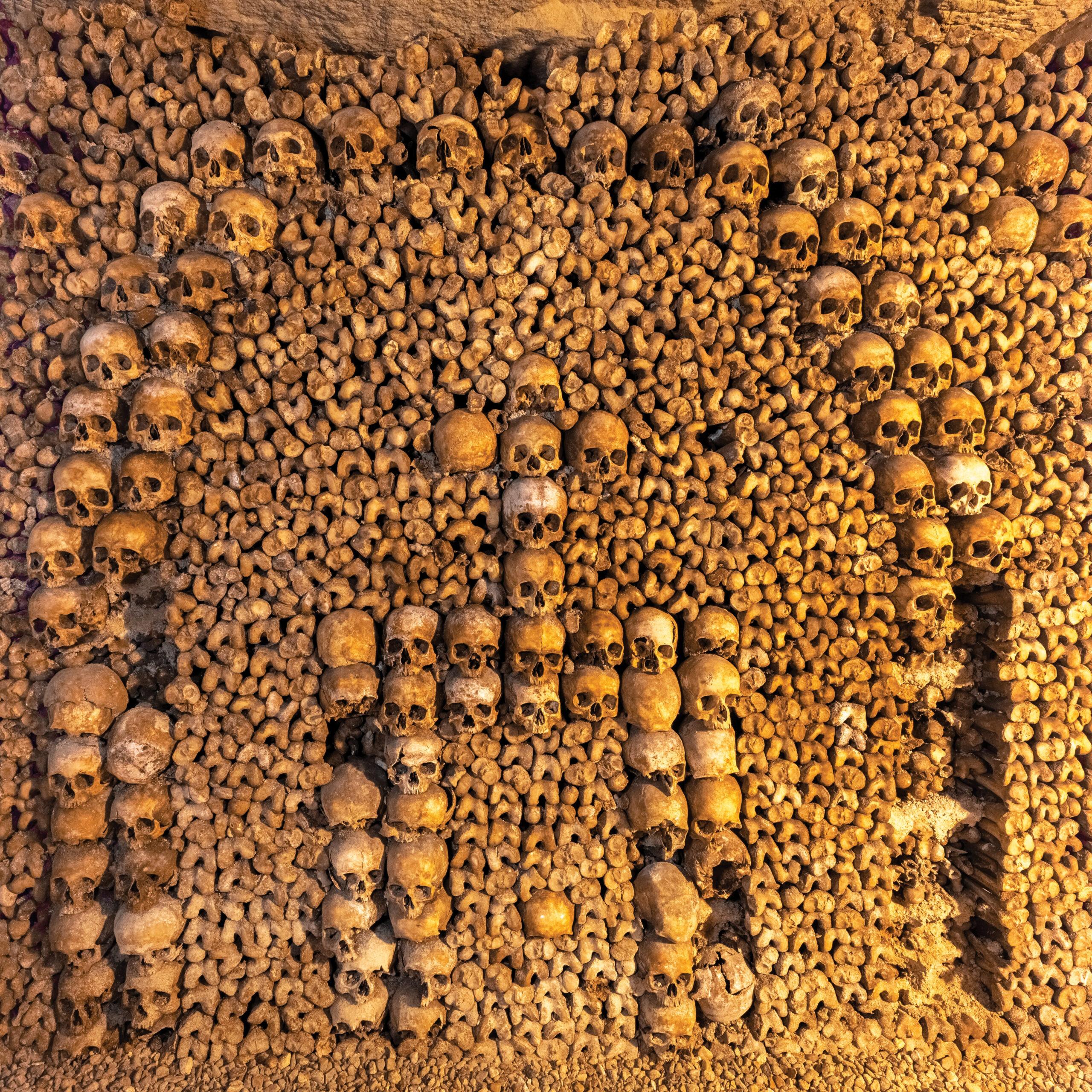
An ossuary, or wall, made of skulls and bones. Courtesy photo
That meant that by the time the cemeteries closed, the government had a map of underground storage space and a need to stabilize it — hence, the catacombs.
For two years, undertakers worked at night, away from public view, digging up graves, emptying charnel houses and transporting bones by the wagonload down into the former mines. More than 6 million bodies were unceremoniously dumped down dark holes, which shattered a large portion of the bones. There they lay until 1810 when, under the leadership of Louis-Étienne Héricart de Thury, Paris decided to stabilize the tunnels, reorganize the bones and make the catacombs a kind of macabre museum. Workers sorted the broken from the intact bones, pushing shattered remnants against the walls and stacking intact skulls, femurs and tibias to create new mosaic walls. Workers also added decorations, like religious symbols and inscriptions that encouraged visitors to meditate on the concept of death.
The ossuaries were an immediate success and, aside from a brief closure in the 1800s due to pressure from the Catholic Church, have remained a tourist attraction ever since.
Want to support independent local journalism?
The Sandpoint Reader is our town's local, independent weekly newspaper. "Independent" means that the Reader is locally owned and operated by people who were born and raised in Sandpoint. The Reader is owned by Publisher Ben Olson, Editor-in-Chief Zach Hagadone and Senior Writer Soncirey Mitchell. Sandpoint Reader LLC is a completely independent business unit; no big newspaper group or corporate conglomerate or billionaire owner dictates our editorial policy. And we want the news, opinion and lifestyle stories we report to be freely available to all interested readers - so unlike many other newspapers and media websites, we have NO PAYWALL on our website. The Reader relies wholly on the support of our valued advertisers, as well as readers who voluntarily contribute. Want to ensure that local, independent journalism survives in our town? You can help support the Reader for as little as $1.
TIMBER WARS: Six-part series, February-November 2022. GO READ IT»
WHERE ARE THE WORKERS?: Five-part series, September-October 2021. GO READ IT»
THE AMERICAN REDOUBT: Seven-part series, November-December 2017. GO READ IT»
STANDOFF AT RUBY RIDGE: 25 Years Later. Five-part series, August-September 2017. GO READ IT»
Curious about what media the locals use? Check our 2018 Local Media Survey. GO SEE »
Sandpoint in Pictures
Filmmaker Jimmy Matlosz of the Idaho Film Company has made a series of mini documentaries about influential Sandpoint locals, including the late Dann Hall and Erik Daarstad as well as icons Diane Michaels and Dan Shook. He is currently working on a series of interviews connected to the history of the Panida Theater. Jimmy is a 30-year veteran filmmaker who's work can be seen at dpmatlosz.com.
Meet the Reader
Ever wonder who makes the Reader happen? Here's a behind-the-scenes look pieced together by summer 2017 intern McCalee Cain in which Ben, Cameron and Lyndsie explain what exactly about the Reader keeps them coming back to their shabby (but well-loved) office each week.