On my recent travels through Greece, Italy and Turkey, one thing became clear: The humble spud speaks every language. It may be one of the most modest ingredients in the kitchen, but nearly every country has found a way to turn this simple little tuber into something special.
In Greece, I savored lemon potatoes, roasted with olive oil, garlic, oregano and plenty of fresh lemon. They appear alongside everything from lamb to chicken, and I never tire of them.
In Italy, the potato takes on a more delicate personality in the form of gnocchi, tender little pillows of potato and flour that are especially delicious tossed with butter and sage.
In Turkey, it’s kumpir — a loaded baked potato, and I mean loaded! Split open and mixed with butter and cheese, it’s piled high with toppings that can include olives, corn, pickles and even sausages.
In my kitchen, Irish colcannon has long been a favorite: mashed potatoes, cabbage, scallions and lots of butter. Comfort food at its finest!
But the potato’s journey to our dinner tables began thousands of miles away, originating in the Andes of South America, around present-day Peru and Bolivia, where Indigenous farmers began domesticating it approximately 8,000 years ago. Long before Europeans ever saw a potato, Andean farmers were cultivating hundreds of varieties in an array of colors, shapes and sizes. (My personal favorite is the papa púrpura, or “purple potato.”)
Spanish explorers carried potatoes to Europe in the 16th century, and their arrival was not an overnight success. Europeans were suspicious of this strange underground vegetable, and it took time for the potato to find its place at the table. Eventually, however, it came to serve as an essential food throughout much of Europe.
My beloved Ireland became particularly dependent on the potato. It provided substantial nourishment from relatively small plots of land, making it an important staple for families. That dependence also made the country terribly vulnerable when potato blight devastated successive harvests in the 1840s.
Today, the potato is one of the world’s most important food crops. Here in the U.S., USDA estimates indicate that about 118 pounds of potatoes were available per person in 2023. And we aren’t eating all of those fresh from the garden. Frozen potatoes, particularly french fries, account for a substantial share of our consumption, along with dehydrated potatoes and the myriad flavors of potato chips.
So, what is the rest of the world doing with this versatile vegetable? Quite a lot! In the past 12 years of writing this column, I’ve offered a plethora of international potato recipes, including Swiss rösti, a golden, crispy cake of grated potatoes, and Spanish tortilla de patatas, a thick, tender omelet made with potatoes, onions and eggs, served in wedges.
I’ve also shared recipes for papas arrugadas (“wrinkled potatoes”) from the Canary Islands and Syracuse salt potatoes from New York. Both feature small potatoes boiled in very salty water until their skins wrinkle, leaving them coated with a delicate layer of salt. They’re delicious and remain among my favorite ways to eat a potato.
In France, potatoes become pommes Anna, an elegant dish of thin slices layered with butter and baked until golden and crisp. The British have perfected shepherd’s pie, with its comforting blanket of mashed potatoes. Canadians lay claim to poutine, a wonderfully indulgent combination of french fries, cheese curds and hot gravy. Lucky for us, this calorie-laden potato dish lives nearby, just north of the border.
Farther away, India has aloo gobhi (“potato and cauliflower”), a fragrant mixture of potatoes and cauliflower seasoned with spices. And in Eastern European Jewish kitchens, crispy potato latkes have long been part of Hanukkah celebrations.
After all my travels, I still believe there is something awfully special about a bowl of good mashed potatoes, prepared with lots of warm cream, Irish butter, salt and white pepper. There will always be a place at my table for mashed potatoes.
I’ll be stopping in Munich next month, so I thought Germany deserves a place at this international potato table, too. I’ve saved one of its most charming dishes for last.
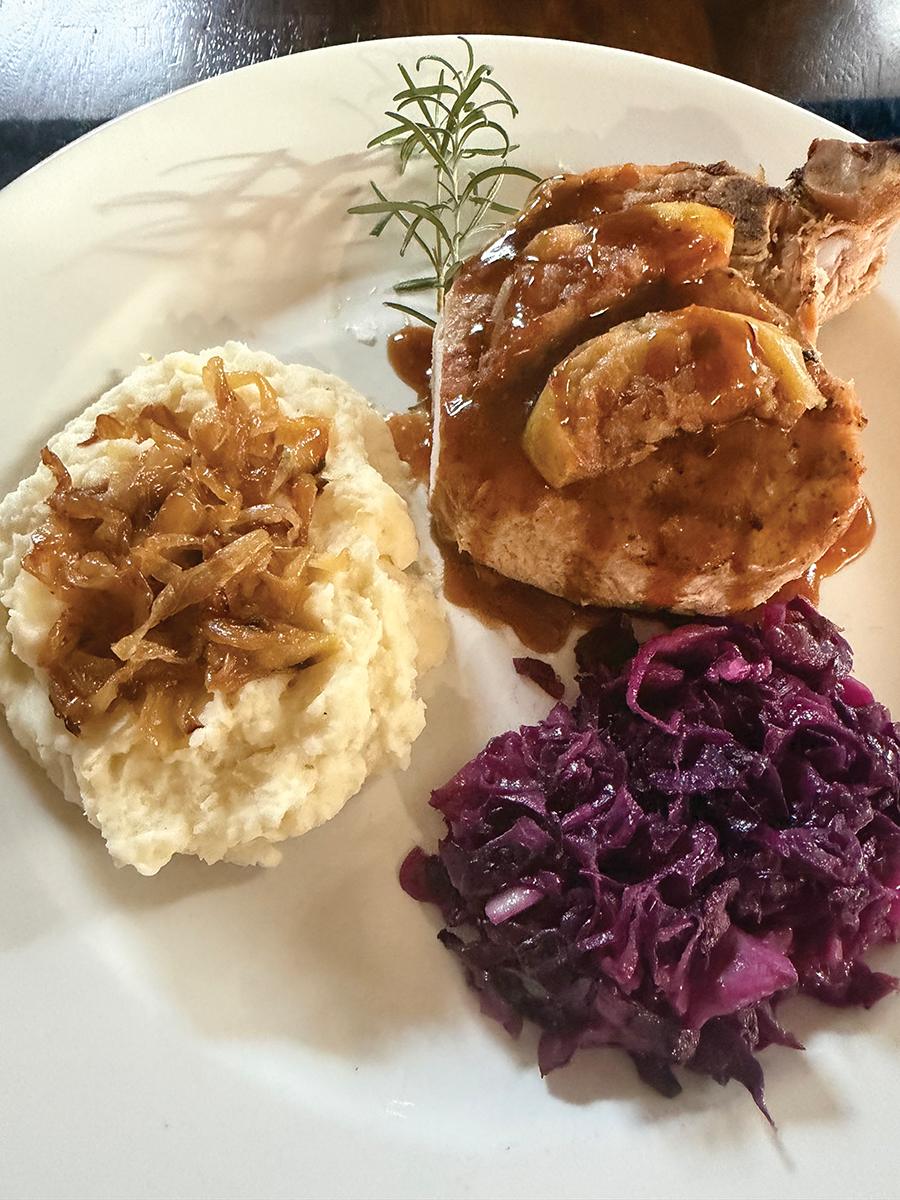
Himmel und Erde translates to “Heaven and Earth.” The name refers to the two principal ingredients: potatoes growing beneath the earth and apples growing on trees toward the heavens. This dish brings together mashed potatoes and soft, cooked apples, topped with sweet, caramelized onions.
Perhaps that is the real magic of the potato. It can be rustic or elegant, inexpensive or dressed up, served at a family supper or in a fine restaurant. It has crossed oceans, survived centuries and famines, and found a home in kitchens around the world.
Maybe Heaven and Earth will find a home at your table, too!
Himmel und Erde (Heaven and Earth)
This dish is fabulous alongside pork or duck. When serving with duck, I often use some of the duck fat and a little butter to sauté the onions. You can also garnish with some crumbled bacon. Yields 6 servings.
Ingredients: • 2 pounds russet potatoes, peeled and cubed • 3 tart apples, peeled, cored and sliced • 1 tbs lemon juice • 6 tbs butter (or most of a stick) • ½ cup warm cream • 2 large yellow onions, thinly sliced • 1 tbs brown sugar • Salt • White pepper • Pinch of freshly ground nutmeg
Directions: Boil potatoes in salted water until fork-tender. Drain.
In a separate small saucepan, cook apples with lemon juice and a splash of water until soft, about 10 minutes. Mash lightly, leaving some texture.
Mash potatoes with 4 tbs butter and warm cream. Season with salt, white pepper and nutmeg. Combine the potatoes with the apples.
Melt remaining butter in a skillet. Slowly cook onions for 20-25 minutes until golden and caramelized. Add brown sugar if desired. Don’t burn!
Top with caramelized onions and serve — garnish with crumbled cooked bacon, if desired.
Refrigerate the leftovers.
Want to support independent local journalism?
The Sandpoint Reader is our town's local, independent weekly newspaper. "Independent" means that the Reader is locally owned and operated by people who were born and raised in Sandpoint. The Reader is owned by Publisher Ben Olson, Editor-in-Chief Zach Hagadone and Senior Writer Soncirey Mitchell. Sandpoint Reader LLC is a completely independent business unit; no big newspaper group or corporate conglomerate or billionaire owner dictates our editorial policy. And we want the news, opinion and lifestyle stories we report to be freely available to all interested readers - so unlike many other newspapers and media websites, we have NO PAYWALL on our website. The Reader relies wholly on the support of our valued advertisers, as well as readers who voluntarily contribute. Want to ensure that local, independent journalism survives in our town? You can help support the Reader for as little as $1.
TIMBER WARS: Six-part series, February-November 2022. GO READ IT»
WHERE ARE THE WORKERS?: Five-part series, September-October 2021. GO READ IT»
THE AMERICAN REDOUBT: Seven-part series, November-December 2017. GO READ IT»
STANDOFF AT RUBY RIDGE: 25 Years Later. Five-part series, August-September 2017. GO READ IT»
Curious about what media the locals use? Check our 2018 Local Media Survey. GO SEE »
Sandpoint in Pictures
Filmmaker Jimmy Matlosz of the Idaho Film Company has made a series of mini documentaries about influential Sandpoint locals, including the late Dann Hall and Erik Daarstad as well as icons Diane Michaels and Dan Shook. He is currently working on a series of interviews connected to the history of the Panida Theater. Jimmy is a 30-year veteran filmmaker who's work can be seen at dpmatlosz.com.
Meet the Reader
Ever wonder who makes the Reader happen? Here's a behind-the-scenes look pieced together by summer 2017 intern McCalee Cain in which Ben, Cameron and Lyndsie explain what exactly about the Reader keeps them coming back to their shabby (but well-loved) office each week.