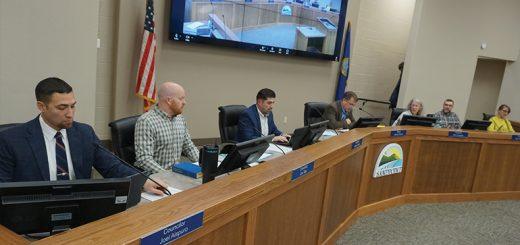
Sandpoint P&Z recommends approval of amended short-term rental ordinance
December 17, 2025
Rule change intended to get ahead of potential lawsuit, comes amid likely state legislation
By Zach Hagadone Reader Staff
Changes to Sandpoint’s ordinance regulating short-term rentals will move forward, after members of the Planning and Zoning Commission voted Dec. 16 to recommend their approval by the City Council.
The commission first considered the changes at its Nov. 18 meeting, deferring a recommendation until city staff could craft a legally defensible definition for “neighborhood integrity,” as well as address parking requirements for STRs. Planning and Community Development Director Jason Welker and Planner Bill Dean returned Dec. 16 with three central changes to the ordinance, as it had been presented in November.
If approved by the council, “neighborhood integrity” would be defined as: “The condition in which residential areas function in a manner consistent with their intended character and density, such that short-term rental activities do not generate impacts such as noise, traffic, parking congestion, or public nuisance, beyond those normally associated with lawful long-term residential use.”
Welker said he believed that definition is “very much in line” with what the state would consider a valid description of “neighborhood integrity,” which will be critical as the 2026 Legislature gavels into session in January.
An example of some Airbnb rentals in Sandpoint. Courtesy image
“We are in an environment in which the state legislature has for two years in a row now contemplated changes to state code that would further strip cities’ ability to regulate short-term rentals, but the reality of the existing state law on short-term rental regulations is that our city code is in violation of state law, as it is currently written,” Welker said.
State law added in 2017 and amended in 2018 stipulates, in part, “Neither a county nor a city may enact or enforce any ordinance that has the express or practical effect of prohibiting short-term rentals or vacation rentals in the county or city.”
Cities can, however, regulate STRs in order to protect “neighborhood integrity” and to ensure health and safety.
However, the legal question centers on Sandpoint’s current cap of 35 non-owner occupied STRs within residential zones. There are an estimated 170 licensed owner-occupied STRs throughout the city, which operate under no such cap.
Fears that the city of Sandpoint may face legal consequences for its cap on non-owner occupied STRs arose in August, when a representative from the Airbnb-backed Idaho Vacation Rental Alliance spoke before a state-level housing committee meeting in Sandpoint. She cited a court ruling that struck down a similar cap on STRs in Lava Hot Springs, arguing that the limitation represented a functional prohibition — an interpretation that Sandpoint City Attorney Zach Jones echoed Dec. 16 before the P&Z Commission.
“My thought on that is that the 36th applicant is prohibited from having a short-term rental, and whether you make that number 500, the 501st applicant is prohibited from having a short-term rental,” he said, later adding, “Regulations can amount to a prohibition.”
Meanwhile, Welker told P&Z commissioners that not only was the city “put on notice” that it would be sued if the STR cap remained in place, but the Airbnb lobby group has already drafted a bill for the 2026 legislative session that would further amend state code limiting “neighborhood integrity” to include requiring smoke alarms, CO2 detectors, fire extinguishers and occupancy limits under the International Building Code.
“That’s it,” Welker said, going on to add that the draft legislation states STRs can be governed by “no greater restrictions” than any other dwelling units, nor can they be subject to any special licensing or permitting standards.
The amended ordinance, as presented on Dec. 16, lifts the cap while defining “neighborhood integrity,” but also carves out a category of “high-occupancy STRs,” which advertise for 11 or more guests. Operators of those properties would be required to undertake all the noticing and hearing requirements of a conditional use permit — though not required to obtain a CUP — including meeting specific standards related to performance and neighborhood impacts.
There are currently 13 such properties operating in Sandpoint that could be considered “high-occupancy” under the proposed ordinance changes.
Regarding parking, the amended ordinance would require one off-street space where five or fewer guests are accommodated, and two spaces for six or more guests. The high-occupancy STR parking requirements would be established by the P&Z Commission as part of the condition of approval.
“We are absolutely not deregulating short-term rentals. … [We] would have the strongest STR ordinance in the state of Idaho and one that’s defensible under state law,” Welker said of the proposed amended ordinance.
During deliberations, Commissioner Scott Torpey worried that if the Airbnb lobby’s bill passes through the Legislature, it would harm the city’s ability to collect the 14% lodging tax.
Welker said the city collects that revenue from short-term rental platforms like Airbnb, not individual registrations.
“There’s a lot of faith we put in Airbnb,” he said, adding that STR companies like Airbnb, Vrbo and others are also working to require that every STR operating outside of their platform has to register with the state tax commission, which would collect taxes directly from owner-operators.
“They’re trying to make more red tape to make it less appealing for STR owners to operate outside of the Airbnb platform,” Welker said, later adding, “There is no end to their greed and their desire to deregulate.
“Idaho is being used as a test case right now — this effort’s not happening in any other state,” he said. “They view the Idaho Legislature as the most conservative and private property-oriented legislature in the states, so they’re seeing if they can get complete and total annihilation of short-term rental regulations in the state of Idaho, then they’ll move on to all the other states.”
Though commissioners were unanimous in recommending approval of the amended ordinance to City Council, some voted with a measure of trepidation.
“This feels super scary, I would argue. I have no idea what this is going to do to neighborhoods, communities — maybe nothing, maybe the ‘market will figure it out,’” said Commissioner Grant Simmons. “… [T]his could have some seriously unintended consequences, and I don’t know what to do about it, because we have to fit the ordinance inside the law.”
“I know it’s clichéd — the hands-are-tied, kind of thing — but I think this does seem pretty black-and-white in terms of what the state code says, the recent case, legal counsel, the legal recommendation,” Commissioner Reid Weber said. “I think it would be hard for me to say ‘let’s go to battle with the state of Idaho’ as a Planning and Zoning commissioner.”
Want to support independent local journalism?
The Sandpoint Reader is our town's local, independent weekly newspaper. "Independent" means that the Reader is locally owned and operated by people who were born and raised in Sandpoint. The Reader is owned by Publisher Ben Olson, Editor-in-Chief Zach Hagadone and Senior Writer Soncirey Mitchell. Sandpoint Reader LLC is a completely independent business unit; no big newspaper group or corporate conglomerate or billionaire owner dictates our editorial policy. And we want the news, opinion and lifestyle stories we report to be freely available to all interested readers - so unlike many other newspapers and media websites, we have NO PAYWALL on our website. The Reader relies wholly on the support of our valued advertisers, as well as readers who voluntarily contribute. Want to ensure that local, independent journalism survives in our town? You can help support the Reader for as little as $1.
TIMBER WARS: Six-part series, February-November 2022. GO READ IT»
WHERE ARE THE WORKERS?: Five-part series, September-October 2021. GO READ IT»
THE AMERICAN REDOUBT: Seven-part series, November-December 2017. GO READ IT»
STANDOFF AT RUBY RIDGE: 25 Years Later. Five-part series, August-September 2017. GO READ IT»
Curious about what media the locals use? Check our 2018 Local Media Survey. GO SEE »
Sandpoint in Pictures
Filmmaker Jimmy Matlosz of the Idaho Film Company has made a series of mini documentaries about influential Sandpoint locals, including the late Dann Hall and Erik Daarstad as well as icons Diane Michaels and Dan Shook. He is currently working on a series of interviews connected to the history of the Panida Theater. Jimmy is a 30-year veteran filmmaker who's work can be seen at dpmatlosz.com.
Meet the Reader
Ever wonder who makes the Reader happen? Here's a behind-the-scenes look pieced together by summer 2017 intern McCalee Cain in which Ben, Cameron and Lyndsie explain what exactly about the Reader keeps them coming back to their shabby (but well-loved) office each week.