There is a lot to love about Greece — the blue Aegean, the whitewashed villages, ancient ruins and sunsets that seem almost too perfect to be real. But ask me what I will remember most about this trip escorting 14 women, and I’ll tell you: the food.
I’m writing this from Athens after traveling with my ladies through Santorini, Mykonos and Hydra. We have walked, sailed, swam, explored, laughed, gotten a little dusty, gotten a little sun-kissed — and, naturally, eaten. A lot.
If there is one thing Greeks understand, it is that a meal is not merely something to sustain you between other meals. The meal is the activity.
And we were there for it.
Something wonderful happens when women share a table. Fourteen of us may sit down together, but within about five minutes, conversations are popping in every direction. Someone is telling a story. Someone is passing the feta. Someone has discovered a fabulous little dish and is insisting that everyone take a bite.
“Try this!” or, “Oh my gosh, you have to taste this!” And suddenly there are forks on the move between the little fried fish, the octopus, the souvlaki, the mostra.
We weren’t always one unit. Sometimes we broke off into pairs and trios to wander down a little street looking for the perfect Greek pastry. Or tuck into a tiny café for wine and cheese. Or, of course, go shopping. Have olives, will travel!
We have discovered Greek food in all its delicious simplicity: tomatoes that taste like they grew in the warm sun, creamy feta, fish fresh and grilled, lamb, souvlaki, eggplant, olives, fresh herbs, honey, Greek yogurt and olive oil — everywhere.
And then there is the rusk.
I had eaten Greek rusks before, but learning their history at a cooking class in Mykonos made me appreciate them in a new way.
A rusk is essentially bread that has been baked twice until it becomes dry and wonderfully crunchy. For generations, particularly on the Greek islands and in Crete, bread needed to last. Without refrigeration and with long stretches between baking days, twice-baking the bread removed much of the moisture and allowed it to be stored for a long time.
Then, when it was time to eat, the rusk could be brought out and topped with something delicious.
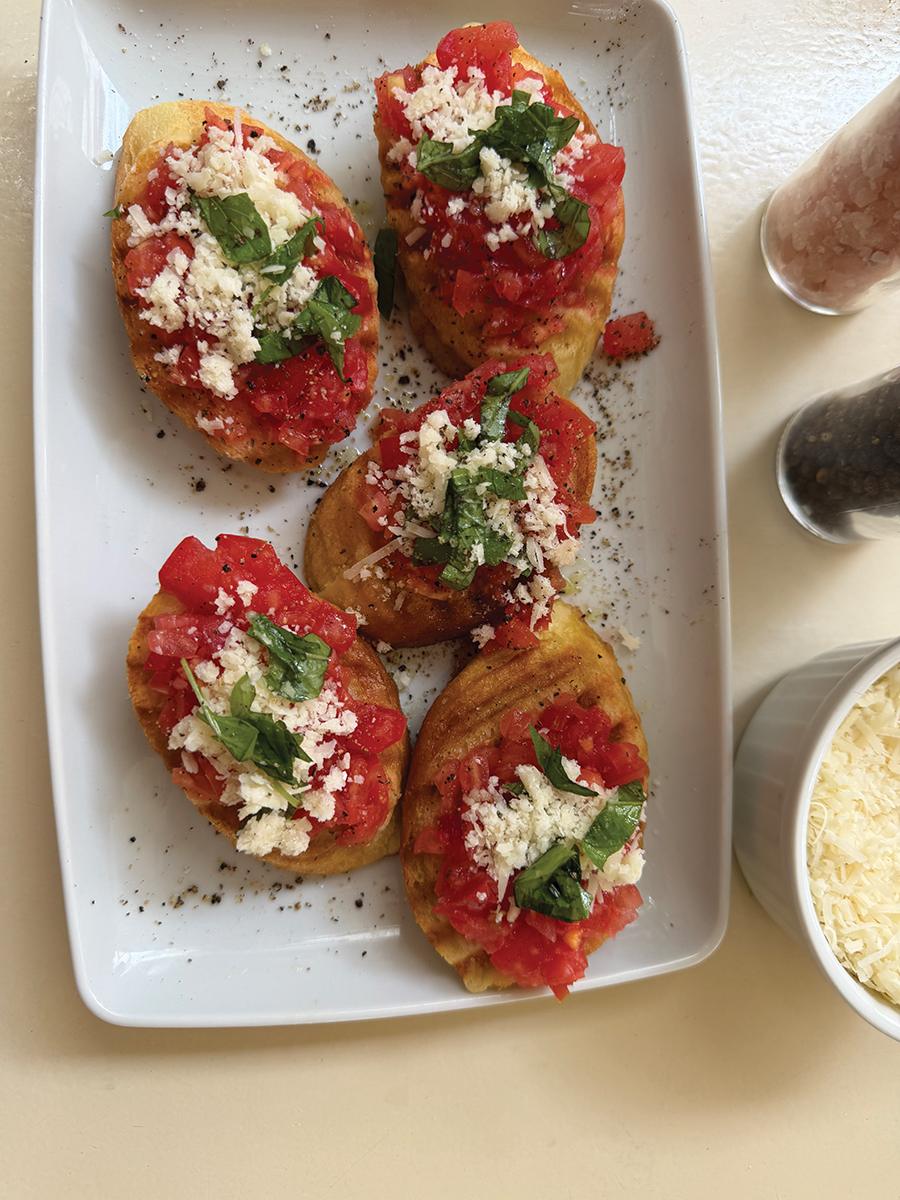
One of the best examples is the Mykonian version called mostra. Traditionally made with barley rusk, ripe tomatoes, local cheese, olive oil and oregano, it is a perfect example of the beauty of Greek food. There is nothing complicated about it. It is humble food — and absolutely delicious. Greeks don’t reach for a bag of chips at snack time; they prepare a snack of mostra.
I concur, give me a good tomato, excellent olive oil, salty cheese and crunchy bread, and I’m pretty happy. And that, really, is one of the things I have loved most about eating in Greece.
The island foods are simple and pure. The tomatoes taste like tomatoes. The olives from Kalamata taste like olives. The feta is creamy, and herbs are used generously. Olive oil is not a garnish — it’s an important food group.
And my favorite part? Meals are meant to be shared.
Somewhere between the first glass of wine and the last bite of dessert, the table becomes more than a place to eat; it becomes the place where stories are exchanged, friendships deepen and memories are made.
And so, I will remember the sunsets in Santorini, the whitewashed lanes of Mykonos, our dusty walk along an old mule trail, and that glorious swim and lunch waiting for us at the end.
I will remember the mules of Hydra’s harbor and the liveliness of Athens’ energy.
Most importantly, I’ll remember these ladies that trust me, year after year, to lead them around the world: passing plates, laughing until our sides hurt, and saying, “Just one more bite.”
Mostra
This snack is a staple in Mykonos. You must grate the tomatoes to bring out the full flavors. If you cannot find barley rusks in a specialty food shop you can substitute dry crostini. Serves 2-4.
INGREDIENTS: • 6 round barley rusks • 1 tomato • Greek virgin olive oil • dash of salt • dash of pepper • 1 tsp dried Greek oregano • 2 oz soft white goat cheese or feta • 1 pinch sugar • 1 tsp white vinegar • 1 tbs capers • 1 tbs chopped Kalamata olives
DIRECTIONS: Place the rusks on a plate and drizzle with olive oil. Grate the tomato, add to a bowl the grated tomato, the vinegar, sugar, salt, pepper, oregano.
Taste and adjust according to your preferences.
Spoon the juicy tomatoes over the top, letting their juices soak into the rusk.
Scatter the cheese over the tomatoes, sprinkle generously with oregano and add the capers. Finish with another good drizzle of olive oil and a few chopped Kalamata olives.
Let it sit for a few minutes so the rusk can soften just slightly — but don’t let it lose the crunch.
Want to support independent local journalism?
The Sandpoint Reader is our town's local, independent weekly newspaper. "Independent" means that the Reader is locally owned and operated by people who were born and raised in Sandpoint. The Reader is owned by Publisher Ben Olson, Editor-in-Chief Zach Hagadone and Senior Writer Soncirey Mitchell. Sandpoint Reader LLC is a completely independent business unit; no big newspaper group or corporate conglomerate or billionaire owner dictates our editorial policy. And we want the news, opinion and lifestyle stories we report to be freely available to all interested readers - so unlike many other newspapers and media websites, we have NO PAYWALL on our website. The Reader relies wholly on the support of our valued advertisers, as well as readers who voluntarily contribute. Want to ensure that local, independent journalism survives in our town? You can help support the Reader for as little as $1.
TIMBER WARS: Six-part series, February-November 2022. GO READ IT»
WHERE ARE THE WORKERS?: Five-part series, September-October 2021. GO READ IT»
THE AMERICAN REDOUBT: Seven-part series, November-December 2017. GO READ IT»
STANDOFF AT RUBY RIDGE: 25 Years Later. Five-part series, August-September 2017. GO READ IT»
Curious about what media the locals use? Check our 2018 Local Media Survey. GO SEE »
Sandpoint in Pictures
Filmmaker Jimmy Matlosz of the Idaho Film Company has made a series of mini documentaries about influential Sandpoint locals, including the late Dann Hall and Erik Daarstad as well as icons Diane Michaels and Dan Shook. He is currently working on a series of interviews connected to the history of the Panida Theater. Jimmy is a 30-year veteran filmmaker who's work can be seen at dpmatlosz.com.
Meet the Reader
Ever wonder who makes the Reader happen? Here's a behind-the-scenes look pieced together by summer 2017 intern McCalee Cain in which Ben, Cameron and Lyndsie explain what exactly about the Reader keeps them coming back to their shabby (but well-loved) office each week.