September in Bonner County means three things: the tourists have mostly packed up with the endless convoy of RVs rambling back to wherever they came from, school has started and we face an annual insect infestation of biblical proportions.
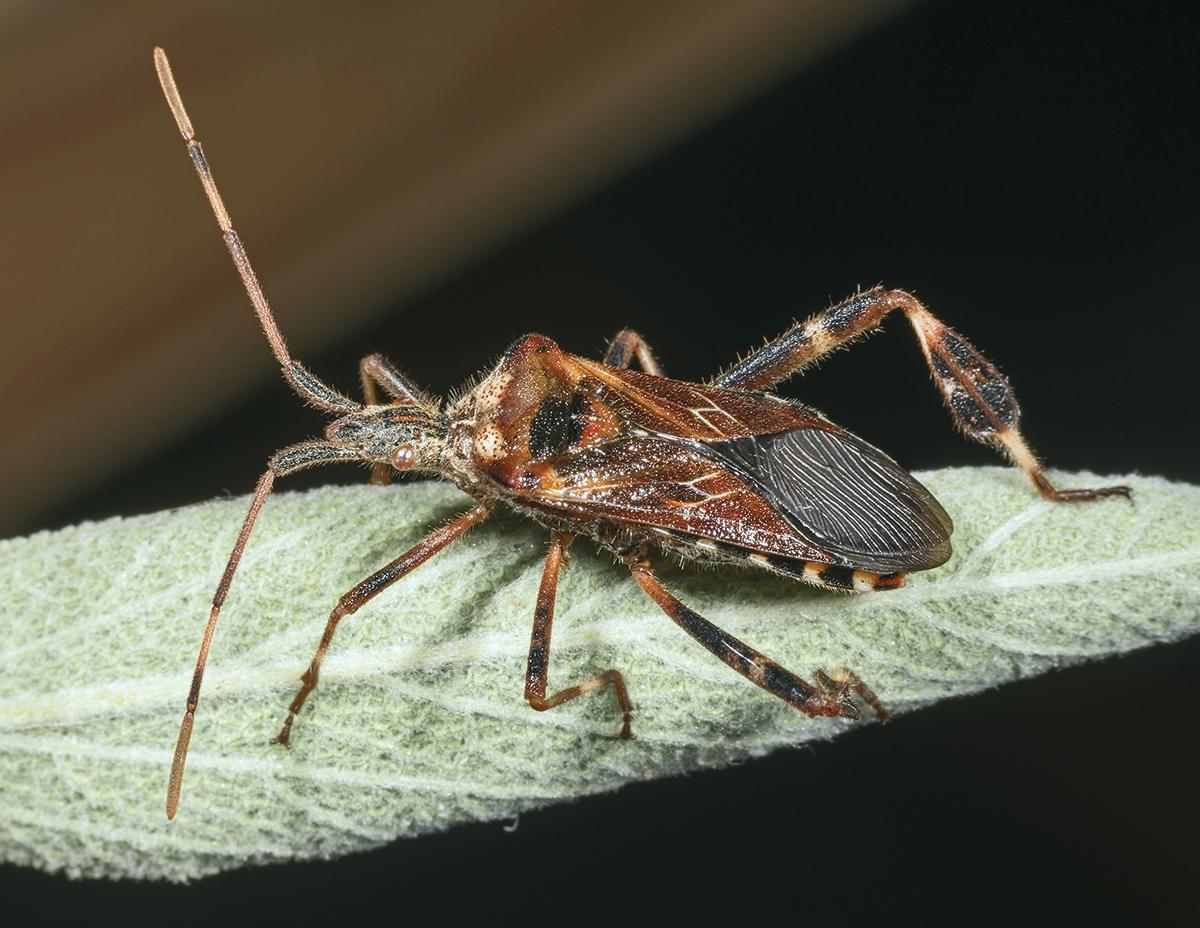
Western conifer seed bugs, colloquially known as stink bugs, are everywhere this time of year. Structures are swarmed by the thousands, citizens are dive-bombed by buzzing stinkers and every spare moment of time at home is spent thwacking clumps of giant insects off door frames, only for five or six of them to still fall in as you walk through and drop onto your hair and shoulders.
Despite their well-earned moniker of “stink bugs,” they aren’t actually true stink bugs. True stink bugs, of the family Pentatomidae, are actually those smelly little black insects that seem to invade in parallel to the seed bugs. Western conifer seed bugs are leaf-footed bugs of the family Coreidae. Despite this distinction, they do secrete a foul-smelling compound when damaged or startled. This compound is an alarm pheromone intended to alert other seed bugs to imminent danger as well as deter predators, of which the seed bug has many, including black-capped chickadees and orb weaver spiders. I’ve even seen large cat-faced spiders in our area catching scores of them in their webs, though I haven’t witnessed them feeding on the stinkers.
Courtesy photo
Western conifer seed bugs have three life stages. The adult stage is the stage we are all unfortunately most accustomed to experiencing. During the adult stage they strike out to find places to overwinter and are drawn to cracks, crevices and above all: warmth. They often gather in swarms on and around windows and doors, particularly in sun-facing areas due to the mix of high heat and crevices into which they can tuck themselves for the winter.
In the natural world, they find cracks in tree bark, rocks or the ground. Unfortunately for us, our houses are built for heat. We need heat in the winter to remain comfortable, so it creates a perfect attractant for these creatures by the thousands.
The first stage of life — and one we seldom see — is the egg. Eggs are laid by females that survived winter in May or June. Eggs are often laid near food sources, which are developing cones on conifer trees. In the nymph stage, western conifer seed bugs lack the ability to fly and instead use their pointed proboscises to suck sap from cones. It’s likely that digesting the resinous compounds found within the cones is a contributing factor to the stink pheromone they produce when startled.
Similarly, poison dart frogs are only poisonous when they eat their natural diet of ants in the Amazonian rainforests, due to the alkaline compounds found in the ants being secreted as a toxic waste that deters predators.
Western conifer seed bugs reach adulthood in September, though it has been noted that this year’s hotter, drier early-spring conditions led to a headstart toward the beginning of August. Tropical climes hosting this insect as an invasive species have seen as many as three generational adult cycles per year.
Though they are native to the Northwest, they are an invasive species throughout Europe, particularly around the Mediterranean, and eastern Asia in Japan and Korea. This is exclusively through North American lumber trade, where seed bugs hitched a ride on Northwest lumber headed to other continents and took hold in foreign ecosystems. Italy sees as many as two adult cycles per year due to its warmer climate.
Though not particularly destructive, they are an incredible nuisance, as 7B residents know. They have been known to cause damage to PEX pipes carrying water in homes, damaging them at a microscopic level by jabbing the pipes repeatedly with their proboscises.
Managing the autumn infestation is nearly impossible. Repeated instances of stink bugs inside your home generally come from cracks and gaps in sealing around windows, foundations or external vents. The insects can squeeze through gaps as small as a quarter-inch wide and will obsessively pursue warm air drafts coming from any opening in a home. They also commonly cling to the edge of doorframes and drop in any time someone enters or exits a main door of the home.
Due to their mobility, it’s often difficult to tell which of these may be the case if you are seeing them in your home. If you are repeatedly seeing them in one area that isn’t near a main entrance, it’s likely you have a sealing gap in a window or vent within about 10 feet of the area. Attics and crawlspaces often attract them as well due to built-in ventilation; though, if properly sealed, shouldn’t allow them into the living areas of your home.
Killing these bugs can be a chore due to their large size, vast number and defensive stink pheromone. One of the most effective and relatively stinkless methods is to vacuum them up when you see them and deal with the vacuum contents later. Another method is to squirt them or places they congregate with water mixed with clove bud oil.
The compounds in the oil aggravate and disrupt their senses and make them very mobile, which often makes them easy to catch if they are hiding in cracks or along window tracks where you can’t reach them. The oil will work to repel them briefly, but it’s better suited for enclosed spaces like cars where the smell has less area to dissipate.
It also makes your drive to work smell like pumpkin pie.
Stay curious, 7B.
Want to support independent local journalism?
The Sandpoint Reader is our town's local, independent weekly newspaper. "Independent" means that the Reader is locally owned and operated by people who were born and raised in Sandpoint. The Reader is owned by Publisher Ben Olson, Editor-in-Chief Zach Hagadone and Senior Writer Soncirey Mitchell. Sandpoint Reader LLC is a completely independent business unit; no big newspaper group or corporate conglomerate or billionaire owner dictates our editorial policy. And we want the news, opinion and lifestyle stories we report to be freely available to all interested readers - so unlike many other newspapers and media websites, we have NO PAYWALL on our website. The Reader relies wholly on the support of our valued advertisers, as well as readers who voluntarily contribute. Want to ensure that local, independent journalism survives in our town? You can help support the Reader for as little as $1.
TIMBER WARS: Six-part series, February-November 2022. GO READ IT»
WHERE ARE THE WORKERS?: Five-part series, September-October 2021. GO READ IT»
THE AMERICAN REDOUBT: Seven-part series, November-December 2017. GO READ IT»
STANDOFF AT RUBY RIDGE: 25 Years Later. Five-part series, August-September 2017. GO READ IT»
Curious about what media the locals use? Check our 2018 Local Media Survey. GO SEE »
Sandpoint in Pictures
Filmmaker Jimmy Matlosz of the Idaho Film Company has made a series of mini documentaries about influential Sandpoint locals, including the late Dann Hall and Erik Daarstad as well as icons Diane Michaels and Dan Shook. He is currently working on a series of interviews connected to the history of the Panida Theater. Jimmy is a 30-year veteran filmmaker who's work can be seen at dpmatlosz.com.
Meet the Reader
Ever wonder who makes the Reader happen? Here's a behind-the-scenes look pieced together by summer 2017 intern McCalee Cain in which Ben, Cameron and Lyndsie explain what exactly about the Reader keeps them coming back to their shabby (but well-loved) office each week.