Community Resource EnVision Center explores a bold new option for bringing the community together
By Ben Olson Reader Staff
Katie Begalke has a vision and it’s one that aligns perfectly with her work as the executive director of the Community Resource EnVision Center.
Since it became a nonprofit organization in 2011, CREC has operated under the mission to establish one central place where people in need can go to receive help. This includes identifying technology and developing capabilities to store and retrieve accurate service information when needs are presented; maintaining a knowledgeable and trained volunteer staff to answer calls for help; and to achieve sustainable funding to support the organization’s overall vision.
Housed inside the former Coldwater Creek campus in Kootenai, Begalke aims to take CREC to the next level by matching the organization’s mission statement with a physical plan to establish a network of service providers and outreach organizations under one roof — literally.
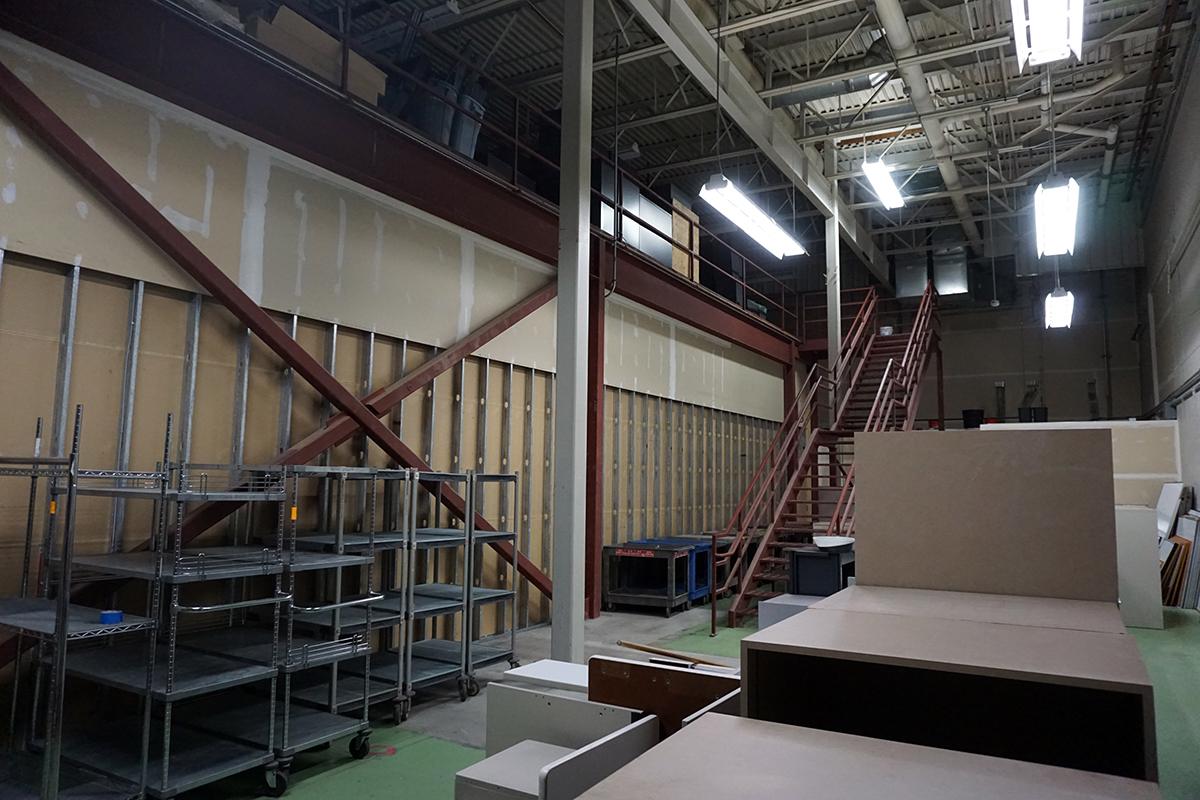
Called “The Hub,” the plan calls for a shared community infrastructure inside the sprawling 220,000-square-foot building and 16,000-square-foot warehouse, which already includes offices, gathering spaces, flex space, parking, infrastructure and plenty of room to grow.
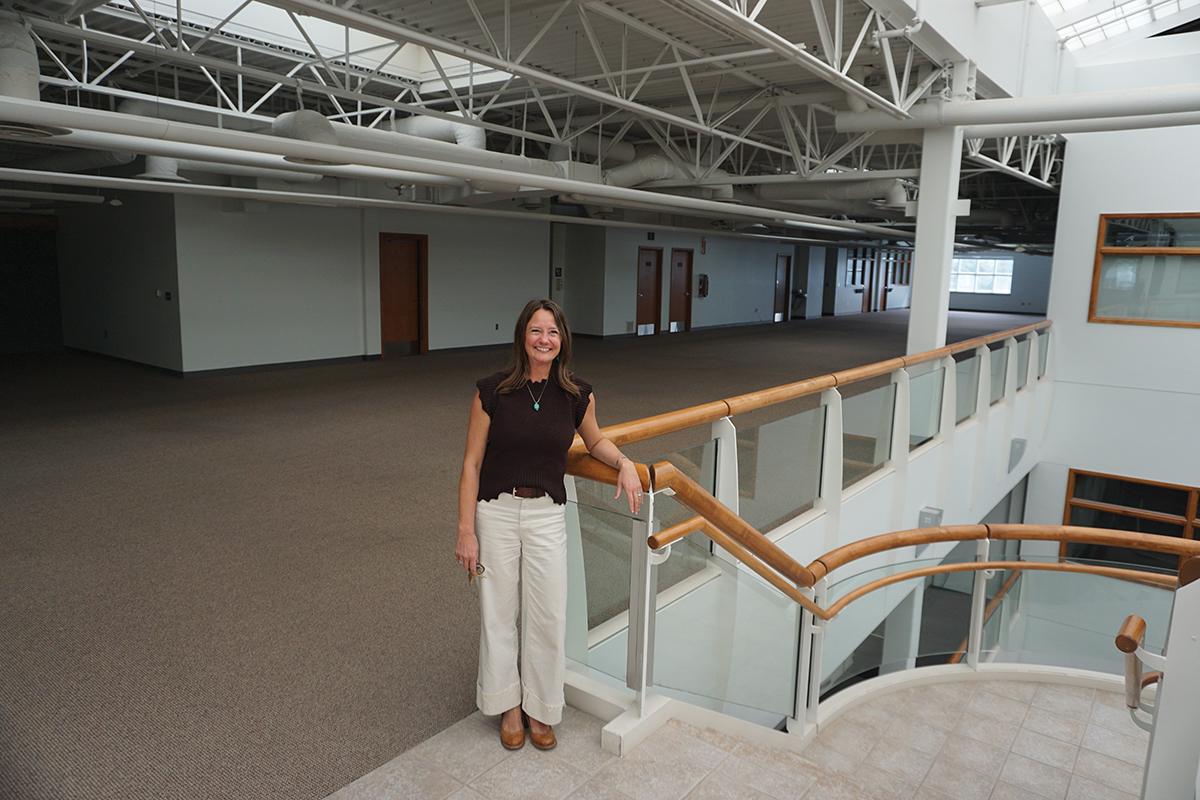
CREC Executive Director Katie Begalke gives a tour of the sprawling former Coldwater Creek campus, which she hopes to someday expand into The Hub. Photo by Ben Olson
“The whole idea for the EnVision Center is to have people come under one roof,” Begalke told the Reader during a tour of the facility. “What would that look like? It’s someone getting job service and signing up for Social Security, having somebody watch your kids while getting mental health care. We spend all this time driving around, getting resources and services, but what would it look like if everything was under one roof?”
CREC has already begun a hybrid model of the plan, occupying and operating a 14,300-square-foot space, which it leases from property owners and, in turn, rents to local businesses, nonprofits and solo entrepreneurs for as little as $150 per month. Or even less for nonprofits.
“We have 37 partners on the floor with us and we’re really working toward proving this model,” Begalke said.
Not only do renters pay 83 cents a square foot, but they also save operating costs by sharing services and utilities like internet, printing, copying, kitchen space and more.
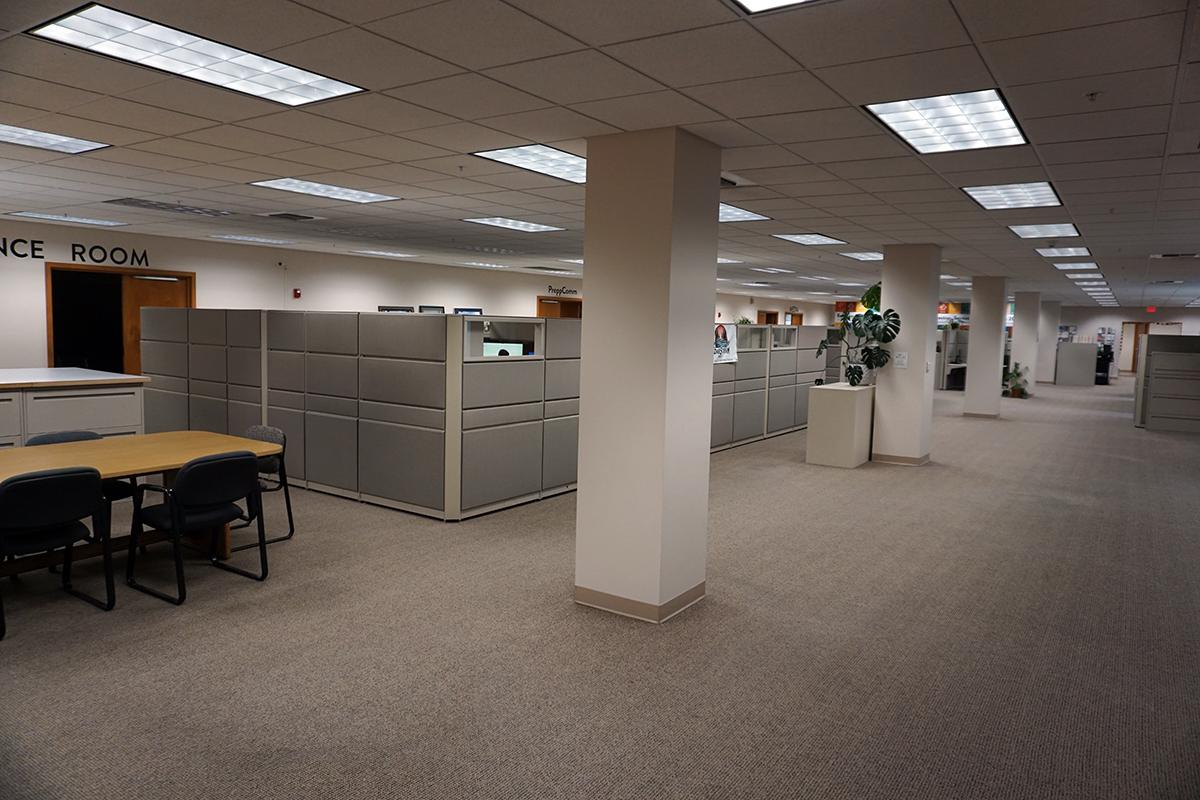
The proposed future home of The Hub. Photo by Ben Olson
“We are all on one internet bill here,” she said. “I pay $300 a month and 37 different organizations share it.”
Begalke pointed to several scenarios that make a case for establishing a large umbrella campus for service providers.
“The library wanted to do an expansion to be able to include a maker studio,” Begalke. “The YMCA has talked about having more of a daycare and we are in desperate need of daycares and child care centers. What would it look like if the library opened a maker space here? What if we brought child care programs out here?”
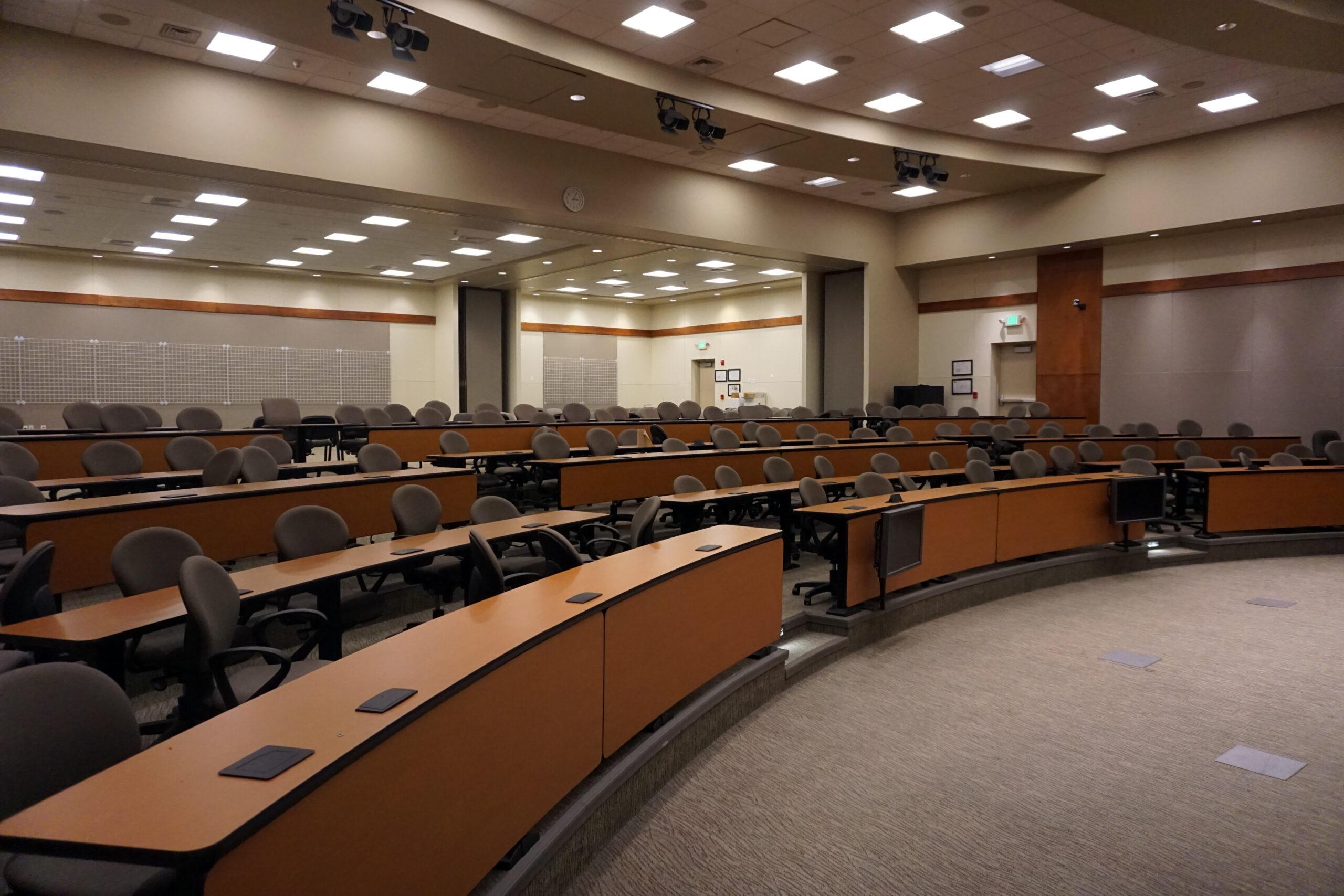
Touring the facility, Begalke’s passion for the idea is evident. Across the enormous campus are conference rooms, board rooms, light industrial spaces, lecture halls, a podcast studio and more. Once the vibrant epicenter of Coldwater Creek, the spaces are now empty and preserved, awaiting their next purpose.
Further underscoring the potential, Begalke pointed out the former Coldwater Creek cafeteria with an attached kitchen that could provide the complex with an eatery and imagines the sounds of people gathering for lunch, work meetings, quick confabs over cups of coffee in shared spaces and more. The facility is also located on the SPOT Bus route, with a waiting shelter to be installed in October; a benefit for the VA clinic currently located in the building.
The proposed future home of The Hub. Photo by Ben Olson
The entire complex is currently on the market for more than $9 million, but with so much space going unused, Begalke hopes to convince the broader community that her plan has the potential to not only save the facility from being purchased by a single entity but serve as a sort of cooperative incubator and campus for local organizations to continue doing their important work.
Not only does Begalke see the potential for The Hub as a business campus, but also as a place for people to meet after hours.
“Where can you go after 9 p.m. in Bonner County besides a bar?” she said. “What would it be like if there was a community center here and you could play games and be making and creating?”
The proposed future home of The Hub. Photo by Ben Olson
Begalke said that if a large enough group of organizations, entrepreneurs and community leaders got together to form a plan to purchase the building, it would pay back not only those who occupy it, but also the community at large for generations. Since Bonner County has three times the national average of nonprofits per capita, there will always be a need for affordable rent and shared spaces and utilities.
“I sit in all these economic development meetings and chamber meetings all the time and I’m always like, ‘We have the answer,’” Begalke said. “We’re just not coming together to do it.”
To learn more about The Hub or to inquire how to help make the vision a reality, visit crecidaho.com/the-hub-explained.
Want to support independent local journalism?
The Sandpoint Reader is our town's local, independent weekly newspaper. "Independent" means that the Reader is locally owned and operated by people who were born and raised in Sandpoint. The Reader is owned by Publisher Ben Olson, Editor-in-Chief Zach Hagadone and Senior Writer Soncirey Mitchell. Sandpoint Reader LLC is a completely independent business unit; no big newspaper group or corporate conglomerate or billionaire owner dictates our editorial policy. And we want the news, opinion and lifestyle stories we report to be freely available to all interested readers - so unlike many other newspapers and media websites, we have NO PAYWALL on our website. The Reader relies wholly on the support of our valued advertisers, as well as readers who voluntarily contribute. Want to ensure that local, independent journalism survives in our town? You can help support the Reader for as little as $1.
TIMBER WARS: Six-part series, February-November 2022. GO READ IT»
WHERE ARE THE WORKERS?: Five-part series, September-October 2021. GO READ IT»
THE AMERICAN REDOUBT: Seven-part series, November-December 2017. GO READ IT»
STANDOFF AT RUBY RIDGE: 25 Years Later. Five-part series, August-September 2017. GO READ IT»
Curious about what media the locals use? Check our 2018 Local Media Survey. GO SEE »
Sandpoint in Pictures
Filmmaker Jimmy Matlosz of the Idaho Film Company has made a series of mini documentaries about influential Sandpoint locals, including the late Dann Hall and Erik Daarstad as well as icons Diane Michaels and Dan Shook. He is currently working on a series of interviews connected to the history of the Panida Theater. Jimmy is a 30-year veteran filmmaker who's work can be seen at dpmatlosz.com.
Meet the Reader
Ever wonder who makes the Reader happen? Here's a behind-the-scenes look pieced together by summer 2017 intern McCalee Cain in which Ben, Cameron and Lyndsie explain what exactly about the Reader keeps them coming back to their shabby (but well-loved) office each week.