Words of the Year provide a long view at the bubbling yeast of humanity
By Ben Olson Reader Staff
In 2003, Merriam-Webster began declaring a Word of the Year because it was the most-searched definition on its website. Linguists might look at a particular year’s chosen word as a keyhole into what people were preoccupied with at that particular time.
Here’s a breakdown of all the words chosen since 2003.
2003: democracy
With the US invading Iraq and persistent news coverage of the post-9/11 ramp-up to war, “democracy” was apropos for 2003.
2004: blog
By 2004, the internet had grown by leaps and bounds. More people were venturing into the new online world, staking a claim on the web through personally written and maintained weblogs or “blogs.”
2005: integrity
Looking back at 2005, it’s understandable why people searched for this word more than any other. There were disgraced professional athletes, a notable CIA leak investigation and congressional scandal after scandal that left many wondering if Congress was, in fact, corrupt. (Note: Yes, it was, and still is.)
2006: truthiness
This was the first of two years when the WotY was decided by a reader poll instead of search history. Stephen Colbert coined “truthiness,” as “the quality of seeming to be true but not necessarily or actually true according to known facts.” He later explained: “It used to be, everyone was entitled to their own opinion, but not their own facts. But that’s not the case anymore. Facts matter not at all.” Sounds eerily familiar.
2007: wOOt
The last reader-chosen WotY, “wOOt,” was a playful departure into a gaming term that was just meant as an expression of joy. Ah, simpler times.
2008: bailout
The Great Recession hit in 2008, leading to a marked decline in lending by banks. Congress passed a controversial bill, which created federal programs to bail out failing financial institutions because they were “too big to fail.”
2009: admonish
This word was the result of one political event that seems tame by today’s standards. During President Barack Obama’s speech to a joint session of Congress, Republican Congressman Joe Wilson interrupted by shouting, “You lie!” His behavior was subsequently admonished and people began looking up the word.
2010: austerity
Meaning both “stern and plain,” as well as “extreme economy especially on a national scale,” the word “austerity” is the last holdover from our emergence from the 2008 financial crisis.
2011: pragmatic
The word “pragmatic” spiked in searches because political parties were arguing viciously over the federal debt ceiling and a potential government shutdown. Americans were seeking to encourage pragmatism over frivolity.
2012: socialism and capitalism
M-W chose both “socialism” and “capitalism” for 2012 because the two terms appeared closely related during search terms. This was a contentious election year and both terms were being used extensively, often by those who had no idea of their definitions.
2013: science
Discussions involving climate change and educational policy made their way to the forefront, as well as debates over “phony” science that continued to capture the public’s imagination.
2014: culture
Terms such as “celebrity culture,” “company culture” or “rape culture” dominated the conversation in 2014.
2015: -ism
The majority of searches in 2015 tended to end in “-ism,” so M-W decided to lump them all into one catchall term.
2016: surreal
While many obscene words adequately describe 2016, “surreal” was probably the most accurate. It was, perhaps, the beginning of a surreal nightmare that nobody has awoken from yet.
2017: feminism
After the #MeToo movement exposed predatory practices of many men in powerful positions, it’s no big surprise that “feminism” was the most searched term that year.
2018: justice
After the two years of Trump’s first term, Americans were bombarded with stories about “justice,” in one way or another. Prominently, there was the Mueller investigation and the Kavanaugh confirmation hearings, which helped the word gain search traction.
2019: they
The gender-neutral pronoun “they” peaked in usage in 2019 as trans rights became a national issue.
2020: pandemic
M-W chose this word for obvious reasons, but I liked the Oxford University Press choice that year, which was nothing. Oxford chose not to do a WotY because 2020 was not “a year that could neatly be accommodated in one single ‘word of the year.’” Amen.
2021: vaccine
After the initial shock of the global pandemic, talk began to focus on the COVID-19 vaccine. Searches for the term spiked 600% in 2021.
2022: gaslighting
Searches for “gaslighting,” which means “behavior that’s mind manipulating, grossly misleading or downright deceitful,” spiked 1,740% in 2022 over the year before. With deepfakes, the dark web and Trump still claiming election wins that never happened, the country was very much in the throes of gaslighting in 2022.
2023: authentic
With AI and social media casting doubts on what’s real and what’s fake, the word “authentic” gained traction in 2023.
2024: polarization
Meaning the “division into two sharply distinct opposites,” polarization certainly encapsulated 2024. And every year after.
2025: slop
Defined as “digital content of low quality that is produced by means of artificial intelligence,” the word “slop” was at the forefront of many discussions in 2025.
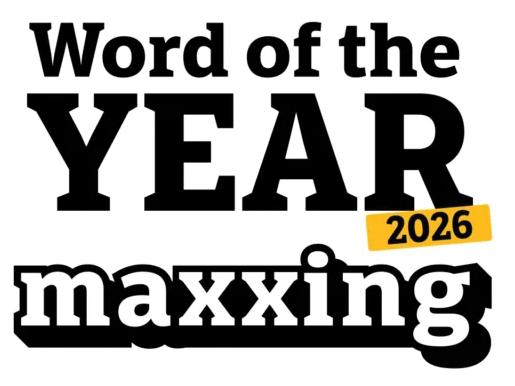
And the 2026 word of the year is: maxxing
The absurdist, insufferable suffix is yet another Gen Z term that pervades our daily lives. Whether it’s “looksmaxxing” (obsessing over physical appearance) or “nonnamaxxing” (“to better one’s life by adopting the habits of an Italian grandmother”), this term is already on the way out because of extreme overuse. No, you’re not “salmonmaxxing,” you’re just eating fish.
Want to support independent local journalism?
The Sandpoint Reader is our town's local, independent weekly newspaper. "Independent" means that the Reader is locally owned and operated by people who were born and raised in Sandpoint. The Reader is owned by Publisher Ben Olson, Editor-in-Chief Zach Hagadone and Senior Writer Soncirey Mitchell. Sandpoint Reader LLC is a completely independent business unit; no big newspaper group or corporate conglomerate or billionaire owner dictates our editorial policy. And we want the news, opinion and lifestyle stories we report to be freely available to all interested readers - so unlike many other newspapers and media websites, we have NO PAYWALL on our website. The Reader relies wholly on the support of our valued advertisers, as well as readers who voluntarily contribute. Want to ensure that local, independent journalism survives in our town? You can help support the Reader for as little as $1.
TIMBER WARS: Six-part series, February-November 2022. GO READ IT»
WHERE ARE THE WORKERS?: Five-part series, September-October 2021. GO READ IT»
THE AMERICAN REDOUBT: Seven-part series, November-December 2017. GO READ IT»
STANDOFF AT RUBY RIDGE: 25 Years Later. Five-part series, August-September 2017. GO READ IT»
Curious about what media the locals use? Check our 2018 Local Media Survey. GO SEE »
Sandpoint in Pictures
Filmmaker Jimmy Matlosz of the Idaho Film Company has made a series of mini documentaries about influential Sandpoint locals, including the late Dann Hall and Erik Daarstad as well as icons Diane Michaels and Dan Shook. He is currently working on a series of interviews connected to the history of the Panida Theater. Jimmy is a 30-year veteran filmmaker who's work can be seen at dpmatlosz.com.
Meet the Reader
Ever wonder who makes the Reader happen? Here's a behind-the-scenes look pieced together by summer 2017 intern McCalee Cain in which Ben, Cameron and Lyndsie explain what exactly about the Reader keeps them coming back to their shabby (but well-loved) office each week.