By Zach Hagadone
Reader Staff
After months of consideration, and a meeting with the Bonner County board of commissioners, the Sandpoint Planning and Zoning Commission voted July 15 to recommend eliminating the city’s area of impact.
The unanimous vote followed a recommendation from P&Z in March to reduce the AOI from 12.3 square miles to 3.4 square miles, which the council approved in May. However, Dover and Sandpoint disagreed on who should serve an area east of Chuck Slough.
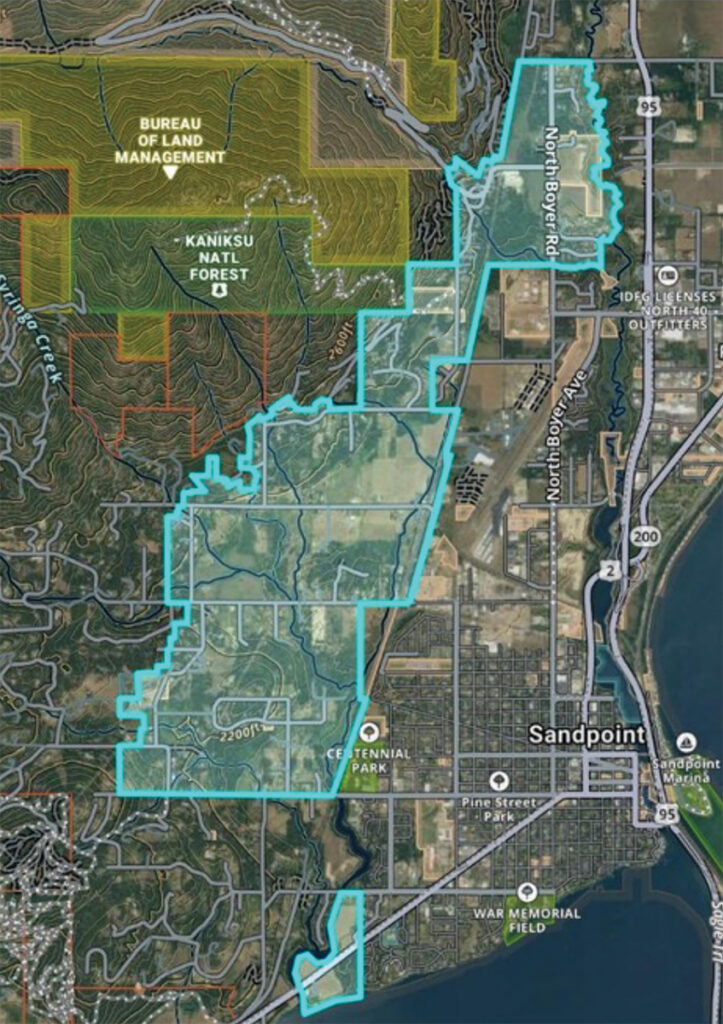
The current area of impact for Sandpoint. If council approves the P&Z recommendation, this would disappear entirely. Courtey image
Members of the BOCC hosted a special meeting on June 16 to consider seven new AOI proposals from Dover, Clark Fork, East Hope, Hope, Kootenai, Ponderay and Sandpoint. The BOCC approved the proposals from Clark Fork, Hope and Ponderay, but sent the others back to their respective City Halls for further refinement in order to more accurately portray how those communities intended to grow.
Sandpoint’s decision to eliminate its AOI altogether stemmed from language approved by the Idaho Legislature in 2024 that limited cities’ ability to operate within their areas of impact — going so far as to remove the word “city” from the previous description as an “area of city impact” — restricting the boundaries to no more than two miles beyond city limits and allowing expansions only into areas “highly or very likely” to be annexed within five years.
“That proved to be what I would describe as maybe the death sentence for our area of impact,” Sandpoint Planning and Community Development Director Jason Welker told P&Z commissioners at the July 15 meeting, later adding, “There were concerns and questions about our ability to serve infrastructure to any of these areas in our now shrunken proposed area of impact.”
As Welker and other city officials have pointed out, municipalities rarely if ever initiate annexation — rather, requests to be included in an area of impact and receive services almost always come from property owners.
“We deliberated and we discussed whether there is any area outside of our existing city limits that is very likely to be annexed by the city of Sanpoint in the next five years, and the answer is honestly ‘no,’” Welker said. “Might some property owners immediately adjacent to Sandpoint pursue annexation by the city of Sandpoint? Possibly. But what’s the purpose of us including it in some hypothetical area, not knowing who might wish to be annexed in the next five years?”
While much of the feedback received from residents outside city limits indicated that they did not wish to be included in any AOI, officials said there were some advantages, including an easier process for subdividing.
Describing the AOI as “really just a planning tool,” Welker added that its elimination will mean that Sandpoint won’t have the opportunity to weigh in with county planning officials with recommendations for development outside city limits but which may affect city infrastructure.
“We’re likely to still be noticed on those. We can provide comment, but even under the current state law, there’s no obligation for the county to actually implement or to strongly consider any of our comments,” Welker said. “So, we can still continue to comment on those as other agencies do. We just won’t have any sort of formal area of impact agreement with the county.”
Despite the elimination of Sandpoint’s AOI, there are still avenues for annexation — however, “it just becomes more complicated,” Sandpoint City Attorney Zachary Jones said, who added that “there’s nothing prohibiting the city from coming back and applying at any time to the county commissioners to modify the area of impact.”