Cooperative Information Network, which includes West Bonner, will be no more as of Sept. 30
By Zach Hagadone Reader Staff
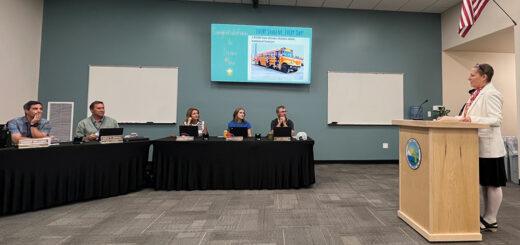
Members of the Cooperative Information Network met July 16 at the Coeur d’Alene Library and voted to dissolve the organization, which represents 30 libraries from the Moscow area to Priest River.
Established more than 40 years ago, CIN will cease to exist effective Sept. 30, after which time the consortium will no longer share a catalog, digital collection, online platform and a host of other resources.
West Bonner County Library District Director Meagan Mize also serves as executive director of CIN, and told the Reader in late 2024 and early 2025 that the relationship between the Community Library Network — which belongs to CIN and includes seven libraries in Kootenai County — and other consortium members had grown rocky.
Courtesy photo
Specifically, tensions arose when CLN indicated in January that it would remove 140 titles from its collection to ensure they complied with the controversial Children’s School and Library Protection Act, passed by the Legislation as House Bill 710 in 2024.
At the same time, Mize said CLN planned to prohibit about 9,000 minors’ library cards from checking out materials from other library systems that are not beholden to Idaho’s “harmful to minors” provisions. In addition, the cardholder policy would have removed minors’ access to materials deemed “obscene” at other Idaho libraries.
Those policies have been reportedly on hold as CLN works to update its internal systems to support the changes.
Neither the East Bonner County Library District nor the Boundary County Library belong to the consortium.
CLN represents about 46% of the CIN, and since February it’s been unclear if the former would remain as a member of the latter.
“The conversation is going to be directed into, ‘How do you expect to be a part of the consortium when you are arbitrarily making — when you’re secretively, I feel — making changes that affect the entire consortium and how we function?’” Mize told the Reader at the time.
Meanwhile, the Spokesman-Review reported July 14, that the Osburn Public Library Board suggested at CIN’s meeting in June that the consortium be disbanded “as a way to avoid a potential lawsuit it believes the Community Library Network is planning to file against CIN.”
That question will be moot after the July 16 vote — from which CLN abstained — as CIN members will spend the next two months winding down the consortium, which will require widespread reallocation of materials, overhauling internal data and splitting up resources previously shared by member institutions. Critically, the CIN’s large digital collection needs to be divvied up.
“We need to figure out a way that we’re going to split this,” Mize said July 16, referring to the shared digital collection system. “We’ve all put money into this.”
It may be that titles in the system are divided between CLN and the Coeur d’Alene library, with CIN members then working with Coeur d’Alene to parcel out those materials. Another option discussed at the meeting was to maintain the collection as it is until 2026 or 2027 or change how libraries access the materials. Physical materials will remain the property of the libraries that own them.
“I don’t know what the answer to this split is,” Mize said. “I’m very confused about even money that has been spent and titles that are here.”
How exactly that division will occur remains to be determined, though libraries will also be working to identify their patrons with the appropriate taxing district so that their user data remains complete after the dissolution, as well as sort through and redistribute bins to the libraries to which they belong.
At some point before the end of September, holds and renewals among CIN libraries will be stopped while the consortium still has a courier under contract to move materials.
Sorting out the financial relationships between members will also take time, as they paid into and shared a number of technologies and other operational and materials expenses.
“I’m sure it’s going to be months,” Mize said of the process of dissolving CIN, including making sure that materials dropped off at one library are returned to the library that owns them.
“This is a treasure — really, this collection is — so I’d really hate to see it go away,” she added.
Want to support independent local journalism?
The Sandpoint Reader is our town's local, independent weekly newspaper. "Independent" means that the Reader is locally owned and operated by people who were born and raised in Sandpoint. The Reader is owned by Publisher Ben Olson, Editor-in-Chief Zach Hagadone and Senior Writer Soncirey Mitchell. Sandpoint Reader LLC is a completely independent business unit; no big newspaper group or corporate conglomerate or billionaire owner dictates our editorial policy. And we want the news, opinion and lifestyle stories we report to be freely available to all interested readers - so unlike many other newspapers and media websites, we have NO PAYWALL on our website. The Reader relies wholly on the support of our valued advertisers, as well as readers who voluntarily contribute. Want to ensure that local, independent journalism survives in our town? You can help support the Reader for as little as $1.
TIMBER WARS: Six-part series, February-November 2022. GO READ IT»
WHERE ARE THE WORKERS?: Five-part series, September-October 2021. GO READ IT»
THE AMERICAN REDOUBT: Seven-part series, November-December 2017. GO READ IT»
STANDOFF AT RUBY RIDGE: 25 Years Later. Five-part series, August-September 2017. GO READ IT»
Curious about what media the locals use? Check our 2018 Local Media Survey. GO SEE »
Sandpoint in Pictures
Filmmaker Jimmy Matlosz of the Idaho Film Company has made a series of mini documentaries about influential Sandpoint locals, including the late Dann Hall and Erik Daarstad as well as icons Diane Michaels and Dan Shook. He is currently working on a series of interviews connected to the history of the Panida Theater. Jimmy is a 30-year veteran filmmaker who's work can be seen at dpmatlosz.com.
Meet the Reader
Ever wonder who makes the Reader happen? Here's a behind-the-scenes look pieced together by summer 2017 intern McCalee Cain in which Ben, Cameron and Lyndsie explain what exactly about the Reader keeps them coming back to their shabby (but well-loved) office each week.