By Brenden Bobby
Reader Columnist
Hear ye, hear ye! It’s my favorite time of year: Renaissance Faire season! The Sandpoint Ren Faire will be spreading merriment on Saturday, June 28 and Sunday, June 29 at the Bonner County Fairgrounds, so I thought it would be fun to take a trip back to the past and explore some medieval helmets — some of the most iconic bits of armor ever to exist throughout the history of warfare.
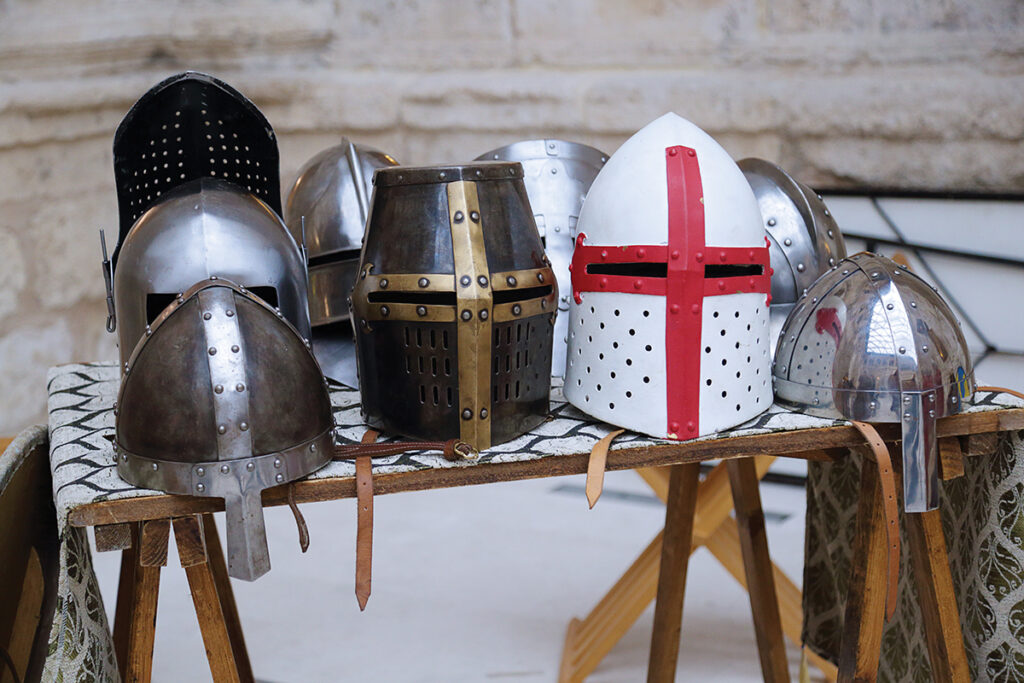
Different types of armor helmets displayed at a medieval fair. Courtesy photo
Ren faires celebrate a vast period of human history from the so-called Dark Ages to the Renaissance, which encompasses about 1,100 years. At the faire you will see all manner of armor and helmets, many of which never actually co-existed.
One of the earliest forms of helmet to appear on the battlefield after the collapse of the Roman Empire was the spangenhelm. The name derives from the metal strips that act as braces for the helmet, which is effectively a metal skull cap designed to protect the brain and little else. The spangenhelm had a long evolution, originating in the times of antiquity and briefly seeing some growth and adaptation during the days of the Roman legions.
Between 600 C.E. and 1100 C.E., the spangenhelm shrank in size, going from a conical shape to a more defined half-sphere that also occasionally came with a noseguard — called a “nasal” — or metal earflaps to protect the ears and cheeks of its wearer. This was a common piece of equipment for rank-and-file soldiers, rather than the common rabble that had been pulled from villages to serve their lords.
An offshoot of the spangenhelm was the heaume, or great helm that is often associated with the Knights Templar during the Crusades. This was common among the knightly crusaders of varying orders by the 12th century, often forged with a cross at the center of the helmet with visor slits for visibility. This type of helmet was often used for jousting but likely extremely hot in the deserts of the Middle East, and it’s unlikely that they were worn for long periods of time — instead, only donned during battles.
Eventually, this helmet evolved into the “frog-mouth” helm that is often associated with jousting knights and late-medieval and early-Renaissance heraldry. The frog-mouth helmet was designed specifically with jousting in mind, as it curved along the jaw to deflect incoming lances and protect the wearer from accidental death and dismemberment — most of the time.
This helmet evolved into its iconic form by 1500 C.E., and many principles of the frog-mouth helmet are still used in modern design, particularly those seen in explosive ordinance disposal kits. The engineering intent is that plates are angled, curved and positioned to make high-velocity projectiles deflect from the wearer, rather than simply dissipating the energy like a bulletproof vest.
The barbute helmet, or barbuta, emerged around the time of the frog-mouth, appearing in Italy by 1407 C.E. This helmet fully covers the head while leaving a T-shaped opening for the eyes, nose and mouth. It is formed from a single piece of metal and was a direct evolution of the spangenhelm skullcap. In a more contemporary context, the barbute was an inspiration for the iconic helmet design of Boba Fett, the Mandalorian bounty hunter from Star Wars, as well as later iterations of the fictional galactic mercenary warriors.
Given Italy’s history of warfare stemming from the days of the Roman Empire, it’s likely this helmet was not only an evolution of the spangenhelm, but the Roman legionary helmets.
While helmets developed full-head coverage from 1400 C.E. to 1600 C.E., they began to shrink during the Renaissance — seeming to disappear almost entirely by the late 1600s. It wasn’t until the early 1900s that helmets returned to the battlefield, mirroring the morion helmets worn by Spanish conquistadores of the 17th century. Today, you’ve likely seen morion helmets in ceremonial settings, such as the Vatican’s Swiss Guard. They appear as rounded, open-faced kettle helmets topped with a tall metal ridge sporting frilly ornaments.
The reason for the disappearance of helmets on the battlefield was simple: They were heavy and ineffective at stopping projectiles from guns and cannons. Maneuverability and visibility became more favorable survival traits until the development of heavy artillery, whose dangers include flinging shrapnel at high velocities into crowds of clustered soldiers. Shrapnel doesn’t move with the force of a bullet, which again made helmets vital protection for soldiers in the trenches, allowing for their reintroduction into warfare.
Contemporary helmets largely follow the design of the spangenhelm, designed to protect soldiers from explosive shrapnel more effectively than projectiles while also granting maneuverability and visibility to the wearer, unlike the knightly helms of yore.
Despite the reduced visibility of knightly helmets, a well-fitted helmet was a work of art meant to function in perfect concert with its wearer and the armor that shielded them. Armor depicted as being clunky and poorly maneuverable is mostly a work of fantasy. Medieval armor was designed to function like steel skin that would articulate and grant its wearer a full range of motion on the battlefield or on horseback. Craftsmen would even be able to apply their skills of armorsmithing to building prosthetic limbs for nobles who lost arms and legs in battle, an art that continues to this day in the medical engineering and 3-D design fields.
Stay curious, 7B, and see you at the faire!