Like roughly 124 million other people, I watched the Super Bowl on Feb. 8. I even (reluctantly) cheered on the Seattle Seahawks with the sliver of my heart not permanently reserved for the Green Bay Packers. This cheering was lazy and apathetic — less about stakes, and more like how a grandma might respond to her grandkid’s job description.
“You work from your computer? That’s nice, dear.”
“Oh, another field goal? How sweet.”
That casualness, though, freed me to take in everything else. I consumed copious amounts of chips and guacamole, second only to pro-AI and gambling commercials, along with a hearty helping of nostalgia, firmly cementing Millennials as the target audience for modern consumerism (looking at you, Backstreet Boys à la T-Mobile).
But more than the commercials or the snack bar, I was able to fully take in the Apple Music Halftime Show. Because I hadn’t been living under a rock, I’d heard the rumblings. The performer would be six-time Grammy Award-winner Benito Antonio Martínez Ocasio, a.k.a. Bad Bunny. The show would be mostly, if not entirely, in Spanish. It would be star-studded. And certain people, most notably the president of the United States, would have a problem with it.
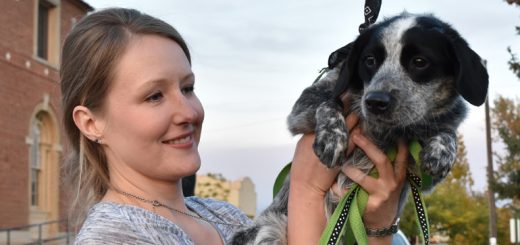
Emily Erickson. Courtesy photo.
What I was wholly unprepared for, however, was the absolute masterclass in performance art: joy and vibrancy wielded as resistance. The show was dense with metaphor and visual storytelling, putting real people at the center of one of the biggest stages in the world. And while my college Spanish is mostly kept on life support by Duolingo, I didn’t need to understand the lyrics to hear the message loud and clear: “This is our humanity. This is what you’re being told to fear.”
The performance opened with a nod to Puerto Rico’s agricultural roots before unfolding into a series of scenes that felt deliberately ordinary. A nail technician. A paragua stand. A casita. Each scene landed like a gentle but insistent poke to the fear-monster’s chest. These weren’t symbols of threats or invasion, but of normalcy: work, family, community, lives lived authentically.
Creative director Harriet Cuddeford described the performance as “celebrating normal people, and what it is to be human and love and have joy, and really appreciate one another.” She continued, “This was to show how much [Benito] values his community … especially people who are of importance in Latino culture.”
From dropping into a living room to a real-life wedding, the show stayed grounded in markets, small businesses and shared spaces. Representation wasn’t abstract, it was intimate. That intimacy peaked when Benito handed his Grammy to a representation of himself as a child, watching his idols on TV (I’m not crying. You’re crying.) Throughout it all, people were plainly dressed, unmistakably real, quietly demanding an answer to the same question again and again: “Really, this is what you’re afraid of?”
He closed with a statement of unity, turning a football toward the camera, inscribed with “Together, We Are America.” In that moment, the performance became irrefutable (or if refuted, deeply revealing). Because rejecting it required exposing a desire for an America that is fundamentally un-American — one where life, liberty and the pursuit of happiness are reserved for a few and built on the backs of everyone else.
I can understand that not everyone experienced the show in the same enthralled way as me. Perhaps, some people were mid-seven-layer dip refill or bathroom break and missed the message entirely, left tapping their toes to unapologetic Latin pop rhythms or focusing on the vocal power of guest stars like Ricky Martin and Lady Gaga. Others may have been distracted by not knowing the lyrics or by the discomfort of unfamiliarity.
But, what I can’t understand is choosing not to look at all. Being so afraid of encountering something different (an alternative representation of culture, community and, frankly, patriotism), during a 12-minute performance that you physically avert your eyes. I can’t fathom a worldview so fragile that merely tolerating another culture feels like a threat. One so small that you choose entertainment manufactured to keep your mind — and your sense of America — narrow and contained (ahem, Trump’s “All-American Halftime Show”).
Worse still were the people who changed channels because they “didn’t want to get political,” even though the alternative was orchestrated by one of the most overtly political figures alive. In the name of neutrality, they chose spectacle over substance, familiarity over curiosity. They turned away from a performance centered on unity — from a jumbotron declaring, “The Only Thing More Powerful Than Hate Is Love.”
But here’s the thing: Looking away doesn’t make something disappear, it just narrows the world you’re willing to see. And when you repeatedly choose comfort over curiosity, sameness over complexity, you don’t stay neutral. You become smaller.
So if celebrating community, joy, family, language and love on one of the largest stages in the world is “political,” then maybe the problem isn’t the performance. Maybe it’s how narrow we’ve allowed our definition of “American” to become. And in the name of expansiveness, when “Together, We Are America” is the message, we can all use second helpings.
Want to support independent local journalism?
The Sandpoint Reader is our town's local, independent weekly newspaper. "Independent" means that the Reader is locally owned and operated by people who were born and raised in Sandpoint. The Reader is owned by Publisher Ben Olson, Editor-in-Chief Zach Hagadone and Senior Writer Soncirey Mitchell. Sandpoint Reader LLC is a completely independent business unit; no big newspaper group or corporate conglomerate or billionaire owner dictates our editorial policy. And we want the news, opinion and lifestyle stories we report to be freely available to all interested readers - so unlike many other newspapers and media websites, we have NO PAYWALL on our website. The Reader relies wholly on the support of our valued advertisers, as well as readers who voluntarily contribute. Want to ensure that local, independent journalism survives in our town? You can help support the Reader for as little as $1.
TIMBER WARS: Six-part series, February-November 2022. GO READ IT»
WHERE ARE THE WORKERS?: Five-part series, September-October 2021. GO READ IT»
THE AMERICAN REDOUBT: Seven-part series, November-December 2017. GO READ IT»
STANDOFF AT RUBY RIDGE: 25 Years Later. Five-part series, August-September 2017. GO READ IT»
Curious about what media the locals use? Check our 2018 Local Media Survey. GO SEE »
Sandpoint in Pictures
Filmmaker Jimmy Matlosz of the Idaho Film Company has made a series of mini documentaries about influential Sandpoint locals, including the late Dann Hall and Erik Daarstad as well as icons Diane Michaels and Dan Shook. He is currently working on a series of interviews connected to the history of the Panida Theater. Jimmy is a 30-year veteran filmmaker who's work can be seen at dpmatlosz.com.
Meet the Reader
Ever wonder who makes the Reader happen? Here's a behind-the-scenes look pieced together by summer 2017 intern McCalee Cain in which Ben, Cameron and Lyndsie explain what exactly about the Reader keeps them coming back to their shabby (but well-loved) office each week.