Growing up, one of my best friends was terrified of dolls. I never really understood it. My grandma made beautiful porcelain dolls like the kind so often portrayed in horror movies, with little frilly dresses and wide eyes, and they just looked like works of art to me. It wasn’t until I saw my first medical training dummies that I understood the depths of their uncanny nature.
Anatomical models with organs, muscles or bones are fine, but the CPR dummies lying lifeless in medical classrooms feel both like a patient awaiting treatment and a cadaver prepared for mutilation in the name of science: bodies caught between false life and death.
In part, the reason these dummies feel so lifelike is that ones like Resusci Anne and those based on her are soulless imitations of a real girl who died long before she reached any med student’s training room.
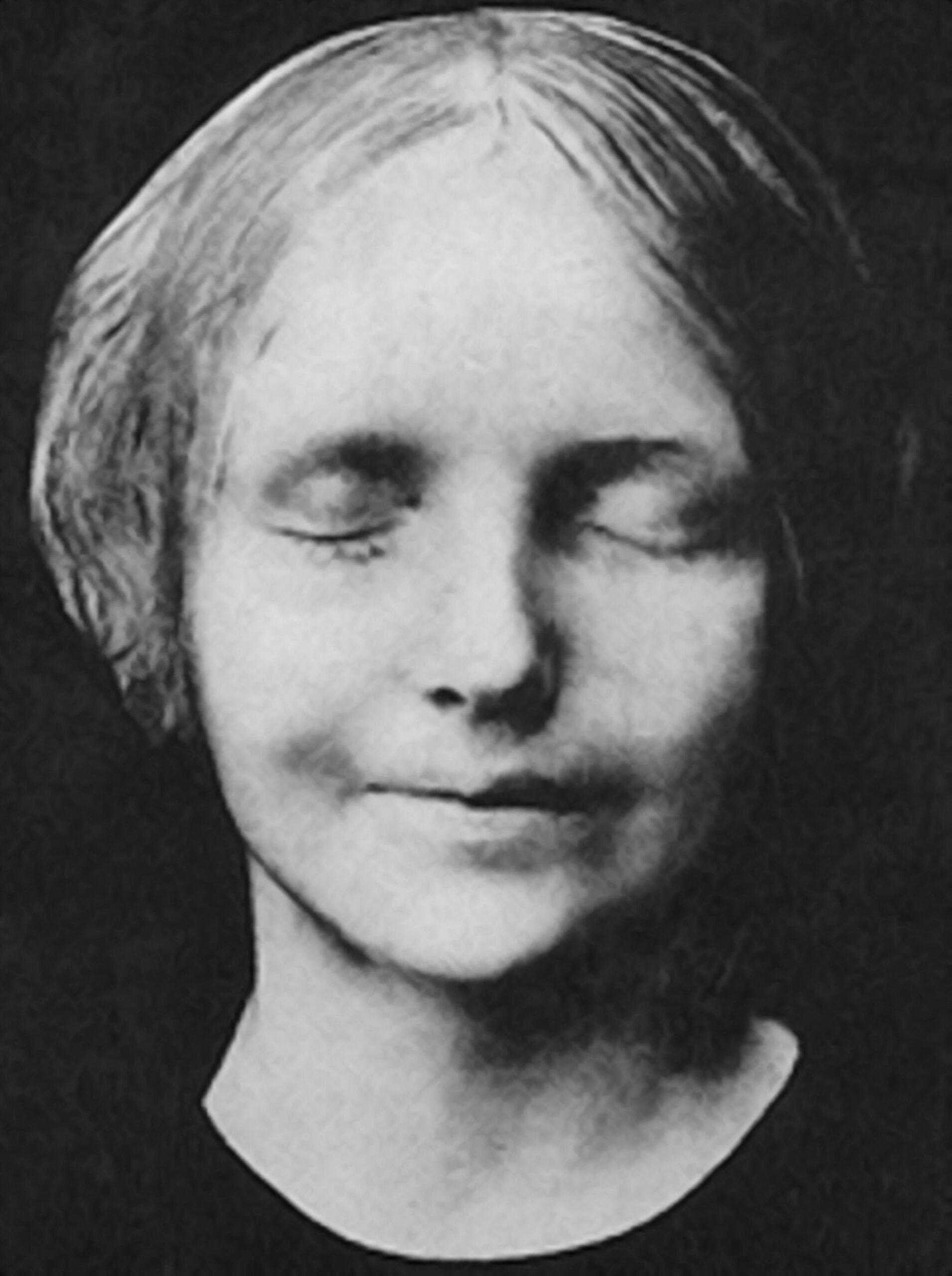
The face of female CPR dolls, mass-produced and shipped across the world, originated with a late 1800s plaster cast of a corpse, called a death mask. The exact origins have been lost to time, but the most famous claims that the mask comes from the body of a girl dredged out of the Seine River in Paris, which is why history knows her as L’Inconnue de la Seine (“The Unknown Woman of the Seine”). She was likely 16 years old.
L’Inconnue de la Seine (“The Unknown Woman of the Seine), whose face was the inspiration for the Resusci Anne CPR dummy. Courtesy photo
According to the most famous account, her body was given over to a Parisian pathologist, who, finding no signs of foul play, ruled her death in the polluted waters of the Seine a likely suicide. Still, the body did not look like a woman drowned, as the features of her face had settled into a peaceful half-smile that philosopher Albert Camus would later liken to the Mona Lisa. The pathologist was apparently so taken by her beauty that he made a cast of her face to preserve in perpetuity — or so one story goes. Other accounts say that the unnamed girl was the daughter of a mask maker or a model who died of tuberculosis. Her true identity, cause of death and final resting place remain a mystery.
Sometime after it was cast, the death mask found its way into the hands of the Parisian Bohemian crowd, who, once more captivated by the face’s beauty, began to reproduce it. According to author Al Alvarez, it became the “erotic ideal” of the time, to which all living women were compared. The girl’s visage inspired countless works of art, from paintings and poetry to ballets.
Then, in 1958, inventors Peter Safar and Asmund Laerdal used her face for their Resusci Anne CPR dummy. You know, the one that inspired the chorus in Michael Jackson’s “Smooth Criminal,” “Annie, are you OK?”
Her second life — if you can call it that — has led many to call her “the most kissed face” in history: an unknown, dead, 16-year-old child.
I can only guess at the Parisian pathologist’s original motives. Did he want to save this girl in some small way by preserving her face? Did he have more perverse motivations for stealing her image? Regardless of intent, he spawned decades of erotic and morbid fascination that ultimately stripped a girl of everything but her image in death. She has never truly rested since she took the plunge into the river.
A small part of me wants to believe there’s a certain poetry in the fact that, though she could not be saved, for decades the girl’s image has taught people how to rescue the drowned and dying. If she or her family had intentionally donated her body to science, that would make for a meaningful legacy. But it wasn’t her choice.
The Bohemians condemned her to an afterlife as the artists’ blowup doll — a vessel for vain musings on beauty, entirely devoid of agency or identity. Then, after the artists had found new women to fetishize, she became a half-naked plastic semblance of a human being, existing perpetually in a liminal space between life and death. This “most kissed face” is the ultimate objectification of a girl whose life was tragically cut short, and whose eternal rest was appropriated on a global scale.
Knowing that, my unease around CPR dolls now has nothing to do with the idea that they’re human facsimiles, but rather that some of them were human and had that identity callously stripped away.
Want to support independent local journalism?
The Sandpoint Reader is our town's local, independent weekly newspaper. "Independent" means that the Reader is locally owned and operated by people who were born and raised in Sandpoint. The Reader is owned by Publisher Ben Olson, Editor-in-Chief Zach Hagadone and Senior Writer Soncirey Mitchell. Sandpoint Reader LLC is a completely independent business unit; no big newspaper group or corporate conglomerate or billionaire owner dictates our editorial policy. And we want the news, opinion and lifestyle stories we report to be freely available to all interested readers - so unlike many other newspapers and media websites, we have NO PAYWALL on our website. The Reader relies wholly on the support of our valued advertisers, as well as readers who voluntarily contribute. Want to ensure that local, independent journalism survives in our town? You can help support the Reader for as little as $1.
TIMBER WARS: Six-part series, February-November 2022. GO READ IT»
WHERE ARE THE WORKERS?: Five-part series, September-October 2021. GO READ IT»
THE AMERICAN REDOUBT: Seven-part series, November-December 2017. GO READ IT»
STANDOFF AT RUBY RIDGE: 25 Years Later. Five-part series, August-September 2017. GO READ IT»
Curious about what media the locals use? Check our 2018 Local Media Survey. GO SEE »
Sandpoint in Pictures
Filmmaker Jimmy Matlosz of the Idaho Film Company has made a series of mini documentaries about influential Sandpoint locals, including the late Dann Hall and Erik Daarstad as well as icons Diane Michaels and Dan Shook. He is currently working on a series of interviews connected to the history of the Panida Theater. Jimmy is a 30-year veteran filmmaker who's work can be seen at dpmatlosz.com.
Meet the Reader
Ever wonder who makes the Reader happen? Here's a behind-the-scenes look pieced together by summer 2017 intern McCalee Cain in which Ben, Cameron and Lyndsie explain what exactly about the Reader keeps them coming back to their shabby (but well-loved) office each week.