BoCo sheriff: ‘We would have received an indictment’
October 14, 2026
Meeting recording still absent from county YouTube
By Soncirey Mitchell Reader Staff
Bonner County Sheriff Daryl Wheeler has weighed in on the recent disclosure of past sexual misconduct allegations surrounding District 2 Republican county commissioner candidate Jeff Roberts, which were made public at the Oct. 6 Bonner County Board of Commissioners meeting.
Though the Idaho Attorney General’s Office did not pursue criminal charges, Wheeler argued that the allegations should have gone before the grand jury.
“Based on the facts of this investigation, both the prosecutor and our team of detectives believe if we took this case to a grand jury, we would have received an indictment,” Wheeler told the Reader in an Oct. 9 email. “During conversations with the AG’s office, we were led to believe they too would take this case to a grand jury. I believe the case should have gone forward and that is why I think it was a miscarriage of justice.”
The accuser reported instances of alleged “forcible fondling” and “attempted forcible rape” to the Bonner County Sheriff’s Office on June 1; however, the original incident is said to have occurred two years prior. Deputies investigated the allegations, which they believed to be “credible,” but were unable to uncover any physical evidence.
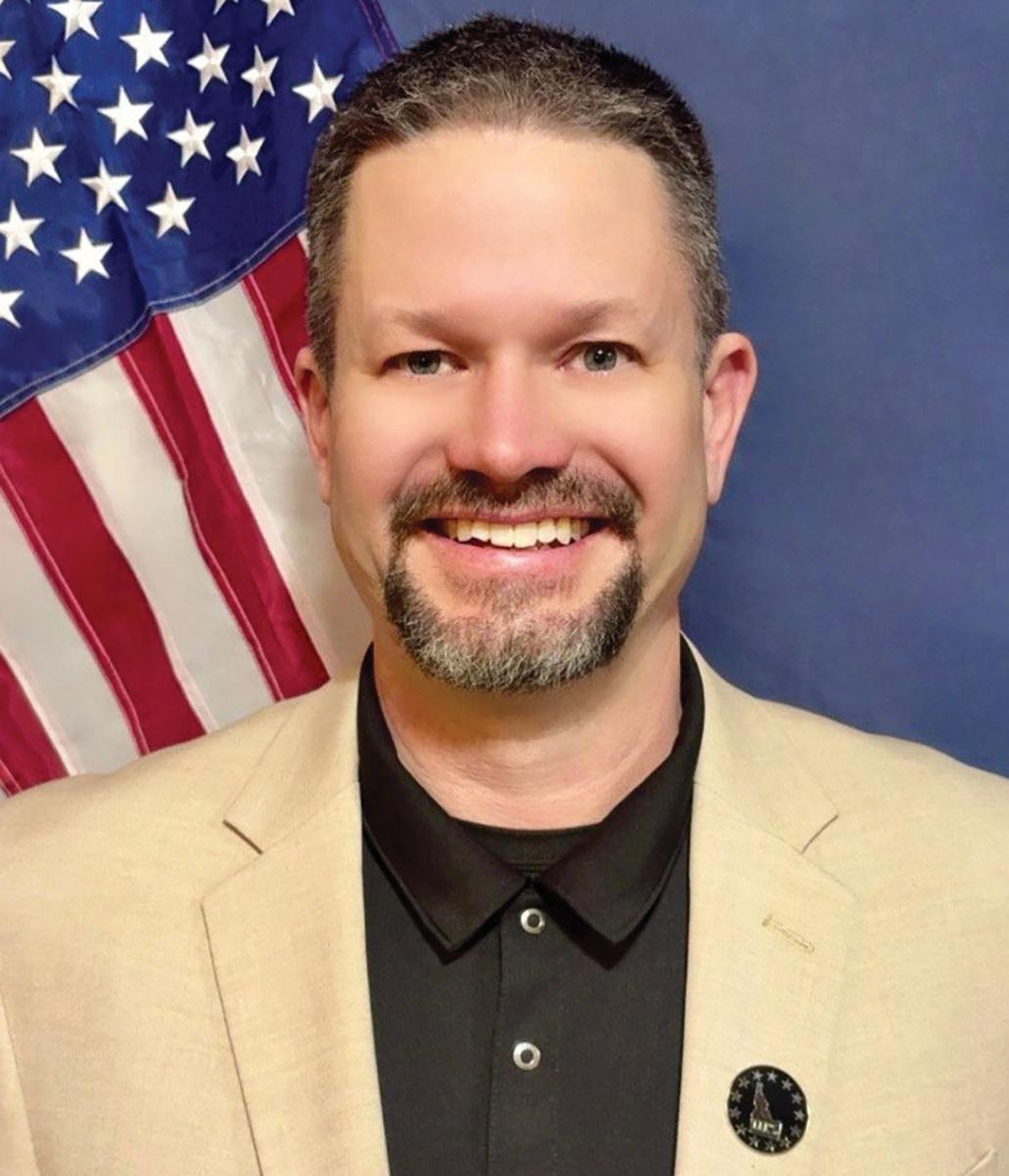
Jeff Roberts. Courtesy photo
Deputies contacted Roberts to arrange an interview, which he initially agreed to before canceling and sending all future communication through his legal representation from Coeur d’Alene-based Palmer | George PLLC.
In an Oct. 7 statement to the Reader, Roberts called the allegations “unequivocally false,” citing a polygraph test “administered by a licensed professional” and provided to the sheriff’s office July 6. According to the prosecutor’s office, the polygraph, dated July 3, was conducted by Lawrence Kuciemba, a longtime Spokane-based polygraph examiner who has worked on a contract basis in a number of high-profile, regional cases dating back decades.
Following reporting by local media, Wheeler told the Reader that his office had not received the test results from Roberts or his legal representation; and, that if it had, those results would have been placed in the case file.
Regardless, “we wouldn’t put much weight in a third-party polygraph,” Wheeler added.
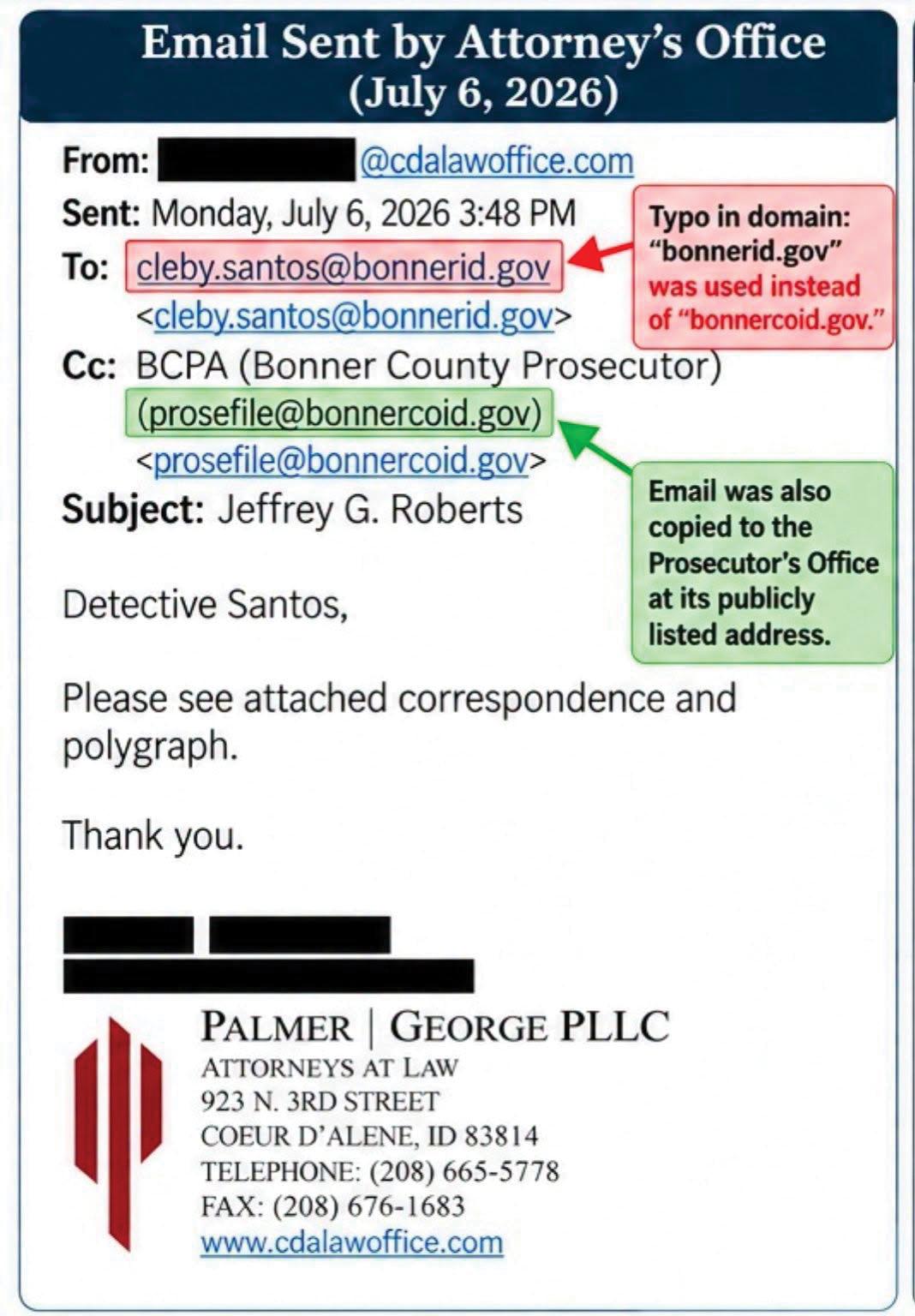
When asked why the BCSO had no record of the polygraph, Roberts referred the Reader to an Oct. 13 post on his Facebook account, which, along with an attached screenshot, allegedly shows that his legal counsel emailed the information to the incorrect address — directing the message to an @bonnerid.gov suffix, rather than @bonnercoid.gov.
When the Reader sent an email to the @bonnerid.gov domain, it immediately generated an error message.
“On July 3rd, I did take and pass a polygraph in regards to these allegations,” wrote Roberts. “It has just come to light that my attorney’s office made a typographical error in the detective’s email address. However, the Bonner County Prosecutor’s Office was copied at its correct, publicly listed address, and I would reasonably expect the Prosecutor’s Office and investigating detective to be communicating about this matter.”
A screenshot Jeff Roberts posted to his Facebook page showing an alleged attempt from his attorney to submit a polygraph test to Bonner County officials using an incorrect email suffix. Courtesy image
When asked whether his office had received the polygraph, Bonner County Prosecutor Louis Marshall told the Reader in an Oct. 14 email, “We did receive a document through our filing portal on July 6 although I didn’t see it until yesterday evening [Oct. 13]. I am not going to comment on the validity of the report as it certainly was not sanctioned by either my office nor the sheriff’s office and we had no control over the process or questions.”
According to Marshall, his office has shared the document with BCSO and “it will become public record subject to the appropriate redactions.”
After the initial investigation, the sheriff’s office submitted the case to the Bonner County Prosecutor’s Office, which forwarded it to the Idaho Attorney General’s Office. According to Marshall, his office did not choose to pursue the case due to an “inherent conflict of interest,” given that Roberts is a candidate for a county elected position.
Deputy Attorney General Madison Gourley informed Marshall Sept. 14 that her office “decided against filing criminal charges” and “consider[s] this matter closed.”
“Based on the facts revealed in the investigation, we do not believe we can prove a crime beyond a reasonable doubt,” wrote Gourley.
“My office heard the testimony of credible witnesses,” Wheeler told the Reader in an Oct. 12 email. “Mr. Roberts refused to be interviewed by my office. … The Attorney General should have sent this case back to the County Prosecutor, to be heard by the Grand Jury. Now Mr. Roberts is speaking to the media, and the case is being tried in the court of public opinion.”
The Idaho AG’s Office did not respond to multiple requests for comment from the Reader.
Though the incident report and a recording of the Oct. 6 BOCC meeting continue to circulate and generate debate online, the official recording remains absent from the Bonner County YouTube page after BOCC Chair Ron Korn instructed staff “to make the video private” that day, according to a Facebook post by Commissioner Asia Williams. Korn has not addressed its removal or responded to multiple requests for comment. Though he has not publicly stated his reasoning, Korn and Roberts share a background in the anti-government militia group the Three Percenters — Roberts in an Oregon branch, and Korn in the local Seven Bravo militia (formerly Seven Bravo 3%). Korn has also endorsed Roberts’ political campaign, as evidenced by his website, votejeffroberts.com.
After instructing staff to remove the video, Korn solicited a legal opinion from the prosecutor’s office on whether “it is necessary to have a board vote” to remove a video from YouTube, according to Williams. She further read aloud Marshall’s response to Korn at the Oct. 13 BOCC meeting, from which Korn was absent.
“Initially, I would point out removing a recording is not destruction of public records so long as the recording is maintained by the county and available for public records request,” wrote Marshall. “The choice to leave the meetings on the platform such as YouTube is discretionary with the BOCC. The board certainly may remove a meeting from an electronic platform.
“My recollection is a previous board made the decision to post meetings on YouTube. This was done by board vote. Therefore, it would be proper to agendize this for a board vote before changing this practice. A single board member cannot overturn the decision made by a previous board absent some kind of legal authority.”
Though the board received the initial legal opinion on Oct. 6, the county had yet to reupload the video as of press time on Oct. 14. Williams put the onus on Korn at the Oct. 13 meeting, stating that “the community can address that issue with [him],” and that she had not, and would not, instruct staff to disregard another commissioner’s instructions and reupload the video.
In an email to Technology Director Jacob Storms, which Williams also read aloud Oct. 13, she stated, “I am not asking you to take action to ensure you are not placed in the middle as an employee. I put that in the hands of the commissioner who gave a verbal instruction.”
“I don’t want Mr. Storms to receive negative input from that because it’s unfair,” she added. “It is unfair for me as a commissioner to say, ‘Because I’m a commissioner, go and do this.’ And the reality is, that happens all the time in this county building, which is a lot of where you see leakage out of your budget because politics plays a role in decision-making instead of following business practices.”
It was immediately unclear whether Korn would bring the issue forward for a board vote. View all agendas and stream future meetings every Tuesday at bonnercountyid.gov/meetings.
Additional reporting by Zach Hagadone.
Want to support independent local journalism?
The Sandpoint Reader is our town's local, independent weekly newspaper. "Independent" means that the Reader is locally owned and operated by people who were born and raised in Sandpoint. The Reader is owned by Publisher Ben Olson, Editor-in-Chief Zach Hagadone and Senior Writer Soncirey Mitchell. Sandpoint Reader LLC is a completely independent business unit; no big newspaper group or corporate conglomerate or billionaire owner dictates our editorial policy. And we want the news, opinion and lifestyle stories we report to be freely available to all interested readers - so unlike many other newspapers and media websites, we have NO PAYWALL on our website. The Reader relies wholly on the support of our valued advertisers, as well as readers who voluntarily contribute. Want to ensure that local, independent journalism survives in our town? You can help support the Reader for as little as $1.
TIMBER WARS: Six-part series, February-November 2022. GO READ IT»
WHERE ARE THE WORKERS?: Five-part series, September-October 2021. GO READ IT»
THE AMERICAN REDOUBT: Seven-part series, November-December 2017. GO READ IT»
STANDOFF AT RUBY RIDGE: 25 Years Later. Five-part series, August-September 2017. GO READ IT»
Curious about what media the locals use? Check our 2018 Local Media Survey. GO SEE »
Sandpoint in Pictures
Filmmaker Jimmy Matlosz of the Idaho Film Company has made a series of mini documentaries about influential Sandpoint locals, including the late Dann Hall and Erik Daarstad as well as icons Diane Michaels and Dan Shook. He is currently working on a series of interviews connected to the history of the Panida Theater. Jimmy is a 30-year veteran filmmaker who's work can be seen at dpmatlosz.com.
Meet the Reader
Ever wonder who makes the Reader happen? Here's a behind-the-scenes look pieced together by summer 2017 intern McCalee Cain in which Ben, Cameron and Lyndsie explain what exactly about the Reader keeps them coming back to their shabby (but well-loved) office each week.