By Ben Olson
Reader Staff
In the first installment of this travelogue, my partner Cadie and I had just completed the arduous hike through the Accursed Mountains in northern Albania, arriving in the beautiful village of Theth.
The day after our eight-hour trek, we lazed around the guest house perched on a hillside overlooking the incredible range of mountains that surround and protect this little shire. The air was cool and crisp, with a feeling of rain on the way. Sure enough, after breakfast, the clouds opened up and we played cards for hours as a torrential downpour settled in for the day. I thought of all the hikers that were caught in the elements on their treks over the mountains and wished them luck.
Theth is a bit more developed than Valbonë, with new guest houses popping up everywhere. Ten years ago, there was very little development in Theth. Ten years in the future, the quaint charm of this village will likely be supplanted by soulless tourist traps. But today, it’s still beautiful.
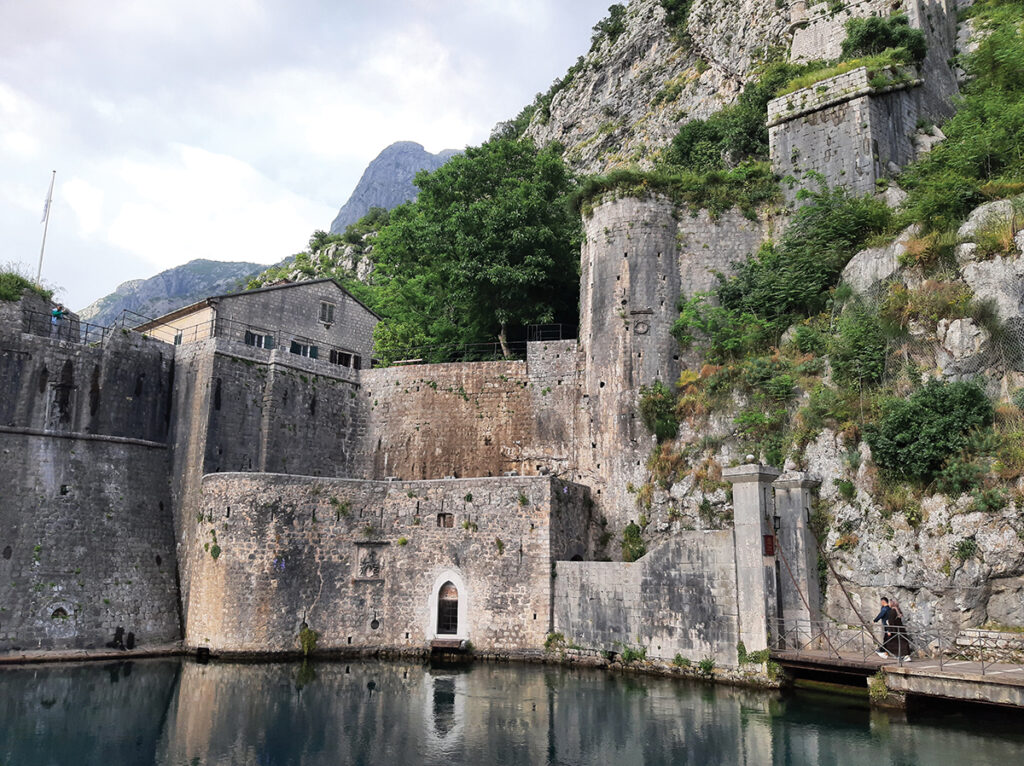
Kotor Fortress in Montenegro. Photo by Ben Olson.
Our host brought us another round of Peja beers and lingered a bit, telling us about the locals in Theth who are fighting to keep it local. He shook his head and told us about Sazan, the last undeveloped island off the coast of Albania, which was sold to the Trump family to be developed into a luxury resort — as soon as they remove all the unexploded ordnance, of course. The locals call the island Ishulli i Trumpëve, or “Trump Island,” and none are happy about it.
“But we are a bit crazy here in Theth and we won’t allow that kind of oligarch development here,” our host told us. “We will fight them if they try it here. These are all locally-owned guest houses. We are tired of outsiders coming here and trying to buy up all of our land. Do you know what I mean?”
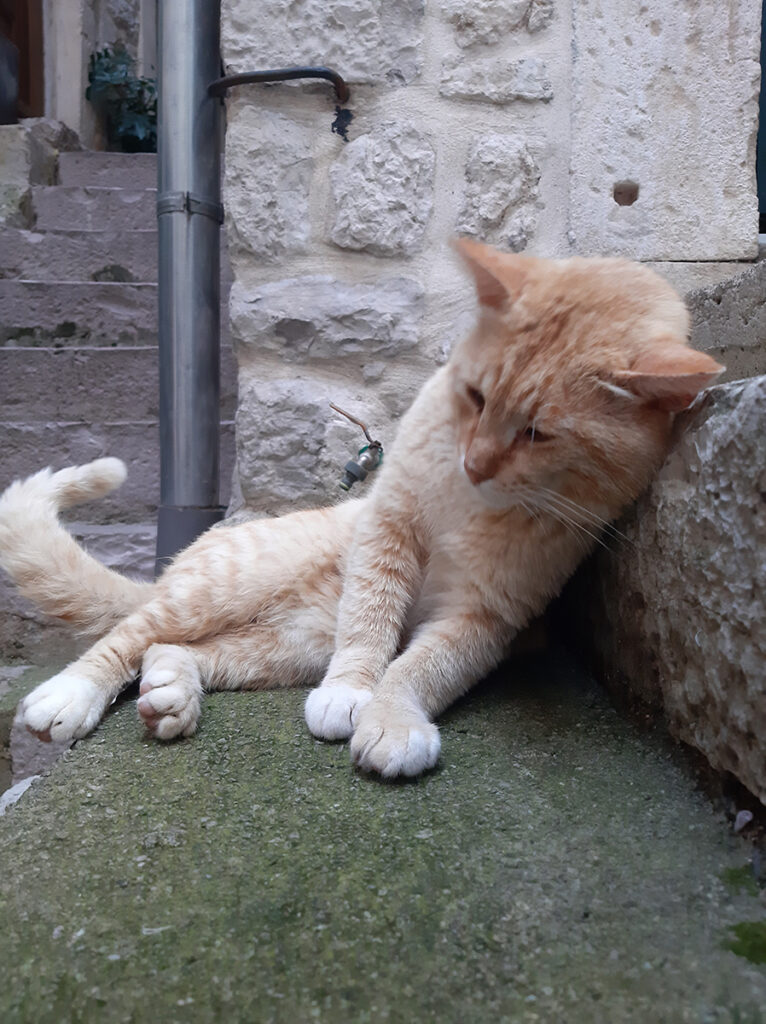
One of the many cats of Kotor Fortress. Photo by Ben Olson.
Yes, brother, I know exactly what you mean. I was born and raised in Sandpoint and have been watching that kind of thing happen all of my life. Same old story.
After three days of wandering the quiet meadows filled with wildflowers and photographing stone churches against the backdrop of the mountains, we bade Theth farewell and boarded a shuttle that climbed into the clouds and delivered us above them. We wound through peaceful valleys tilled by ancient farmers while their stock lingered nearby, as they have done for generations. We reached Shkodër again and drank a quick beer before transferring to another bus headed north into Montenegro.
The five-hour ride followed large Lake Shkodër and, after a cursory stop at the border, we admired another stamp in our passports. Our destination was Kotor, an ancient fortress city tucked in a bay of the Adriatic Sea.
Kotor Bay resembles a fjord, with fingers of the waterway providing respite from the elements at sea. The bus dropped us a five-minute walk from old town Kotor — a UNESCO World Heritage Site surrounded by a fortress built by the Venetians in the 16th and 17th centuries.
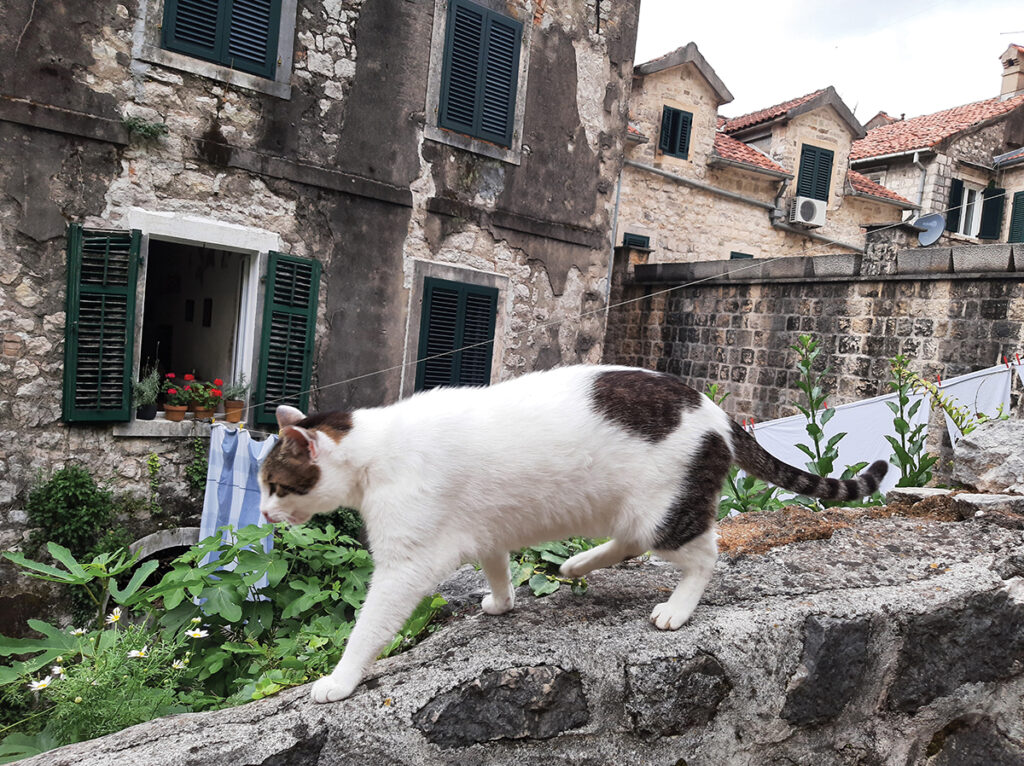
Kotor Fortress has dozens of cats, all of them well-fed and clean, serving as the fortress’ unofficial mascot. Photo by Ben Olson.
We crossed over an actual moat into the southern gate, then wound with our packs through the narrow cobbled streets to the other side of the fortress, where our rental was located. Everywhere your eyes fell was a photograph: the ancient stone walls, the ramparts with generations of flowers sprouting between them, the beautifully dilapidated doorways, the arches and churches that give this place a special feeling.
The most famous residents of Kotor are its cats. They are literally everywhere. You’ll see them sunning on castle walls, roaming underfoot, lying unmolested on piazza tables. It was clear that Kotor was their city and we were just visitors. These felines were living in the closest thing to cat heaven this world has ever known and I loved them all for it.
They were all clean and well fed thanks to local shopkeepers keeping bowls of food and water outside their storefronts.
The cats of Kotor are descended from the felines brought off the boats of ancient mariners. Many consider the cats symbols of good luck — especially because they helped keep the town disease-free by hunting all the mice and other rodents.
It was a pleasant way to end a day: drinking a beer on a castle wall with a purring kitty in your lap.
A cruise ship puts in at Kotor, which means the fortress is crawling with people at midday; but, as we discovered on our second day, if you wake at sunrise, you can wander the castle walls until about 10 a.m. before the hordes of cruisers descend.
Cadie and I did just this our third morning in Kotor, splitting up and experiencing our own quiet morning in the ancient city. I must have taken 90 photographs just of the peeling, arched doorways and stone walls that spoke to me at every twist and bend.
The food inside the fortress was good, but more expensive than places outside the walls, so we walked to the beach and shared some cheap gyros. Beer was also cheaper outside the walls, so we hoofed it a few blocks and got monumentally day drunk at a local bar on Nikšićko beer, inventing a new dice game along the way.
Soon, it was time to move on, back into Albania to meet up with our friend Lucia, who was flying over from her time in Southeast Asia.
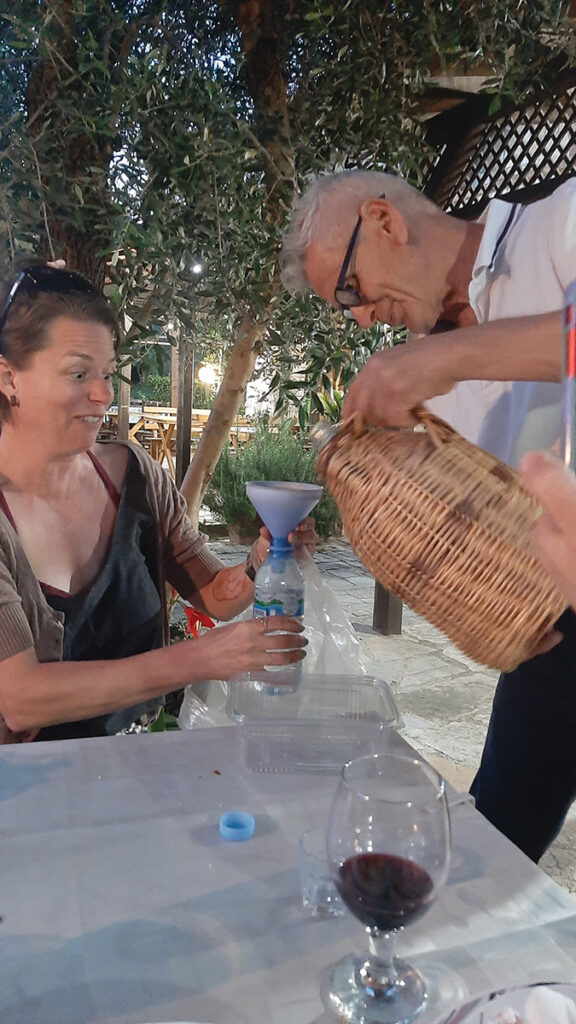
Cadie gulps as Angelo fills her a to-go bottle of rikija. Photo by Ben Olson.
We stopped one more time in Shkodër, running into the cousin of our guest house host at a pizza place, proving it is indeed a small world. The next day it was onto Tirana to rent a car, pick up Lucia from the airport and head south.
Cadie and I spent about five hours in an airport restaurant courtyard, drinking beer and hiding from the hot sun while we waited for Lucia’s new flight (she missed her first one, putting a slight delay on our travels).
Before long, we were speeding down the Albanian countryside in a rented Volkswagen, navigating the roundabouts and strange twists and turns like old pros. I seem to be specially engineered to drive in foreign countries. There’s something about the lawless, every-driver-for-themself vibe that speaks to me. Cadie and Lucia might have different interpretations of my driving abilities after several near-misses, but what doesn’t kill us makes us stronger, I suppose.
Before sunset, we arrived in Berat, staying in an Italian-style villa just feet from the walls of another castle (for only $30 a night, no less).
We walked up the hill to the castle entrance, stopping at a terraced restaurant that was devoid of customers. This is where we met the fabled Angelo, the restaurateur who proceeded to get us drunk on rakija, a traditional 100-proof Albanian grape brandy that varies in taste from battery acid to high-grade moonshine.
Angelo poured a complimentary carafe of rakija for the table and, whenever he noticed it was empty, would fill it again. He was proud of the liquor, proclaiming that he made it himself. Because we were his only customers, he gave us his undivided attention — and lots more rakija.
The meal was excellent: kebabs, salad, spinach-filled pastries, chicken and wine.
“Rakija is good to drink at night… for the ladies,” Angelo whispered in my ear at one point. “I take two every morning with my cup of coffee. I have many children.”
After three hours of eating like lords, we paid the bill and laughed at the paltry amount. It was somewhere around $45 for three of us, with enough booze to stun a small horse. But Angelo wasn’t finished. He produced a wicker jug and insisted on pouring more rakija in a water bottle for us to take home and drink later, even providing us with three glasses to go.
We toasted to his health as swayed down the street in the general direction of our rental.
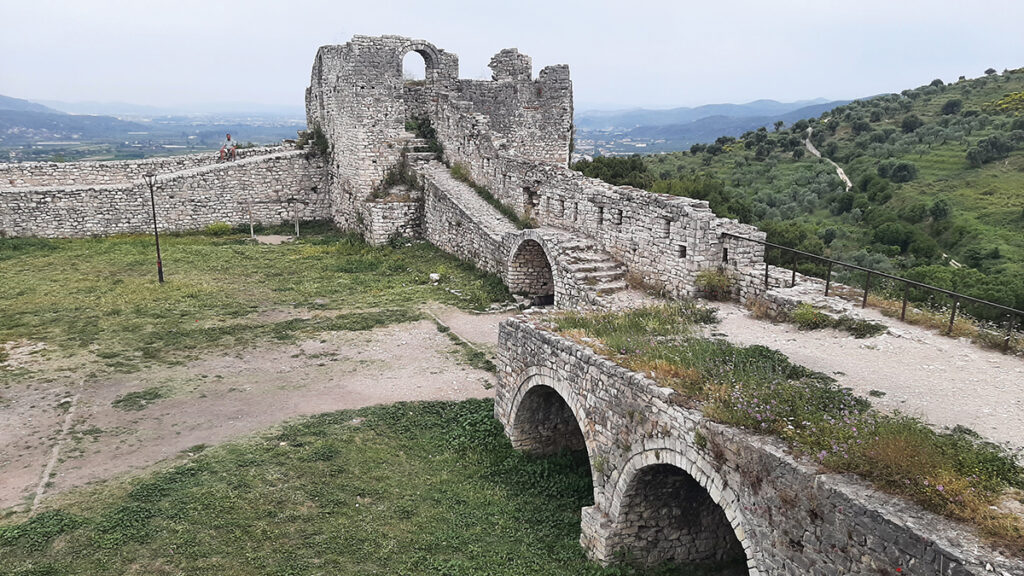
Berat Castle in Albania. Photo by Ben Olson.
From Berat we traveled to the beach for a few days in the sun before the end of our trip. After hitting a foul ball in the city of Vlorë, where our rental was dirty and the town was an industrial port city, we checked out immediately and left to drive mystical mountain-lined roads where there were more sheepherders than buildings, ending up at the cute town of Himarë a few hours south. This place was more our speed.
There was a promenade and several small, neat beaches with only a minimal amount of development. Walking across town in the direction of the beach convinced us to spend the day. Near the beach, I noticed a gated cave surrounded by trash and cheesy constructions.
Upon closer examination, I read this was the Spile Cave. For those not versed in Homer, the Spile Cave is the mythical home of the cyclops Polyphemus in Homer’s Odyssey.
That’s the thing about traveling in Europe — you can throw a rock in any direction and hit something that has historic significance. For history nerds like myself, that’s about as good as it gets.
Cadie, Lucia and I rented an umbrella for the day and proceeded to drink Korça beers, also finishing off the last of the rakija Angelo poured for us the night before.
Hours later, we stumbled back to our rental and slept it off. I woke up to find that I was more sunburned than I’d ever been, plus hungover on a few different types of beer and liquor. I dubbed the hangover/sunburn a “hangburn” and wouldn’t wish it on my worst enemies.
Packing gingerly and moving like a slug through a salt pile, we loaded the car and headed out of Himarë along a beautiful coast road that rivaled the Pacific Coast Highway in every way.
Back in Berat, we spent our last night in Albania on the terrace of our rental, listening to the muezzin calling Muslims to prayer from the minarets scattered about the city. It’s a peaceful sound and one that confirms you are not in Kansas anymore.
The next day, we drove back to the airport at Tirana, dropped off the rental car and hopped a bus to the eastern station, saying goodbye to Lucia, who was headed to Bosnia for another stint of working in hostels and farms.
A long bus ride up and over the Albanian mountains led us back into Macedonia, where our trip began.
We drank Skopsko and Zlaten Dab beers, enjoying one final meal in Skopje before our early morning flight took us up and away from our Balkan adventure.
Flying 30,000 feet above the Atlantic Ocean bound for home, I penned a few final thoughts about the Balkans in my journal.
It’s a complex region with hurt that still festers just beneath the surface. Just a few decades ago there were civil wars raging in the same beautiful landscapes through which we traveled, but today the people are healing. There are still rivalries and probably always will be, but the Balkans are becoming the next place to visit that hasn’t yet been turned upside down by tourism.
The prices are about half what we pay for things in the U.S., except for fuel. The food is healthy, delicious, and not filled with preservatives and empty calories. The beers are simply wonderful, every one of them. The people are friendly and many went out of their way to take care of us. We were all sad to say farewell to this beautiful place.
A few people asked before and after the trip, “Weren’t you scared to travel there?” Not for a second. Travel is a state of mind. It’s a way to gain perspective on the world that isn’t at our doorstep. It’s a vehicle to see the world not wrapped in our American gauze. Fear only gets in the way of the experience.
My biggest takeaway from this trip was realizing that the people of the Balkans — especially Albanians — have figured out a better way to live. I hope to keep that close in my life after coming back to the U.S. in its current ailing state. It was wonderful to take a break from the national toxicity that has become our everyday reality, if only for three glorious weeks in May.
Safe travels to you all and thanks for reading.