For an elk hunt to end with a harvest, a lot has to go right.
Of course there are elements within the hunter’s control: preparedness, timeliness, knowledge of the land. But critical to a successful harvest are also uncontrollable elements: wind direction, trail conditions, the elk’s daily decision whether or not to adhere to patterns and norms.
These reflections have all come to me since Oct. 10, when I set out on opening day of rifle season in hopes of a successful harvest. More than that, I hoped for a sense of peace I’ve dependably found during solitary walks in the woods since I was just a preteen being trusted to learn my family’s hunting grounds.
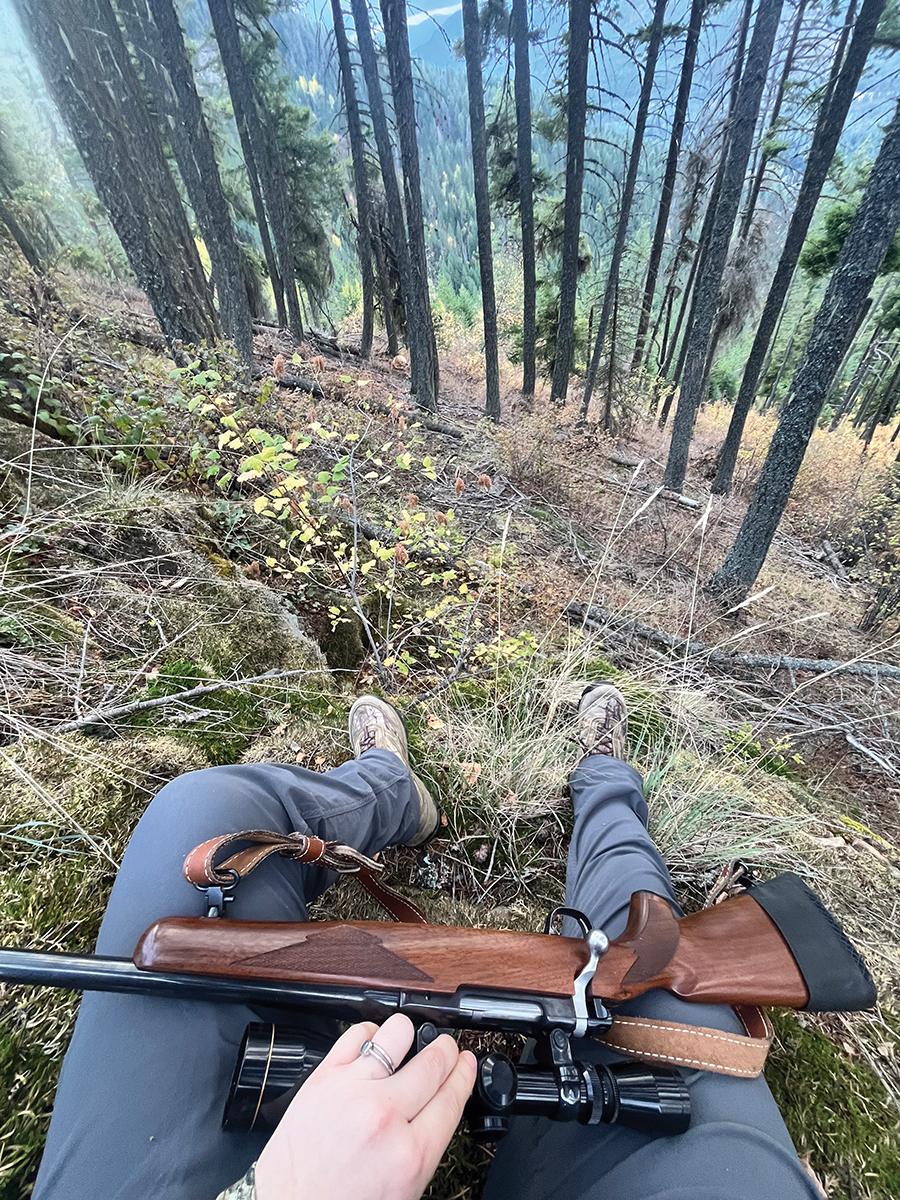
The author’s trusty rifle shot straight on opening day. Photo by Lyndsie Kiebert-Carey
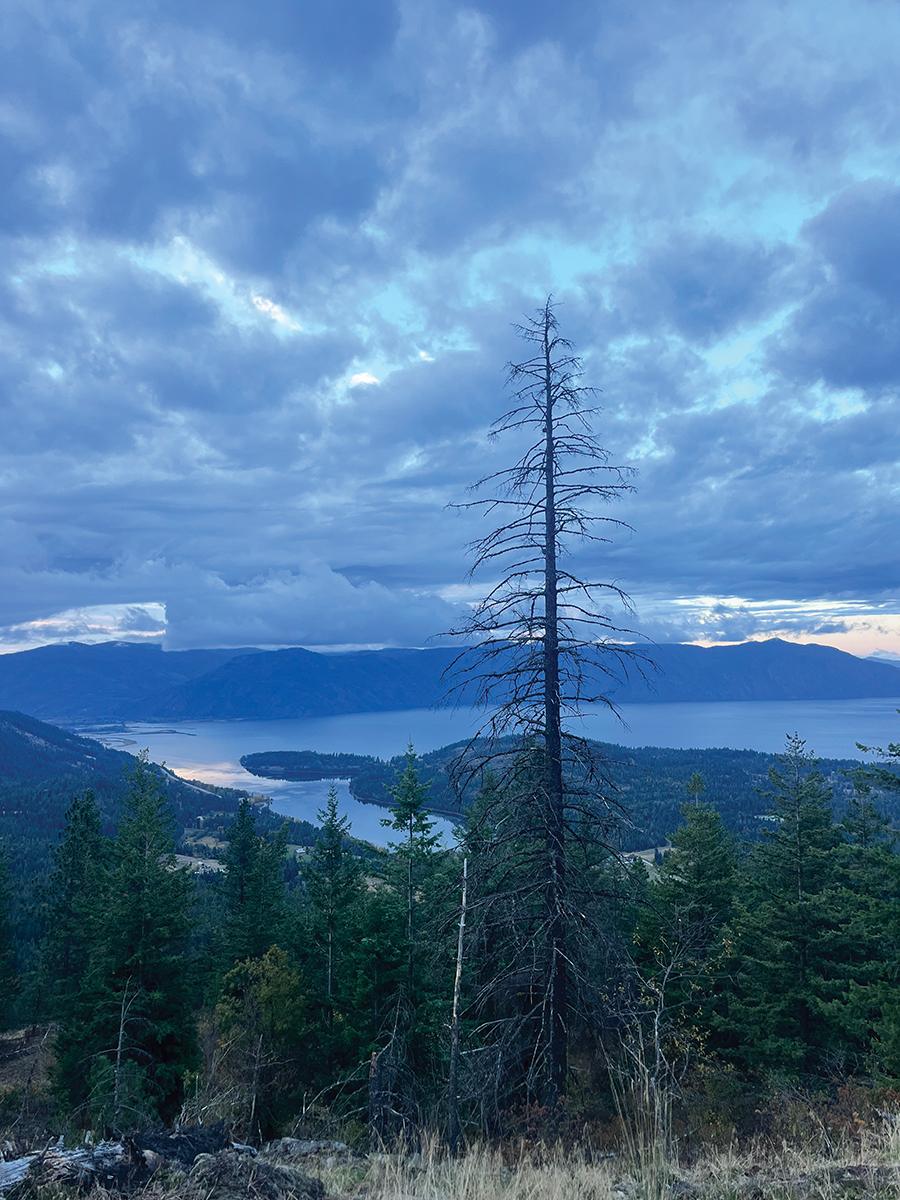
My dad and I departed the truck and hit our respective routes just after daylight. I began along the switchbacks of what’s become my favorite hunting trek — a grueling ridge lovingly dubbed the Hog’s Back. Its open faces afford views of Lake Pend Oreille’s shores from the mouth of the Clark Fork all the way to Sandpoint. The train whistled and rattled while the duck hunters enjoyed their own opening day, their shots echoing up the canyon. The morning held a chill that I knew my movement would soon dispel. The night’s rain dampened the forest floor and promised to conceal my footsteps. This was a perfect setting for contemplation.
Good morning, Hope. Photo by Lyndsie Kiebert-Carey
I settled into my rhythm. Five or six steps, pause, listen, look, continue on. Shift rifle from hand to hand, readjust backpack straps, wipe forehead.
I found myself thinking about my team. On Oct. 10, Clark Fork High School’s varsity volleyball team had recently wrapped up an undefeated regular season and was preparing for the district championship the following week. As the head coach, my preparation takes many forms: planning practice, scouting potential opponents, writing notes for conversations I want to have with players.
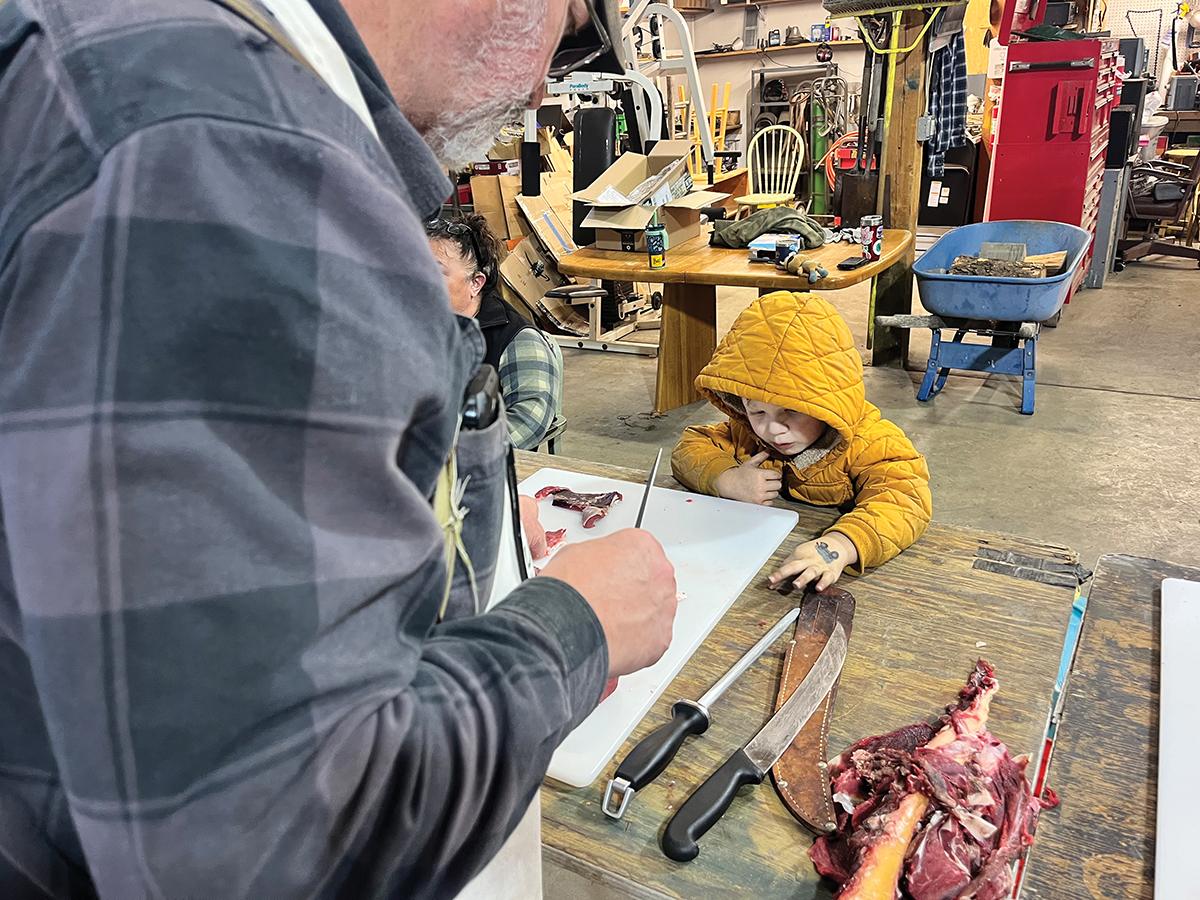
Travis Kiebert and Liam Carey butcher Mama’s elk. Photo by Lyndsie Kiebert-Carey
Each of these things took up headspace as I continued my hunt, and I was thankful for the uninterrupted opportunity to ponder. Day-to-day life with my 3-year-old son, Liam, provides plenty of entertainment, but considerably less time to ponder.
I paused at the top of a tough stretch of trail, happy to have it behind me. Cloud coverage would buy me some time, but I wanted to reach the apex of my route before the sun crested the ridge and shifted the breeze against my favor. I had about 45 minutes to reach the point where I’d begin sidehilling into thicker timber. Familiar calculations told me I had time for a handful of pauses before then, and I wanted to save a long one for a spot coming up — where I’d been telling myself for years would be the perfect place to sneak up on a feeding herd.
If I could keep quiet, the next vista would provide my first look into the timber to my right before anything at that distance could hear or smell me. So, with an optimist’s heart and a realist’s mind, I snuck across loose rocks and pushed myself into labored breathing, my mind somewhere between the volleyball court and the mountain, until I reached my predetermined spot to pause.
It took a moment for the finer details of the timber to fully materialize. Foreground, trees. Background, forest floor. And there, just the slightest shade of red against the dull brown and gray, was a cow elk.
She stood between two dead white fir, facing uphill. Something on the neighboring ridge had caught her attention. To her left, another cow was feeding, unbothered. There was gentle rustling in the brush below, which didn’t phase them.
Hopefully, I thought, a bull.
I made sure I liked my footing. I disengaged the safety on my rifle. For the first time ever, come to think of it, I felt ready for whatever might come next.
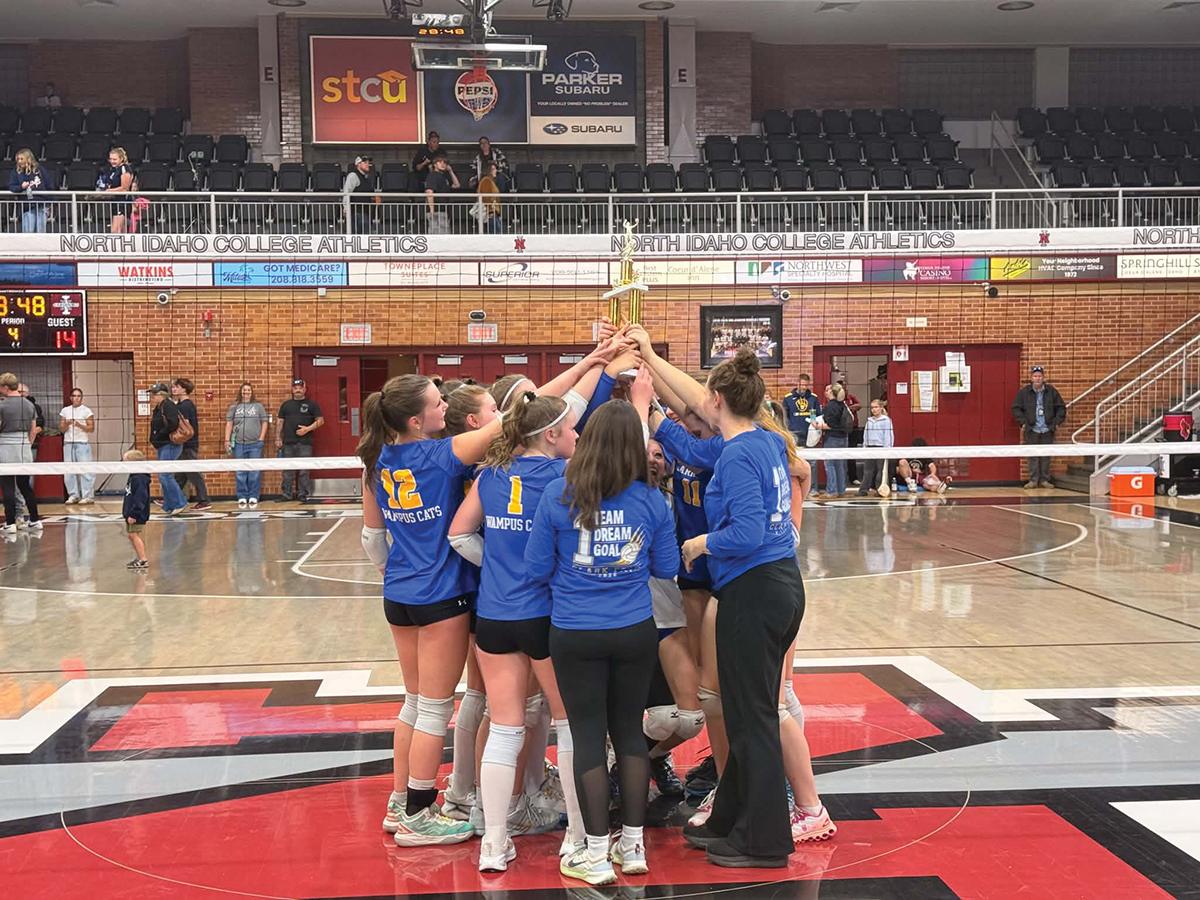
Clark Fork hoists the 2026 North Star League Championship trophy. Photo by Tel Thompson.
When I recounted the story, I told my dad I watched the cows for about two minutes before the action started. It may have been 30 seconds.
For whatever reason, the lead cow decided it was time to go and broke uphill. Her companion followed and a tan body entered my peripheral vision — a male.
I put my crosshairs between two trees on the game trail, saw antlers cross my vision and fired. He reared (hit, but not in the lungs, which would have caused more of a buckling) and disappeared from my sight. At this stage in a hunt, sound is no longer a reliable indicator of what’s happening. The rifle shot rendered me temporarily deaf, and without the spike in my line of sight, my only choice was to make a good guess at his resting place.
About 10 minutes and plenty of bushwhacking later, I found my harvest lying with the lake before him and I grappled with the bittersweet gratitude of the successful hunt.
This would be celebrated as my first solo kill, but “solo” only applies so far as my solitary walk and the shot itself. My dad dressed the animal with my sheepish help and my husband arrived not long after with his chainsaw, ATV and (thankfully) the enthusiasm and stamina to inspire our packout.
For the past decade, the elk hunt has arrived amid a time of year I’ve come to love more than any other: volleyball season. In that time, my team has never gone undefeated through the regular season — until this year. Maybe it’s their commitment or athleticism. But I also think a lot had to go right that was out of our control, just as with a hunt that ends in a harvest.
The Clark Fork Wampus Cats would go on to win the district championship the following Thursday, and my family would butcher the spike on Sunday. I write this story with elk meat in my belly and a half-packed duffel bag on my bedroom floor, poised for the 1A Idaho State Volleyball Tournament, where my team of incredible, kind, smart, hardworking, hilarious girls will compete with an undefeated record this weekend.
A lot had to go right — but this column has never been about outcomes. The joy of the hunt, for elk and for trophies, is always first and foremost.
Lyndsie Kiebert-Carey is a fifth-generation Bonner County hunter and editor emeritus of the Reader. She has contributed a column about elk hunting every October since 2017.
Want to support independent local journalism?
The Sandpoint Reader is our town's local, independent weekly newspaper. "Independent" means that the Reader is locally owned and operated by people who were born and raised in Sandpoint. The Reader is owned by Publisher Ben Olson, Editor-in-Chief Zach Hagadone and Senior Writer Soncirey Mitchell. Sandpoint Reader LLC is a completely independent business unit; no big newspaper group or corporate conglomerate or billionaire owner dictates our editorial policy. And we want the news, opinion and lifestyle stories we report to be freely available to all interested readers - so unlike many other newspapers and media websites, we have NO PAYWALL on our website. The Reader relies wholly on the support of our valued advertisers, as well as readers who voluntarily contribute. Want to ensure that local, independent journalism survives in our town? You can help support the Reader for as little as $1.
TIMBER WARS: Six-part series, February-November 2022. GO READ IT»
WHERE ARE THE WORKERS?: Five-part series, September-October 2021. GO READ IT»
THE AMERICAN REDOUBT: Seven-part series, November-December 2017. GO READ IT»
STANDOFF AT RUBY RIDGE: 25 Years Later. Five-part series, August-September 2017. GO READ IT»
Curious about what media the locals use? Check our 2018 Local Media Survey. GO SEE »
Sandpoint in Pictures
Filmmaker Jimmy Matlosz of the Idaho Film Company has made a series of mini documentaries about influential Sandpoint locals, including the late Dann Hall and Erik Daarstad as well as icons Diane Michaels and Dan Shook. He is currently working on a series of interviews connected to the history of the Panida Theater. Jimmy is a 30-year veteran filmmaker who's work can be seen at dpmatlosz.com.
Meet the Reader
Ever wonder who makes the Reader happen? Here's a behind-the-scenes look pieced together by summer 2017 intern McCalee Cain in which Ben, Cameron and Lyndsie explain what exactly about the Reader keeps them coming back to their shabby (but well-loved) office each week.