Sandpoint Council votes to give residents no-cost parking permits in city-owned lots
November 24, 2026
Permits would be open to all non-city residents for $35
By Zach Hagadone Reader Staff
Sandpoint City Council members voted unanimously Nov. 18 to adopt the recommendation of the Parking Committee, providing city residents with two free parking permits per household while retaining the $35 non-resident fee for accessing lots where paid parking kiosks are currently installed.
No-charge resident permits would be available by registering a vehicle through the city’s parking portal by providing a license plate number. After review and verification by Sandpoint community resource officers, the licence plate or plates associated with an address inside city limits would immediately gain access to all city parking facilities with kiosks. Those locations include City Beach, the downtown City Lot at Third Avenue and Church Street, Pend d’Oreille Bay Trail and other waterfront lots with kiosks.
Parking would remain free up to the posted time limits in all downtown zones, regardless of permit, with overstaying in those stalls incurring a fee. Likewise, the kiosks are still active where installed, providing users with the opportunity to pay for shorter stays based on the system that has been in place since the summer of 2026.
The $35 non-resident permit would also be available through the city’s parking portal and immediately grant access to lots with kiosks. In addition, the non-resident permits would be available to anyone who does not reside within city limits.
“[T]hat solves one of the big shortcomings of our permit program in 2026 that we learned about after launching it, which was that there are many employees of downtown Sandpoint businesses that do not live in Bonner County,” said Sandpoint Planning and Community Development Director Jason Welker, “so opening what was previously the county resident permit up to anybody — regardless of residency — helps resolve that, so that those downtown business employees can acquire the same $35 permit that anybody can acquire and have access to our downtown parking lot.”
According to data collected in the months following the rollout of Sandpoint’s paid parking program in early July, permit revenues totaled just more than $92,000 — including both resident and non-resident permits, which previously cost $20 and $35, respectively. Of those, city residents purchased 1,400 permits accounting for $28,000 in revenue, while 1,400 county residents spent $49,000 on permits. Other permit types — including boat trailer and other long-term street parking permits — ran to $19,282.
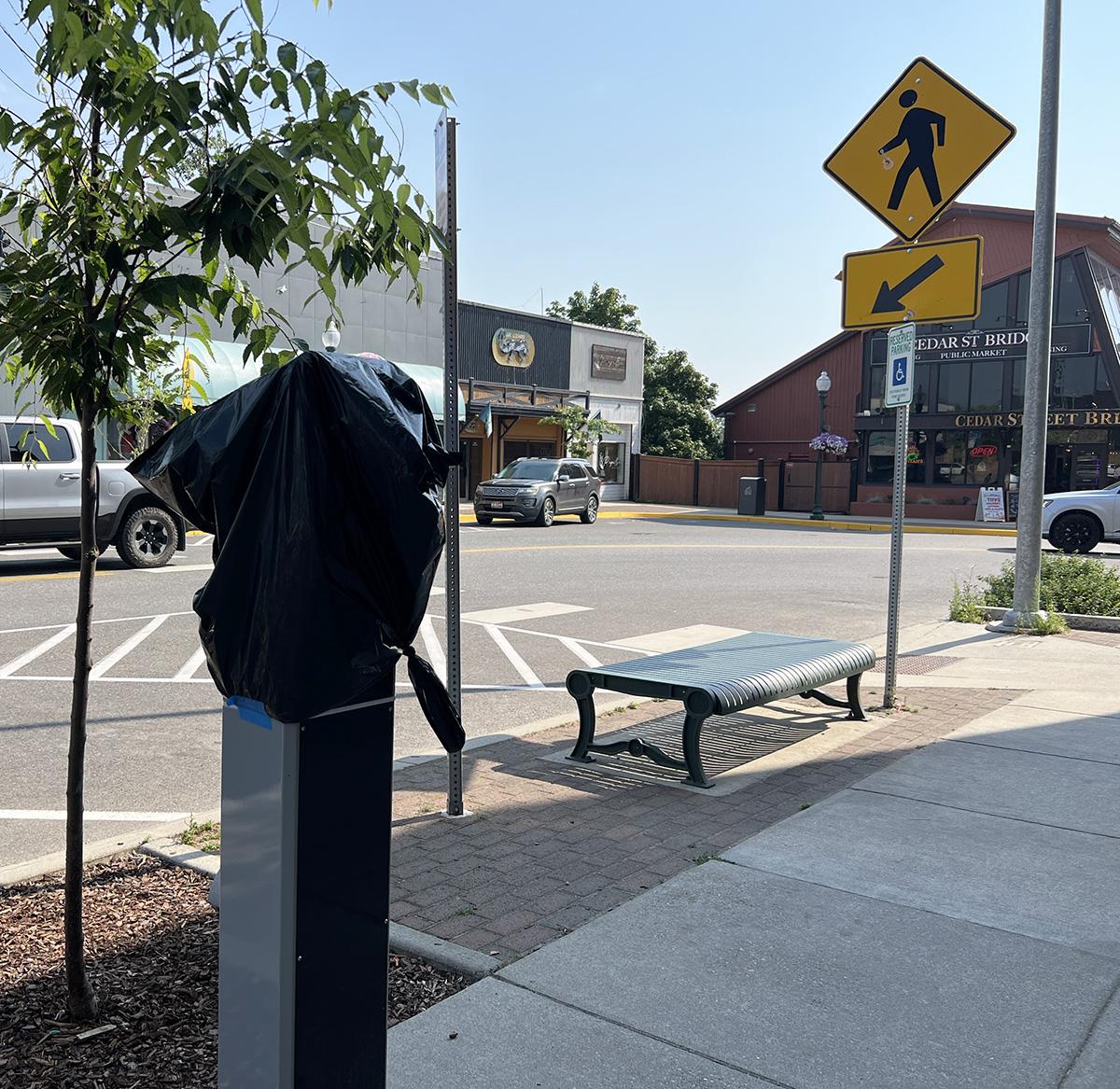
A bag placed over a parking kiosk in downtown Sandpoint in summer 2026. The kiosks were removed from downtown shortly after. Photo by Ben Olson
The city subtracted the latter permit types from its analysis, resulting in $77,000 in revenue from resident and non-resident permit purchasers. Under the previous policy, program costs ran to $12 for each resident permit — a total of $33,600 to administer — resulting in an overall contribution to parking operations, maintenance and improvements of $43,400.
Making the resident permits no-cost and bringing verification in-house eliminates a range of backend fees, reducing the cost of administering the program to $2 per permit. At the same time, the $35 non-resident permits would cost the city a total of $5.50 each to issue, including system costs and an online payment fee, according to the city’s staff report.
Assuming City Hall’s projection is correct that 2,000 non-resident permits will be purchased in 2027, the program would generate $70,000. Also assuming 2,400 residents will apply for no-cost permits, the cost of processing and issuing both types of permits would run to $15,800, with a net revenue of $54,200 — just shy of $10,000 more than was gathered in 2026.
Welker said the permits would be valid for the entire calendar year, with the goal on Nov. 18 of getting the recommendation approved in order to coordinate with IPS and the Sandpoint Police Department to see the new program launched by no later than the middle of December.
“And we can work on, over the next three or four weeks, promotion, marketing and an informational campaign and email messages to existing permit holders so that they may purchase their new permit or get their free resident parking permit before the new year,” he added.
Sandpoint Mayor Jeremy Grimm noted “so many complexities” to the parking program, and thanked the Parking Committee along with Welker, police officials and city finance staff for “working through these challenges.”
“There’s a lot of what-ifs and an extreme need to think through the flow of this process,” he said.
The parking program has been controversial since its start in early July, with many area residents questioning the fee structure, the security of the data entered into the system and even its necessity. A software glitch on the day of the system launch further frustrated users and fueled opposition, amounting to a small protest at the City Lot.
What’s more, a so-far-unsuccessful effort was mounted to recall Grimm and Council President Deb Ruehle over the issue, and some area residents — organized as Sandpoint Citizens Against Paid Parking and active on Facebook — are collecting signatures to put a referendum on the ballot repealing the ordinance empowering the city to institute and enforce paid parking.
The city tweaked the program through the summer and fall, going so far as to remove paid parking kiosks from the downtown two-hour parking zones and establishing the Parking Committee to work on solutions such as the one adopted on Nov. 18. At the same time, many downtown business owners expressed deep concern that confusion and opposition to the new parking rules had damaged their summertime trade.
Those concerns led Scott Wilburn — a longtime musician, graphic designer, guitar builder and owner of Wilburn Custom Shop on Second Avenue — to resign from his position on the Parking Committee in October.
“I’m concerned that the people that are the most harmed by what they did with the parking [program] are the small business owners — I’m one of them,” he told the Reader in an interview before the Nov. 18 council meeting. “My business in the first two weeks of them doing that parking kiosk thing in the street was down by like 72%. That’s brutal for us, because July and August are the biggest months of the year — except for Christmas — and if we don’t make money in those two months we’re screwed.”
Wilburn added that he took his responsibility as the lone downtown business owner on the committee seriously, meeting with members of the Downtown Business Association, talking with his fellow merchants and circulating a survey to get their thoughts on the policy.
He gathered “overwhelmingly negative” responses, and presented his findings to the committee, but felt that he and his business-owner colleagues’ worries were “poo-pooed.”
Wilburn described the city’s attitude toward downtown business owners’ concerns as “cavalier” and, while adding that he didn’t wish to cast aspersions — “They’ve got an impossible job and I wouldn’t want to do it,” he said of city officials — “It was a clusterfuck — they just made a mess of it. And those of us who make a living down there have had a serious challenge because of it.”
With Wilburn’s departure, the committee lacked a quorum, which was filled with the appointment of John Lally on Nov. 18. Lally is a Bonner General Health employee who also preaches at Sandpoint Church of God.
City councilors seemed satisfied with the committee’s work so far, with Councilor Pam Duquette saying, “I have proposed free city permits from the beginning, so thank you for figuring this out.”
Councilor Kyle Schreiber, who along with Duquette has been among the most vocal skeptics of the program on the dais — with Schreiber originating the motion to remove the kiosks from the downtown two-hour zones — said he was, “surprised and pleasantly surprised to see that staff had offered to do the residency verification. That’s pretty sweet. I know that there’s a big concern out there in the public with some random third party having access to people’s data.”
However, IPS will still be managing the program, though city employees will be verifying license plate information.
“IPS is our parking enforcement system from soup to nuts, so to speak. From the beginning of the program to the end of the program, it’s all through IPS,” Welker said. “All of the registered vehicles need to be in the IPS system so that a permit can be tied to that vehicle. …
“In fact, it’s kind of misleading to call it a ‘permit.’ It’s really just license plate registration in the IPS system. So when somebody ‘buys a permit’ or gets a free permit, what they’re really doing is they’re registering their vehicle for free parking in city lots,” he added.
Despite widespread discussion of the parking program on social media and in conversation among members of the downtown business community, the public shied away from testimony on the matter at the Nov. 18 council meeting. Mayor Grimm, however, said that his concern about the no-cost resident permit policy would be “overconsumption of the City Lot.”
“One of the neat things right now is if you go down there, there’s always a spot with someone with a permit they know they bought. I’ve heard from employees that that’s a great thing,” he said. “For the first time … they know they have a place, so I assume we will see more congestion at the city lot, but it does achieve your goal of getting free permits to all city residents.”
Schreiber said he had “the opposite thought.”
“Actually, I thought that allowing the $35 permit without any residency check would actually increase the demand more because now any visitor can just log in, get a permit right then, park and now — for their entire visit to Sandpoint — they have a parking pass. They don’t have to be a resident. They don’t have to pass any checks. …
“I’m not as concerned about city residents having free access to their own parking lots, as I am the tourists, which was kind of the impetus of this whole project,” he said.
Want to support independent local journalism?
The Sandpoint Reader is our town's local, independent weekly newspaper. "Independent" means that the Reader is locally owned and operated by people who were born and raised in Sandpoint. The Reader is owned by Publisher Ben Olson, Editor-in-Chief Zach Hagadone and Senior Writer Soncirey Mitchell. Sandpoint Reader LLC is a completely independent business unit; no big newspaper group or corporate conglomerate or billionaire owner dictates our editorial policy. And we want the news, opinion and lifestyle stories we report to be freely available to all interested readers - so unlike many other newspapers and media websites, we have NO PAYWALL on our website. The Reader relies wholly on the support of our valued advertisers, as well as readers who voluntarily contribute. Want to ensure that local, independent journalism survives in our town? You can help support the Reader for as little as $1.
TIMBER WARS: Six-part series, February-November 2022. GO READ IT»
WHERE ARE THE WORKERS?: Five-part series, September-October 2021. GO READ IT»
THE AMERICAN REDOUBT: Seven-part series, November-December 2017. GO READ IT»
STANDOFF AT RUBY RIDGE: 25 Years Later. Five-part series, August-September 2017. GO READ IT»
Curious about what media the locals use? Check our 2018 Local Media Survey. GO SEE »
Sandpoint in Pictures
Filmmaker Jimmy Matlosz of the Idaho Film Company has made a series of mini documentaries about influential Sandpoint locals, including the late Dann Hall and Erik Daarstad as well as icons Diane Michaels and Dan Shook. He is currently working on a series of interviews connected to the history of the Panida Theater. Jimmy is a 30-year veteran filmmaker who's work can be seen at dpmatlosz.com.
Meet the Reader
Ever wonder who makes the Reader happen? Here's a behind-the-scenes look pieced together by summer 2017 intern McCalee Cain in which Ben, Cameron and Lyndsie explain what exactly about the Reader keeps them coming back to their shabby (but well-loved) office each week.