Capital investments include $34 million for wastewater treatment plant
By Zach Hagadone Reader Staff
City Council members voted unanimously Aug. 19 to adopt Sandpoint’s Fiscal Year 2027 budget, approving expenditures of $92 million — the largest budget in the city’s history.
The reason for the historic level of spending is the inclusion of $34 million in projects related to the reconstruction of the wastewater treatment plant. Voters in 2025 approved bonding authority of $130 million for improving the aging facility.
Specifically, the FY ’27 budget includes $30 million for the first phase of design and construction at the plant, as well as $3.3 million for wastewater lift station replacements and $280,000 for inflow and infiltration reduction.
The $30 million Phase I wastewater plant line item is the single largest capital improvement in the budget, with the next highest capital expenditures including $6.7 million for water mainline projects in the Woodland, Boyer and Pine corridors to address aging infrastructure.
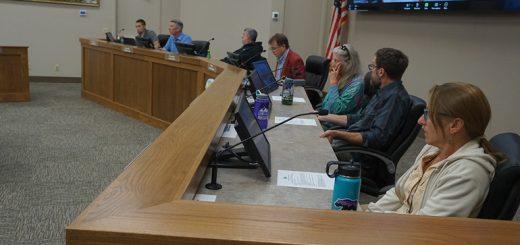
Sandpoint city councilors meet in City Hall chambers. Photo by Ben Olson
A further $4.75 million is earmarked for Phase III of downtown revitalization and $3.5 million for stormwater improvements in the Great Northern Road corridor.
Sandpoint will also spend $475,000 to replace six police patrol vehicles and hybrid patrol vehicles, emphasizing that they are replacements, not additions.
“This budget reflects a philosophy that has guided this administration from the beginning: We must take care of what we already have,” Sandpoint Mayor Jeremy Grimm wrote in the budget letter. “Roads, sidewalks, parks, public buildings, public safety equipment, water systems and wastewater infrastructure are the foundation upon which our quality of life and local economy depend. Maintaining and improving those assets is not always the most visible work of government, but it is among the most important.”
Altogether, the city will allocate more than $13 million toward transportation-related infrastructure, with $8.5 million of that funded through the Sandpoint Urban Renewal Agency, instead of relying on General Fund dollars or property tax revenue.
Direct investment of $4.5 million will go toward road reconstruction and seal coating, sidewalk and pathway improvements, Cedar Street reconstruction, Highway 2 improvements and replacement of street maintenance equipment.
“Together, these investments reflect a maintenance-first philosophy focused on preserving and extending the useful life of existing transportation infrastructure before more costly reconstruction becomes necessary,” Grimm wrote.
In addition to allocations in the budget, the city is also proceeding with a local option tax measure on the November ballot, asking voters to approve a 1% non-property sales tax for 10 years beginning Jan. 1, 2027 and with all revenues raised being put toward public infrastructure and access improvements throughout the city.
Those projects would include street pavement maintenance, street rehabilitation and reconstruction, pothole repair, stormwater and drainage improvements related to streets, sidewalk repair and construction, ADA and pedestrian crossing improvements, bicycle and pathway connectivity and more.
Councilors voted unanimously Aug. 19 to approve the ballot language, with Grimm pledging that City Hall will “put together a very educational piece of literature, do a bunch of outreach to some businesses to educate them.”
The city proposed a similar LOT in 2024, which failed to garner the necessary supermajority of votes. However, Grimm said on Aug. 19 that the city had “learned a lot” from the successful wastewater treatment plant bond election in 2025, which drew an unprecedented 90% support from voters.
“It is a tough time to throw this out there with the costs that we’re all facing, but we don’t have any other solution to fix our roads and sidewalks,” Grimm said.
Those tough economic times were reflected in the FY ’27 budget letter, which noted that, “The financial challenges facing Idaho cities continue to grow.”
“State law limits annual property tax revenue growth to 3% plus the value of new construction, while the costs of health care, insurance, construction materials, equipment, technology and contracted services continue to rise at rates that often exceed inflation,” Grimm wrote. “The gap between allowable revenue growth and the actual cost of providing municipal services places increasing pressure on local governments throughout Idaho.
“In response, the city continues to pursue alternative funding strategies that reduce the burden on local taxpayers,” he added. “Urban renewal funding, grants, impact fees, utility revenues and user-supported programs are increasingly important tools that allow Sandpoint to maintain critical infrastructure without relying solely on property taxes.”
Overall, Grimm said on Aug. 19 that he is “excited to implement this budget. It is going to be really significant to get this wastewater treatment plant moving.”
Want to support independent local journalism?
The Sandpoint Reader is our town's local, independent weekly newspaper. "Independent" means that the Reader is locally owned and operated by people who were born and raised in Sandpoint. The Reader is owned by Publisher Ben Olson, Editor-in-Chief Zach Hagadone and Senior Writer Soncirey Mitchell. Sandpoint Reader LLC is a completely independent business unit; no big newspaper group or corporate conglomerate or billionaire owner dictates our editorial policy. And we want the news, opinion and lifestyle stories we report to be freely available to all interested readers - so unlike many other newspapers and media websites, we have NO PAYWALL on our website. The Reader relies wholly on the support of our valued advertisers, as well as readers who voluntarily contribute. Want to ensure that local, independent journalism survives in our town? You can help support the Reader for as little as $1.
TIMBER WARS: Six-part series, February-November 2022. GO READ IT»
WHERE ARE THE WORKERS?: Five-part series, September-October 2021. GO READ IT»
THE AMERICAN REDOUBT: Seven-part series, November-December 2017. GO READ IT»
STANDOFF AT RUBY RIDGE: 25 Years Later. Five-part series, August-September 2017. GO READ IT»
Curious about what media the locals use? Check our 2018 Local Media Survey. GO SEE »
Sandpoint in Pictures
Filmmaker Jimmy Matlosz of the Idaho Film Company has made a series of mini documentaries about influential Sandpoint locals, including the late Dann Hall and Erik Daarstad as well as icons Diane Michaels and Dan Shook. He is currently working on a series of interviews connected to the history of the Panida Theater. Jimmy is a 30-year veteran filmmaker who's work can be seen at dpmatlosz.com.
Meet the Reader
Ever wonder who makes the Reader happen? Here's a behind-the-scenes look pieced together by summer 2017 intern McCalee Cain in which Ben, Cameron and Lyndsie explain what exactly about the Reader keeps them coming back to their shabby (but well-loved) office each week.