By Brenden Bobby
Reader Columnist
I have very fond memories of my fourth-grade year at Hope Elementary. Mr. Nietman devoted nearly the entire year to the study of the rainforest and the impacts it has on the continents of Africa and South America.
The Amazon rainforest of South America alone covers an area of 6.7 million square kilometers. Surprisingly, the rainforest is a relatively new ecological development in the grand history of Earth. It has grown considerably since the last glacial maximum during our most recent ice age. Roughly 11,000 years ago, South America was a much grassier and colder place. Colder environments and more open spaces in the past have created favorable conditions for megafauna to roam. Larger body masses better insulate internal organs while an increase in weight can help ward off competition and predators. That was until humans figured out that they could steal adaptations from other creatures by killing them and taking their hides.
The human species proved that brains beat brawn time and time again.
Glyptodon
The armadillo is a bit of a joke in Texas and Mexico. It’s essentially an armor-plated opossum that hasn’t adapted well to a world with fast-moving vehicles. Its distant prehistoric cousin, the glyptodon, would not have had such troubles in the modern world.
The massive animal had a bony shell that could reach lengths exceeding five feet, with some species weighing upward of 4,400 pounds. They were very bony creatures with massive solid skulls and bone-ringed tails they could swing to batter predators with skeleton-crushing force.
Glyptodons were omnivorous and known to eat anything they came across while crawling along the ground. Their meals included vegetation and carrion, likely acting as nature’s cleaning crew rather than active hunters. They were known to be prolific diggers, likely to find roots and tubers rather than to burrow like meerkats or gophers.
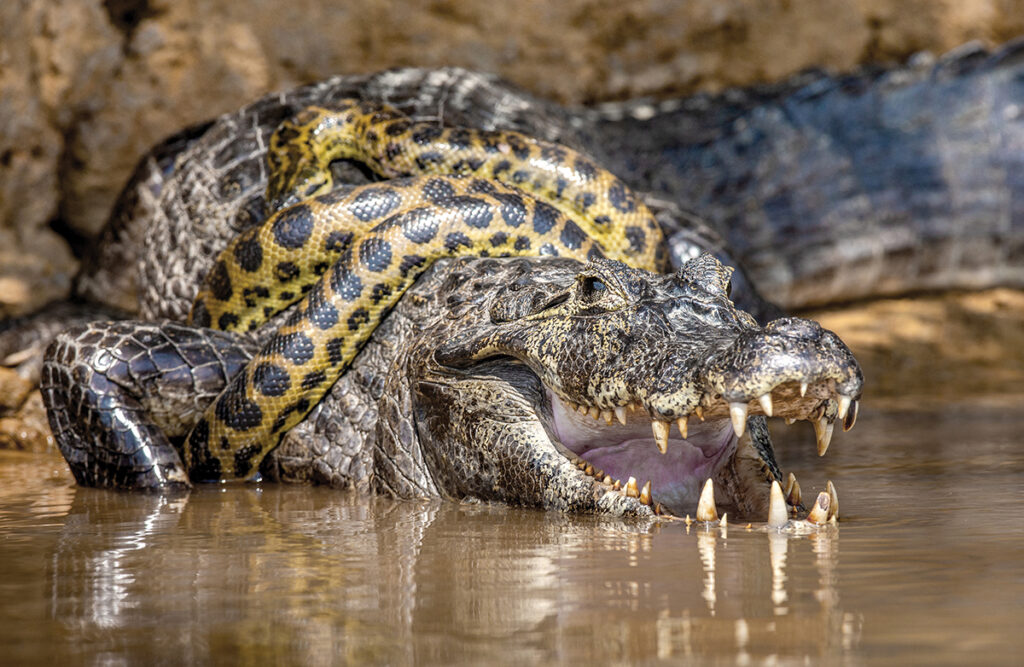
An anaconda strangles a caiman in Brazil. Courtesy photo
It’s likely that a mixture of a shifting climate in the wake of the glacial maximum as well as neolithic humans contributed to the extinction of the glyptodon.
Dire wolves
Not unique to A Song of Ice and Fire, dire wolves were a large relative to many wolf species today. It may be easy to think that wolves simply shrank over time and originated from dire
wolves, but this wasn’t the case. Their lineage diverged about 5.7 million years ago, making dire wolves distinct from gray wolves.
Dire wolves had a huge range across North and South America, favoring woodlands and arid plains where they could run and hunt for prey. Despite their fame for being huge animals, they were comparable to some of the largest gray wolves, reaching up to 175 pounds and six feet long. The most intact fossils we’ve recovered have been fished out of the La Brea tar pits near Los Angeles. Unfortunately, their genetic material has been almost completely destroyed by the tar.
Dire wolves have made headlines recently as Colossal Biosciences has claimed to have brought them back from extinction. These three wolves aren’t dire wolves at all, but gray wolves that were subjected to 20 edits to their genes to increase their size. Rather than bringing back an extinct species, this supercharges a pre-existing species that carries the potential to deal untold damage to ecosystems if ever allowed to breed without restriction in the wild.
Cue Ian Malcolm walking toward a big pile of triceratops poo.
Anaconda
We tend to talk about extinct megafauna, but one form of South American megafauna still exists: the green anaconda. It is the largest and heaviest snake in the world but remains just a little shorter than the reticulated python. The largest green anaconda on record weighed 500 pounds and was more than 27 feet long.
As a point of reference, that snake weighed as much as a grand piano and was as long as a moving truck.
Being an aquatic predator, the anaconda will devour anything it can wrap its jaws around. This includes fish, caimans or even jaguars that come close to the water’s edge. As opportunistic predators, they are eager to consume virtually anything with a heartbeat. In rare cases, this includes humans.
However, the idea of massive snakes going on Amazonian man-killing rampages is largely a work of fiction. The anaconda is not known for actively stalking humans, but instead seems to eat whatever it can reach at the water’s edge.
One of the strangest behaviors of this snake is the breeding ball. A female will secrete pheromones that attract males in droves. Multiple males will coil around the female in an attempt to mate, forcibly pushing weaker males away in the process. This can go on for weeks on end, which is horrifying when you factor in the sheer size of these reptiles.
Females have also been observed to breed through parthenogenesis, which means they can reproduce a perfect genetic clone of themselves without the need for a male. This is a highly inefficient means of reproduction, as it makes the offspring susceptible to pathogens
and dangers the parent faced, but it’s an acceptable means to continue a genetic lineage in dire conditions.
Stay curious, 7B.