Human beings are often regarded as the pinnacle of evolution when it comes to life on Earth. As a species, we are capable of modifying our environment at scales never before seen outside of major ecological disasters including chain volcanic eruptions and asteroid strikes. Sometimes this is for the better; but, collectively, it has proven to be for the worse in the past few years.
That being said, there are myriad critters on Earth that can make short work of human beings. Adding insult to injury, many of these creatures can effortlessly end us accidentally while totally lacking the capability to eat us.
Jellyfish are among those creatures.
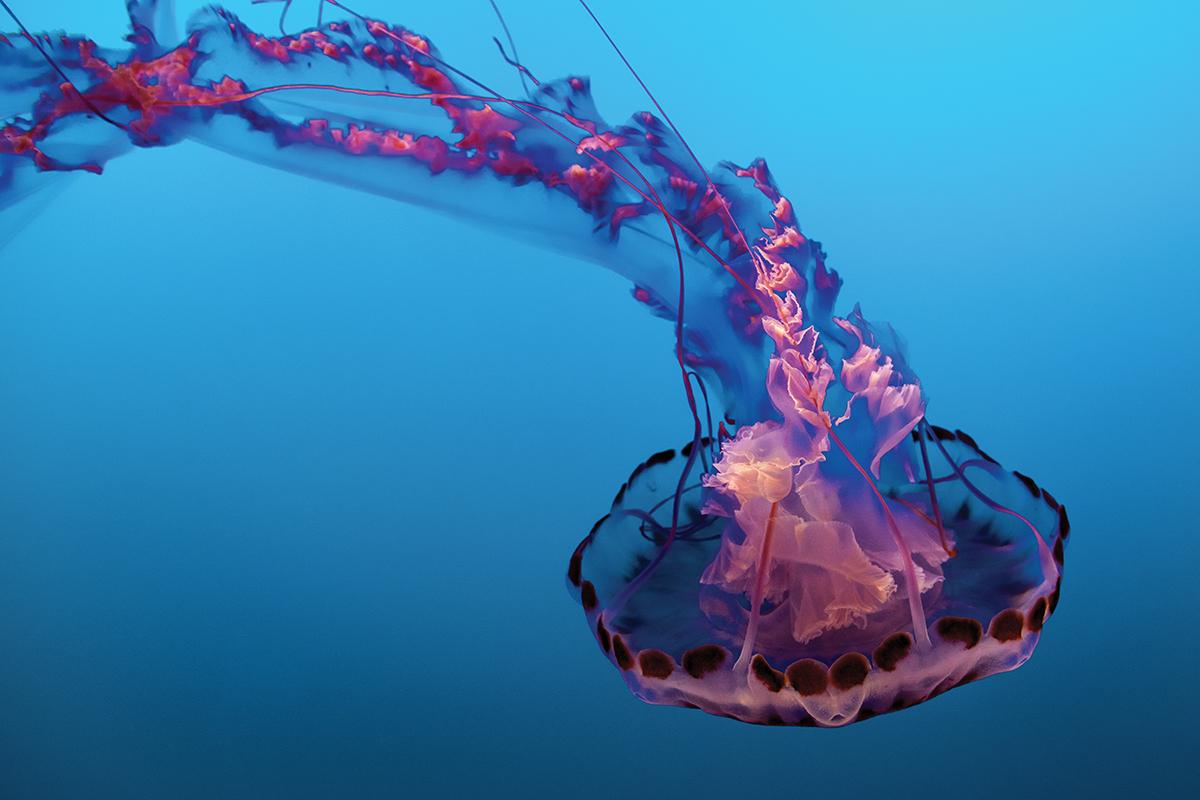
Imagine a jellyfish for a moment: You probably envision a translucent, tentacled thing that looks like a plastic bag floating through the ocean. This is actually just one stage of the creature’s life, called the “medusa phase.” Jellyfish begin their lives as larvae, which tend to look more like amoebas or cells than insect larvae. This phase is spent searching for a suitable surface to which to bond and enter the polyp phase, during which the jellyfish creates a polyp that can look a bit like a sea anemone that remains stuck to a surface for days, months or even years. During the polyp phase, jellyfish can reproduce asexually to create more larvae that will become more polyps. Sometimes, these polyps will transform into the medusa phase, allowing them to swim freely through water to hunt prey and reproduce sexually with other jellyfish.
These creatures are extremely strange and utterly unique on the planet. They are also one of the oldest forms of life, first appearing on Earth at least 500 million years ago.
Perhaps the strangest feature of jellyfish is that they do not think or possess consciousness in a way that most life on Earth does. They lack brains and instead possess nervous nets rigged to their various organs that allow them to respond to external stimuli such as light, touch, temperature and chemical reactions. Despite lacking brains, some jellyfish do possess the ability to learn from mistakes and adapt to optimize movement and hunting. Trying to understand exactly how this works when they literally lack a brain is a difficult prospect for humans. Jellyfish simply do not experience existence in the way that we do, yet they are still alive and extremely effective at what they do.
Jellyfish are generally apex predators in their environment. In marine areas that have been overfished and the jellies’ natural food source has been virtually depleted by humans, it becomes nearly impossible for fish populations to return to levels preceding the overfishing due to the jellies’ prolific ability to hunt. They can be predated by certain species of fish such as tuna. Some human cultures, particularly in parts of Southeast Asia, consider specific species of jellyfish to be a delicacy once dried.
These marine creatures have another adaptation that humans would find repellant. The mouth and the anus are the same opening. Food that is captured is fed into the gastric digestion chamber while waste is expelled from the same orifice. This opening is on the underside of a jelly’s bell, usually hidden by a swarm of venomous stinger-lined tentacles.
The method of venom delivery utilized by jellyfish is an interesting adaptation. Each tentacle can contain up to thousands of specialized cnidocytes, which are specialized cells that contain what is essentially a coiled harpoon designed to deliver cytotoxic venom into prey. The cnidocytes are activated by a mix of external stimuli, including touch and a chemical interaction of amino acids and sugars, which cause the cell to rupture, rapidly depressurize and trigger the harpoon-like cores to launch out and impale the cells of whatever has had the misfortune of finding its way into the jelly’s tentacles.
In the case of the Australian box jellyfish, also known as the sea wasp, these toxins have evolved to attack the cells of the heart to cause heart failure in humans in up to five minutes. While humans aren’t the Australian box jellyfish’s primary food source, it works even more effectively on fish and crustaceans.
Some fish have a symbiotic relationship with jellyfish. Mangrove jacks have developed an immunity to box jellyfish toxins and will actively hide within the jelly’s tentacles to evade predators. The upside-down jellyfish, Cassiopea, relies on fish that hide within its tentacles to excrete waste into its mouth as a source of nutrients.
Though not technically a jellyfish, the Portuguese man o’ war resembles other jellyfish at first glance. These creatures are siphonophores, which are a collection of different cnidarians coexisting as what is effectively a single animal. However, these parts can detach and live on their own without having to exist as a part of the Portuguese man o’ war. Trying to comprehend this as a human is somewhat mind-boggling — it would be like if your eyeballs could just detach and go live on their own completely independent of the rest of your body.
It wouldn’t be “Mad About Science” if we didn’t talk about gross stuff, and as you are probably expecting, we’re going to talk about pee. Peeing on jellyfish stings doesn’t really alleviate the sting, at least not in any way outside of offering a placebo effect. Ammonia doesn’t have any chemical reaction with stings, especially in the case of the lethal Australian box jellyfish. Vinegar is capable of counteracting the toxins of jellyfish, but proper medical care is still required after severe stings.
Stay curious, 7B.
Want to support independent local journalism?
The Sandpoint Reader is our town's local, independent weekly newspaper. "Independent" means that the Reader is locally owned and operated by people who were born and raised in Sandpoint. The Reader is owned by Publisher Ben Olson, Editor-in-Chief Zach Hagadone and Senior Writer Soncirey Mitchell. Sandpoint Reader LLC is a completely independent business unit; no big newspaper group or corporate conglomerate or billionaire owner dictates our editorial policy. And we want the news, opinion and lifestyle stories we report to be freely available to all interested readers - so unlike many other newspapers and media websites, we have NO PAYWALL on our website. The Reader relies wholly on the support of our valued advertisers, as well as readers who voluntarily contribute. Want to ensure that local, independent journalism survives in our town? You can help support the Reader for as little as $1.
TIMBER WARS: Six-part series, February-November 2022. GO READ IT»
WHERE ARE THE WORKERS?: Five-part series, September-October 2021. GO READ IT»
THE AMERICAN REDOUBT: Seven-part series, November-December 2017. GO READ IT»
STANDOFF AT RUBY RIDGE: 25 Years Later. Five-part series, August-September 2017. GO READ IT»
Curious about what media the locals use? Check our 2018 Local Media Survey. GO SEE »
Sandpoint in Pictures
Filmmaker Jimmy Matlosz of the Idaho Film Company has made a series of mini documentaries about influential Sandpoint locals, including the late Dann Hall and Erik Daarstad as well as icons Diane Michaels and Dan Shook. He is currently working on a series of interviews connected to the history of the Panida Theater. Jimmy is a 30-year veteran filmmaker who's work can be seen at dpmatlosz.com.
Meet the Reader
Ever wonder who makes the Reader happen? Here's a behind-the-scenes look pieced together by summer 2017 intern McCalee Cain in which Ben, Cameron and Lyndsie explain what exactly about the Reader keeps them coming back to their shabby (but well-loved) office each week.