As the remaining leaves shift to shades of red, orange and yellow, we continue our monthslong march into the season of spookiness with more unsolved mysteries of our world.
Today, we are exploring incredible architectural feats from the distant past that we cannot explain. One’s mind immediately drifts to the Great Pyramids of Giza, Stonehenge or the Stone Spheres of Costa Rica. Many of those are well studied, with valid hypotheses as to their creation and purpose. Much like last week’s “Mad About Science” topic, the Voynich manuscript, the subjects we explore today are enigmas to the modern mind.
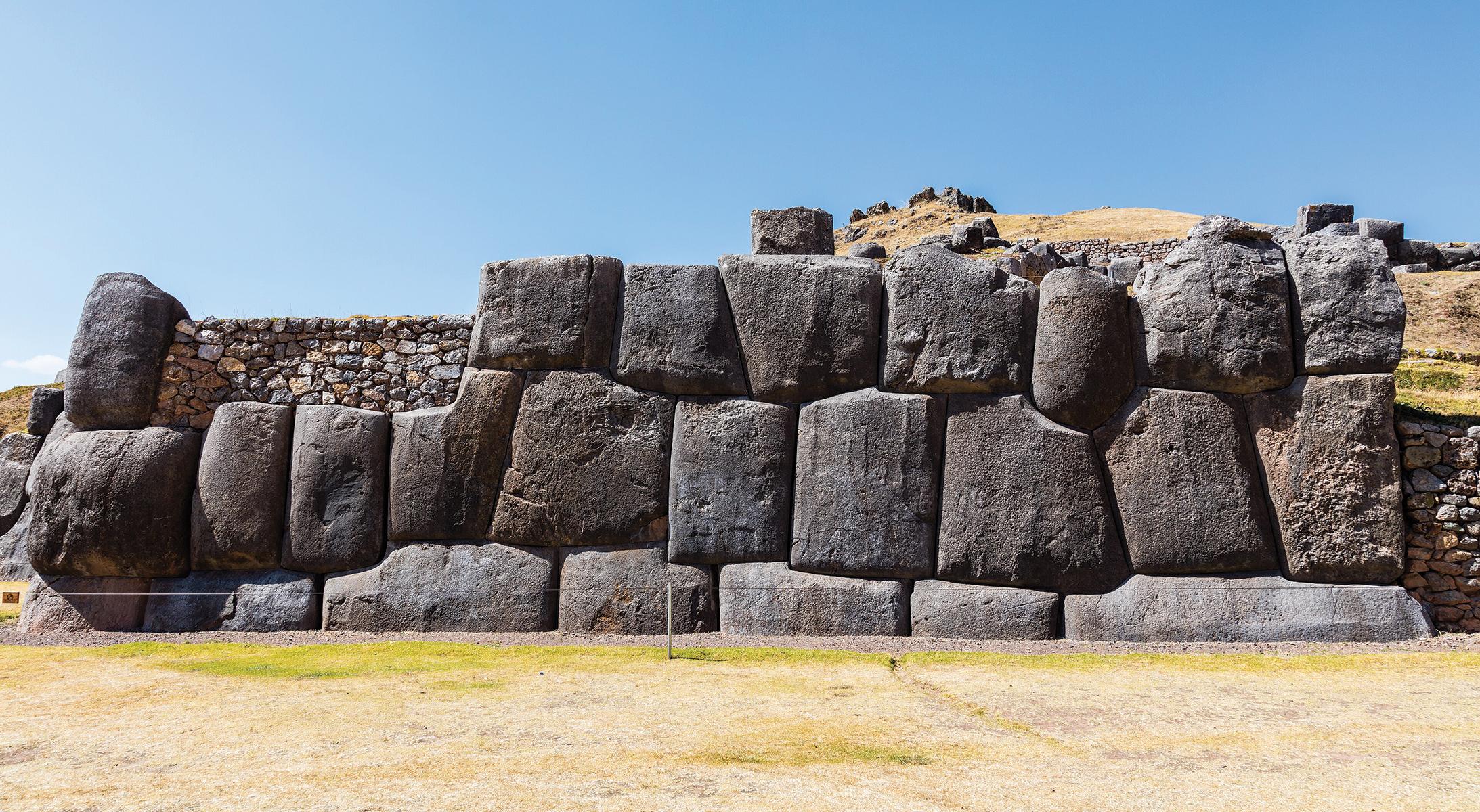
Sacsayhuamán is a ruined hilltop stone fort used by the Inca during and before the Spanish invasion beginning in 1532, though documented use of the site dates back to at least 900 C.E. It sits in southern Peru, near the city of Cusco. Even though the fort was largely disassembled by the Spanish after subjugating the Inca, many of the largest stones weighing up to 125 tons remain locked in place atop the hill.
That isn’t just fanciful wording, the stones are cut so precisely and with such attention to detail that they actually lock together. It’s impossible to even slide a piece of paper between many of the stones due to the precision of the masonry.
One of Sacsayhuamán’s ruined walls. Courtesy photo
The first portion of this unexplained mystery is how they managed to get these stones up the mountain. Hauling anything uphill is difficult, but hauling 125 ton slabs of stone up a hill is almost unthinkable. It’s likely the Inca utilized their advanced road systems and found some unknown method for reducing friction beneath the stones while dispersing the weight across countless ropes being pulled by people or animals up the hill.
The next, and perhaps more perplexing, part of this mystery is how they managed to engineer the stone slabs so precisely. It was unlikely that they were completely tooled before transportation, so some degree of advanced measurement and precision stonework had to take place on site. Cutting stone is no easy task, especially on top of a mountain away from running water or any other sources of power. No mortar was used, and instead the stones were simply cut into zigzagging patterns to interlock exactly.
Finally, we have absolutely no idea how they managed to place the finished stones. One hypothesis posited rolling them into place with logs that were removed one by one so that each piece could fall into its final position, but this was impossible to replicate with much smaller slabs. Some sort of crane or pulley system could have been utilized, but we have no idea how they could have lifted such huge pieces of rock without advanced metallurgy or powered mechanics. The accuracy of their placement leads us to believe they were set down with an immense level of control.
There are other fortifications across the world that we can’t fully explain. Iron age and medieval fort remnants scatter the United Kingdom and parts of Germany with a peculiar shared feature: The stone has been burned by a flame hot enough to fuse the material into a solid mass.
Called “vitrified forts” and found particularly throughout Scotland, these structures show signs of very high heat — up to about 2,000° Fahrenheit for some types of rock — melting together the stones that make up the walls. This doesn’t appear to be accidental and instead seems to have been done multiple times as a form of maintenance to certain forts throughout the countryside.
This likely wasn’t done for defensive purposes, as heating the stone actually makes it more brittle. Additionally, the amount of labor and materials required to create an open flame with the heat necessary to achieve this particular effect didn’t match the understood behaviors of people during the iron and medieval ages. Resources were scarce and chopping wood was dangerous. Creating charcoal was also a massive ordeal, and burning immense amounts of it just to weaken your defensive walls for giggles doesn’t make any sense.
The leading hypothesis is that this was some sort of ritualistic practice for retiring a fort, though it still doesn’t explain why some forts underwent the process multiple times as a form of maintenance.
The final curiosity is Ishi no Hoden, a 500-ton slab of carved volcanic tuff in Takasago, Japan. The slab has a unique pyramidal shape protruding from its side, while it also appears to be floating above a pool of water. The oldest written record of the structure dates to around 700 C.E., but it’s completely unknown how this was carved or for what purpose.
While the toolmarks on the surface of the structure show an immense level of precision, aside from the slab’s existence, there has never been any sign of it having been worked on. There are no quarry remains, there are no tool fragments, and there is no written or even oral documentation outside of Shinto folklore to describe when, how or why it even exists.
There also aren’t similar slabs anywhere else that have ever been found. However, volcanic tuff from nearby quarries had been used to build the fortifications of nearby Himeji Castle, built in 1333 C.E. and one of the last and mostly pristine pre-modern Japanese castles that survive today.
Whoever decided to create this unusual megalithic monument decided they would be one and done, and didn’t even bother leaving behind a calling card. It is such a massive piece of work that it must have been someone’s lifetime purpose to create. In doing so, they didn’t even want to be remembered for who they were — just what they did.
Stay curious, 7B.
Want to support independent local journalism?
The Sandpoint Reader is our town's local, independent weekly newspaper. "Independent" means that the Reader is locally owned and operated by people who were born and raised in Sandpoint. The Reader is owned by Publisher Ben Olson, Editor-in-Chief Zach Hagadone and Senior Writer Soncirey Mitchell. Sandpoint Reader LLC is a completely independent business unit; no big newspaper group or corporate conglomerate or billionaire owner dictates our editorial policy. And we want the news, opinion and lifestyle stories we report to be freely available to all interested readers - so unlike many other newspapers and media websites, we have NO PAYWALL on our website. The Reader relies wholly on the support of our valued advertisers, as well as readers who voluntarily contribute. Want to ensure that local, independent journalism survives in our town? You can help support the Reader for as little as $1.
TIMBER WARS: Six-part series, February-November 2022. GO READ IT»
WHERE ARE THE WORKERS?: Five-part series, September-October 2021. GO READ IT»
THE AMERICAN REDOUBT: Seven-part series, November-December 2017. GO READ IT»
STANDOFF AT RUBY RIDGE: 25 Years Later. Five-part series, August-September 2017. GO READ IT»
Curious about what media the locals use? Check our 2018 Local Media Survey. GO SEE »
Sandpoint in Pictures
Filmmaker Jimmy Matlosz of the Idaho Film Company has made a series of mini documentaries about influential Sandpoint locals, including the late Dann Hall and Erik Daarstad as well as icons Diane Michaels and Dan Shook. He is currently working on a series of interviews connected to the history of the Panida Theater. Jimmy is a 30-year veteran filmmaker who's work can be seen at dpmatlosz.com.
Meet the Reader
Ever wonder who makes the Reader happen? Here's a behind-the-scenes look pieced together by summer 2017 intern McCalee Cain in which Ben, Cameron and Lyndsie explain what exactly about the Reader keeps them coming back to their shabby (but well-loved) office each week.