They are objects that come in many different sizes, ranging from hypothetical microscopic black holes that evaporate almost immediately, to the supermassive blackhole of Phoenix A, with a projected Schwarzschild radius of 295.25 billion kilometers. To reach that number, you would have to travel between the sun and Pluto 50 times.
Despite being so unfathomably huge, we know very little about it — or virtually any other black hole, all things considered. By their very nature, they swallow up anything that comes close enough to fall into the gravity well and plunge into the event horizon. This is the point where our math begins to break down, as the black hole’s immense gravitational force alters the fabric of time and space.
We believe there is a singularity at the core of every black hole, a hyper-condensed collection of matter that fuels the physics-breaking effects of the black hole, but reaching it is impossible — not because we don’t have the technology to reach it, but because it somehow doesn’t exist yet. That is to say, it exists in the future, because the black hole warps time, and observing the singularity would break all established laws of our universe because, somehow, it doesn’t exist yet.
Astrophysicists proposed an interesting concept that could circumvent much of what makes a black hole so mysterious and reality-breaking. What if there existed some form of star that did everything a black hole did without an event horizon or a singularity? It would be a location of such intensely packed and ultra-dense mass that it can bend space and time around it, but doesn’t cause the laws of physics to break down as you near it.
This is the idea of the gravastar, and it’s going to sound completely crazy in an article about crazy, unreal-seeming concepts.
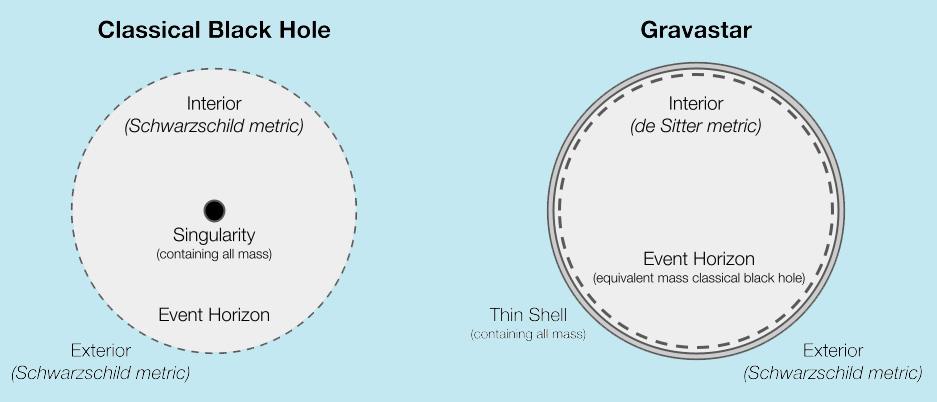
The idea of a gravastar is that an immense amount of mass (10 solar masses or more) is condensed into an area about the size of London through tremendous external forces. The internal force of the mass pushing out against the external forces reshapes the matter into an extremely thin spherical shell of hyper-dense matter. Inside of this matter-shell exists a vacuum that is under a huge amount of pressure — vastly higher even than the vacuum outside the shell.
The vacuum we talk about in regards to space is different from your vacuum at home, even though some of the principles are similar. You can think of the vacuum of space to be less empty nothingness, and more a medium through which energy transfers. Imagine a still pond to be the vacuum of space. Nothing is interacting with it, so the water is completely static. Suddenly a duck lands in it and starts swimming, creating ripples. The duck is displacing space, just like matter and energy do for a vacuum to create ripples. This water will behave very differently when it’s put inside a metal canister and more water is pumped in — not just to a point of being full, but where there can’t be any more pressure held within.
This is the basis of a gravastar — it’s basically a tire with no release valve.
One of the most curious aspects about the idea of the gravastar is that it requires a strange shell of matter. This matter is tightly compacted to a level that seems like it should be impossible. However, mathematics proves that it is possible, just extremely difficult to replicate at a human scale. The pressure involved in its metamorphosis would actually change the nature of the matter itself, creating not only some kind of new element but a new phase of matter altogether that is virtually unbreakable.
Meanwhile, a strange equilibrium exists between the shell and the differing pressures from the inside and outside vacuum. Even more curious, this shell would be so thin that it’s hard to really imagine it.
For example, consider that atoms are the basis of all matter in our universe. Now imagine using a load of bricks to build a house. The house is an object made up of atoms. Now you want to crush the house, but you don’t want to break the bricks. You’re going to have to press these from every direction with an immense amount of force. The house is pressed with a giant series of hydraulic jacks, and instead of blasting apart all over the place, the house and all of its constituent bricks are flattened into a new kind of object that weighs as much as the house and contains all the bricks that made the house, but it’s now about the depth of a sheet of paper. One heavy, strong piece of paper.
That is basically a gravastar’s outer shell, while the interior is completely hollow and filled with a vacuum that is subjected to the forces of dark energy.
The strangest thing about all of this is that, from the outside, it’s completely indistinguishable from a black hole. Barely 1 billionth of a degree warmer than absolute zero, they would appear as dark “holes” where gravity bends space and light around it. It would be able to influence other astronomical bodies around it just like a black hole.
It’s a strange and intriguing concept we haven’t yet been able to prove or disprove, and even after having taken pictures of the supermassive black hole at the core of the Milky Way (or at least its effects on the surrounding matter), we can’t fully and definitively prove that it is, or isn’t, a black hole or a gravastar.
Stay curious, 7B.
Want to support independent local journalism?
The Sandpoint Reader is our town's local, independent weekly newspaper. "Independent" means that the Reader is locally owned and operated by people who were born and raised in Sandpoint. The Reader is owned by Publisher Ben Olson, Editor-in-Chief Zach Hagadone and Senior Writer Soncirey Mitchell. Sandpoint Reader LLC is a completely independent business unit; no big newspaper group or corporate conglomerate or billionaire owner dictates our editorial policy. And we want the news, opinion and lifestyle stories we report to be freely available to all interested readers - so unlike many other newspapers and media websites, we have NO PAYWALL on our website. The Reader relies wholly on the support of our valued advertisers, as well as readers who voluntarily contribute. Want to ensure that local, independent journalism survives in our town? You can help support the Reader for as little as $1.
TIMBER WARS: Six-part series, February-November 2022. GO READ IT»
WHERE ARE THE WORKERS?: Five-part series, September-October 2021. GO READ IT»
THE AMERICAN REDOUBT: Seven-part series, November-December 2017. GO READ IT»
STANDOFF AT RUBY RIDGE: 25 Years Later. Five-part series, August-September 2017. GO READ IT»
Curious about what media the locals use? Check our 2018 Local Media Survey. GO SEE »
Sandpoint in Pictures
Filmmaker Jimmy Matlosz of the Idaho Film Company has made a series of mini documentaries about influential Sandpoint locals, including the late Dann Hall and Erik Daarstad as well as icons Diane Michaels and Dan Shook. He is currently working on a series of interviews connected to the history of the Panida Theater. Jimmy is a 30-year veteran filmmaker who's work can be seen at dpmatlosz.com.
Meet the Reader
Ever wonder who makes the Reader happen? Here's a behind-the-scenes look pieced together by summer 2017 intern McCalee Cain in which Ben, Cameron and Lyndsie explain what exactly about the Reader keeps them coming back to their shabby (but well-loved) office each week.