By Zach Hagadone
Reader Staff
Members of the Sandpoint City Council voted June 25 to maintain the status quo with management of the James E. Russell Sports Center, giving the facility and its new supervisor time to make the changes necessary to increase use.
City officials hosted a workshop May 28 at the JER community room to address a $101,000 shortfall in expected revenue, as the center generated an estimated $72,000 — mostly from membership fees — during its first six months of operation, though incurred about $138,000 in expenses.
Planning and Community Development Director Jason Welker offered four possible options for how to manage JER in such a way that it recoups more of its costs, as between 40% and 46% of the facility’s operations are currently being subsidized by the city’s Recreation Fund.
One option would be to adapt JER to serve multiple sports beyond tennis and pickleball, while others would be to work with a third-party operator, such as the U.S. Tennis Association-Pacific Northwest or minimize operations.
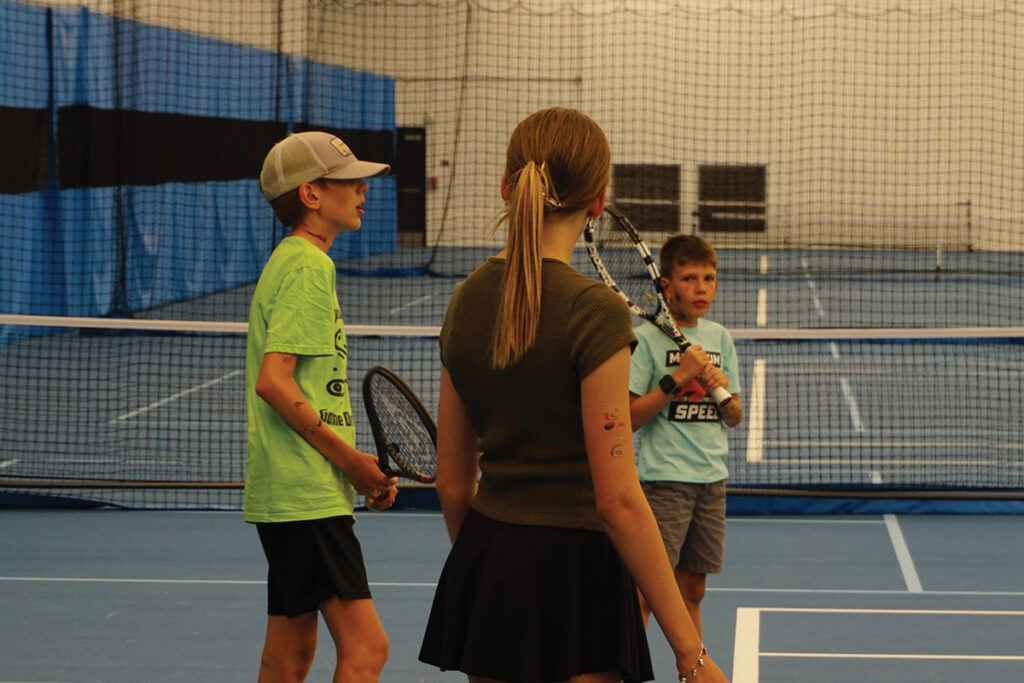
Three young Sandpointians practice tennis at the James E. Russell Sports Center. Photo by Ben Olson
Jim Russell, whose family donated the $7.5 million to develop the center, named for his father, addressed the council via Zoom, saying, “there’s been a lot of discussion about the JER Center, with some folks claiming to know what we want or know what dad wanted, and now more discussion about what should be done in the future regarding the JER Center, so I want to express personally and on behalf of my mom what we would like to see happen and what we believe dad wanted.”
Specifically, Russell noted that 75% of the current operating costs go to wages and benefits, with other facility expenses amounting to less than half the projected monthly revenue of $10,000.
“[I]f you could get two volunteers six hours a day for five days a week, you basically could recoup 40% of your projected shortfall with just volunteerism,” he said, adding that based on that calculation, 177 annual memberships would cover the annual expense shortfall.
As for converting JER to a multi-sport center — which would require temporary or semi-permanent court infrastructure to accommodate uses like basketball and baseball — Russell said, “the original intent for the JER Center was for a community use facility, primarily tennis and pickleball, and was written into the donor agreement between us and the city, [and] the capital expense to make permanent or semi-permanent changes would only add to the cost recovery burden.”
He also argued that it is unclear whether the potential increase in revenue from multi-use would outweigh the loss from reduced racket sports.
“In my opinion it’s just simply too soon to run down the path of multi-use in terms of reconfiguring the center with permanent or semi-permanent changes to the courts,” Russell said, later adding, “I would respectfully request that if we ever went down the path of multi-use that you explore options where you could return the center to four tennis courts and 14 pickleball courts in two hours or less with minimal labor expense — not a permanent or a semi-permanent.”
Meanwhile, Russell called on the council to give JER Manager Ryan Wells the time to increase advertising for the facility, develop programs and make other operational changes, rather than considering a third-party operator. However, should the city explore that route, he proposed that any such partnership come with a revenue sharing model that includes a minimum cost recovery requirement for any event at the center.
For his part, Wells told the council that after a month of the job, his efforts have been “just build more robust programming.”
“We’ve heard over and over and over that the lack of membership retention is based on the fact that we’re not offering much there, and then once we get those people in, that will open up the door to a lot more kids’ programs and having that kind of snowball,” he said, later adding, “We have a real gem here, we just haven’t marketed it and we haven’t run it in the way that that building was intended to be run.”
Finally, Russell called on members of the community to make better use of the facility.
“Can the city improve operations? Absolutely. I don’t think anybody would disagree with that, but the only reason this discussion is taking place is the racket sport community has not used the facility enough,” he said. “If they want the JER to remain a racket sport facility-only, you need to show up pay and use the facility in greater numbers more frequently and bring your friends, your families, your neighbors, and other cities’ and counties’ facility use will solve all ills.”
Councilors agreed with Russell’s points, including Councilor Justin Dick.
“I mean no disrespect to anybody here or anybody that’s involved with the last six months [of JER operations], but as a business owner looking at the last six months and trying to figure out what to do with it, if I was judged based upon what my restaurant did last year and the amount of money I lost there, the thing would be shut down with a bulldozer,” he said.
“When you find out that you’re losing money you change your hours of operation, you increase your marketing, you change your menu, you change purveyors — there’s a whole bevy of things that we take a look at doing, and if we’re not successful in the first six months we make the changes,” Dick added. “I think we’ve heard Jim. Jim brought up the labor [cost] is too high, the revenues are too low. Those are two things that are easily discernible and we need to figure those out and it looks like we can do that.”
Councilor Pam Duquette expressed support for Dick’s argument, and asked for “some measurable goals that we could check on, like in three months or six months, to see where we are.”
Council President Deb Ruehle made the motion to “give the James E. Russell Center an opportunity to stay the course with Ryan’s guidance.” However, she also moved to continue talks with USTA-PNW in order to get more details on what the organization could or could not provide with management of JER.
Ruehle called for continuing to operate the facility as primarily tennis and pickleball for a full budget cycle before reassessing its profit and loss. Meanwhile, Councilor Kyle Schreiber asked that the city continue to engage with the other local sports communities to discern how their additional uses might be incorporated at JER without damaging the existing courts, requiring any capital expenditures other than what are already allowed or hampering the center’s existing focus on tennis and pickleball.
Dick, Duquette, Ruehle and Schreiber were all in favor of directing Welker to continue with the status quo approach at JER, though with an emphasis on generating memberships and more users, and greater tracking of the facility’s performance. Any additional expenses at JER would be represented in Welker’s budget, which is forthcoming.
Councilors Joel Aispuro and Rick Howarth were absent.