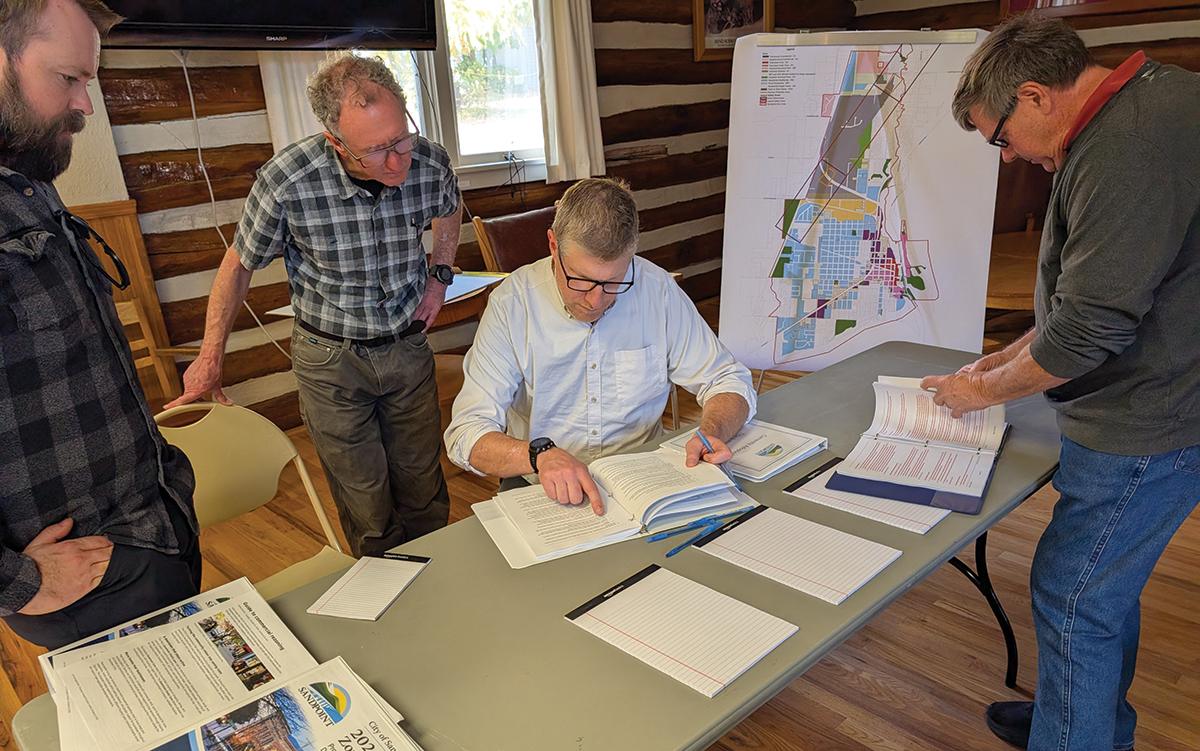
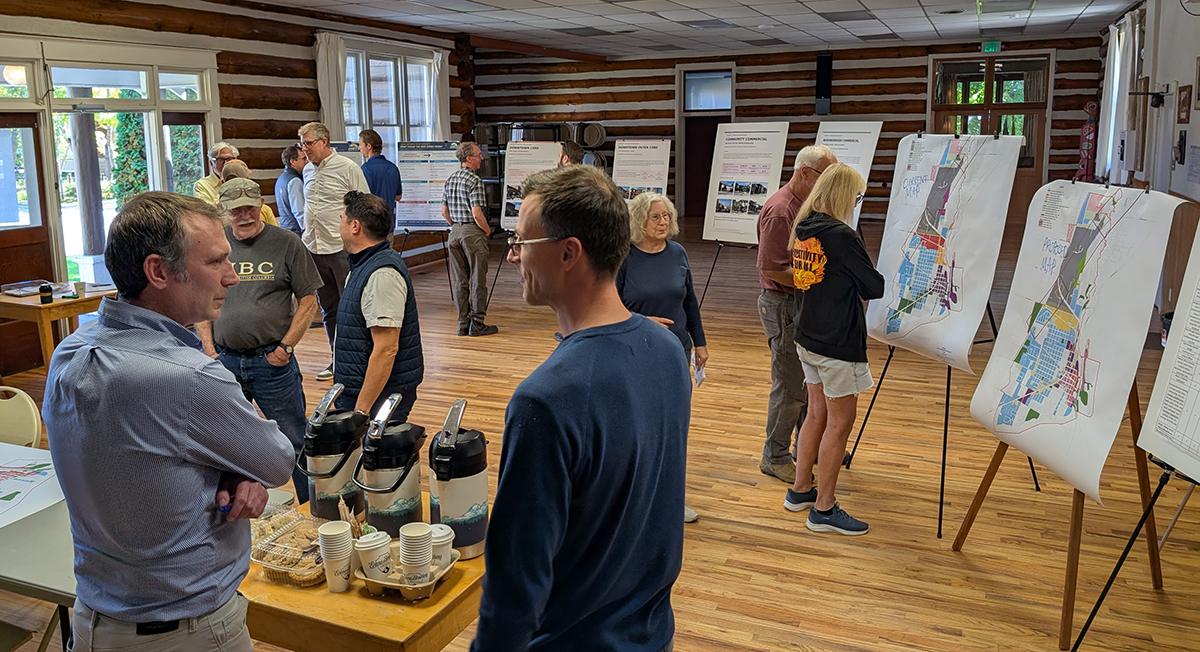
Attendance was steady throughout Sandpoint’s zoning code update open house, which took place Oct. 6 from 12:30-5:30 p.m. at Community Hall, where attendees were invited to view presentation materials and interact with staff and elected officials on concepts for how to change a range of land use policies throughout the city.
The central theme of the reimagined code was the addition of more “location-specific” commercial zones and “targeted residential zoning” — specifically, the identification of “neighborhood commercial” and “community commercial” zones to provide more flexibility of uses and blended transitions between residential and commercial properties.
Attendees examine Sandpoint’s proposed zoning changes. Photo by Zach Hagadone
City officials have already hosted presentations on potential changes to the downtown core and outer core areas, with a downtown historic district overlay and overall goal of incorporating more mixed-use residential-commercial in the city’s densest business area.
The Oct. 6 open house was meant to show how other zones throughout city limits would interact and support the larger goals of the Comprehensive Plan.
“Really what this presentation’s been is about our downtown, and the rest of it begs the question: ‘What do we do about the rest of our commercial properties?’” said City Planner Bill Dean.
He pointed to the neighborhood and community commercial zones as particularly impactful, with the former envisioning retail services, restaurants and craft manufacturing interspersed with residential. Building heights would complement adjacent housing — typically between 18 and 35 feet, depending on the lot and its surroundings — and incorporate limited primary frontage surface parking.
Defined as “small-scale services,” the neighborhood commercial zones would include a maximum 5,000-square-foot building footprint with 10- to 20-foot buffers next to residential.
Attendees examine Sandpoint’s proposed zoning changes. Photo by Zach Hagadone
Dean said a good example of neighborhood commercial is to be found with the Granary District, where lower-intensity commercial uses operate on the edge of residential areas.
“That’s a good picture of what neighborhood commercial is all about,” he said, going on to describe community commercial as a highly trafficked corridor with a more robust mix of uses, larger-scale employment.
“If we’re going to invite density in this community, let’s put it in a place where the infrastructure can handle it,” he said.
Specifically, community commercial would enable the creation of districts supporting commercial, residential, institutional and mixed-use development with larger employment and more intensive use, especially along arterials and U.S. Highway 2 between Boyer and Division avenues.
Buildings in those zones would be capped at 45 feet — five feet higher than allowable in the proposed downtown historic district but 10 feet lower than in the downtown outer core — with an emphasis on active streetscapes.
Associate Planner Erik Brubaker said that participants in the Oct. 6 open house were especially appreciative of the envisioned transition from residential to commercial zones, rather than “strip-style” development along thoroughfares like the highway.
“The general trajectory has been really appreciated,” he added.
The draft zone changes are due to go before the Planning and Zoning Commission in a 5:30 p.m. public hearing on Tuesday, Oct. 20 in City Hall Council Chambers (1123 Lake St.). Following that, commissioners will make a recommendation to the council with a final decision expected sometime in December.
Want to support independent local journalism?
The Sandpoint Reader is our town's local, independent weekly newspaper. "Independent" means that the Reader is locally owned and operated by people who were born and raised in Sandpoint. The Reader is owned by Publisher Ben Olson, Editor-in-Chief Zach Hagadone and Senior Writer Soncirey Mitchell. Sandpoint Reader LLC is a completely independent business unit; no big newspaper group or corporate conglomerate or billionaire owner dictates our editorial policy. And we want the news, opinion and lifestyle stories we report to be freely available to all interested readers - so unlike many other newspapers and media websites, we have NO PAYWALL on our website. The Reader relies wholly on the support of our valued advertisers, as well as readers who voluntarily contribute. Want to ensure that local, independent journalism survives in our town? You can help support the Reader for as little as $1.
TIMBER WARS: Six-part series, February-November 2022. GO READ IT»
WHERE ARE THE WORKERS?: Five-part series, September-October 2021. GO READ IT»
THE AMERICAN REDOUBT: Seven-part series, November-December 2017. GO READ IT»
STANDOFF AT RUBY RIDGE: 25 Years Later. Five-part series, August-September 2017. GO READ IT»
Curious about what media the locals use? Check our 2018 Local Media Survey. GO SEE »
Sandpoint in Pictures
Filmmaker Jimmy Matlosz of the Idaho Film Company has made a series of mini documentaries about influential Sandpoint locals, including the late Dann Hall and Erik Daarstad as well as icons Diane Michaels and Dan Shook. He is currently working on a series of interviews connected to the history of the Panida Theater. Jimmy is a 30-year veteran filmmaker who's work can be seen at dpmatlosz.com.
Meet the Reader
Ever wonder who makes the Reader happen? Here's a behind-the-scenes look pieced together by summer 2017 intern McCalee Cain in which Ben, Cameron and Lyndsie explain what exactly about the Reader keeps them coming back to their shabby (but well-loved) office each week.