By Brenden Bobby
Reader Columnist
It’s the Fourth of July, you’re cracking open a cold beer and bearing down on a juicy slice of watermelon while listening to some Creedence Clearwater Revival on the shores of our beautiful lake, when a sudden hankering consumes you: It’s time to learn about noodles.
Elongated strips of congealed flour have a long and mysterious history. Nations from all over the world lay claim to the discovery of noodles, with more yet ardently defending the perfection of their development.
Some form of noodles can be found in virtually every cuisine in every corner of the globe, though the most prominent ones come from China, East Asia and Italy (through pasta).
Noodles are an inexpensive filler and vehicle for delivering liquid nutrients suspended in broths and sauces. The starch helps keep you full, for a time, while the heartier aspects of the dish serve to sustain you. This is a double-edged sword, however, as starch is very quickly digested, which leaves you hungry again in a short amount of time.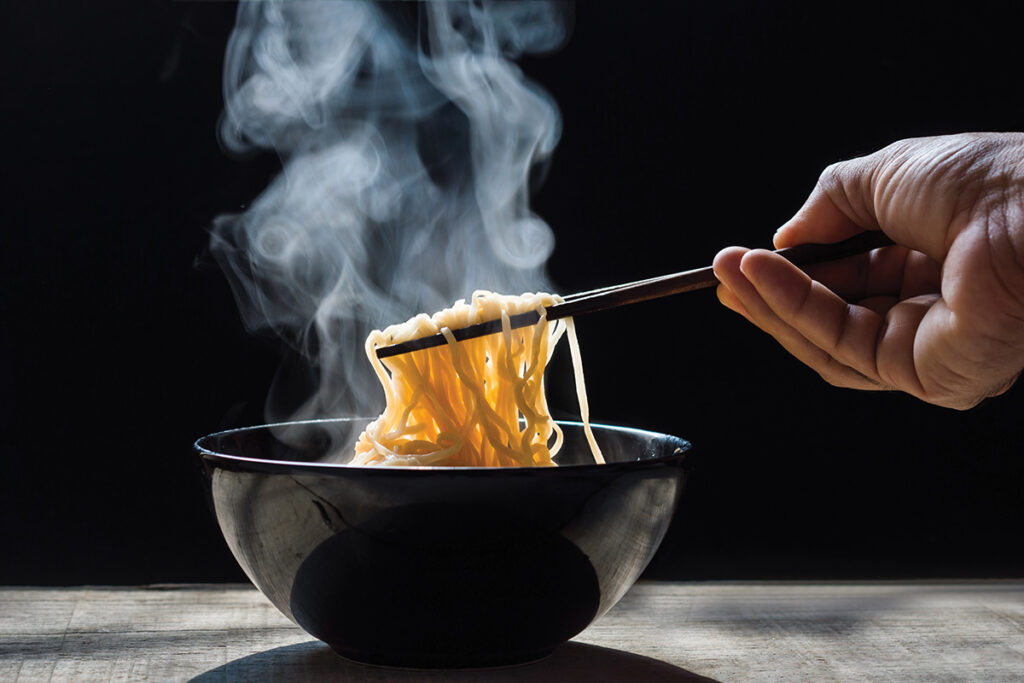
The quality of the flour used heavily influences the rapidity of digestion. Low-quality, starchy flours will produce an inferior noodle that will leave you hungry faster. A superior and fortified flour mixture can better quell your appetite, at the cost of being more difficult to produce and more expensive. This is likely why a cheap Cup Noodles won’t fill you in the same way a plate of Fettuccine Alfredo would, though the heavy cream sauce plays a significant role in this as well.
Any Italian grandmother will likely tell you that noodles were first invented in Italy, but though the Italians may have perfected the art of elongated dough strips, it’s very likely that noodles were first developed in China thousands of years ago. The oldest archaeological evidence of the food comes in the form of a 4,000-year-old upturned bowl of millet flour noodles, unearthed in a Chinese archaeological dig in 2005. Imagine forgetting your lunch one day, only for archaeologists to dig it up thousands of years later. Not only did you go hungry the rest of the day, but some goofy guy is quietly judging you in a science article while thinking about having lunch himself.
It’s uncertain if even China can lay claim to the invention of noodles, as there is strong evidence of noodle creation in the Middle East as well. But, as it stands currently, that missed lunch from 2,000 B.C.E. is the oldest existing example of noodles.
There are two probable scenarios to explain the development and spread of noodles. The first, and currently most likely, is that millet or rice flour noodles were created in China and then spread west into the civilizations of the Middle East between 2000 and 1400 B.C.E. through trade networks. Dried noodles may have been easier to transport than raw flour and may also have made for a good travel snack for traders, so long as they had access to water and fire.
The other possible history is that they were developed using durum wheat flour in the Middle East and spread both east and west around the same time. To this day, culinary science develops through collaboration and the exchange of ideas. Chefs will adopt techniques, designs and ratios from other chefs to create new and exciting dishes with ingredients we’ve had access to for thousands of years. It’s very likely that something similar happened with noodles once people figured out how to mill flour and add water to create dough.
But why noodles? Why not bread?
Portability, of course! Cutting dough into strips and strands and drying it makes it very portable and easy to fit into a bowl. Baking bread uses a larger amount of dough, and once it’s baked, you’re committed to either eating it or wasting it. Making noodles allows you to better portion out your meals without fear of waste, which is perfect for people traveling long distances and snacking on the go.
You may be wondering how modern canned soups keep noodles firm. The noodles are immersed in liquid for months, perhaps even years, without losing their texture. What kind of sorcery is at play here?
There are a number of factors manufacturers use to keep these noodles from disintegrating in the can. The biggest contributor is the alkalinity treatment the noodles receive, as manufacturers will coat them with alkaline salts in a 9-1 ratio of sodium to potassium chloride. This effectively creates a barrier that protects the noodle and makes it feel slippery when you eat it. Once cooked, a chemical reaction happens that makes the pH more neutral and allows the noodles to soften and become more palatable.
Another factor is the introduction of microbial transglutaminase, or mTG, which is an enzyme that is used to bind food together at a molecular level and keep it from gelling or disintegrating in unfavorable conditions. This is used frequently in food preservation, particularly for things like extruded meat, but it also keeps your noodles intact.
Whether you’re a local or a visitor, take a break from the box-store corn on the cob and patronize one of our local restaurants. Whether it’s Alfredo from Arlo’s or pad Thai from Secret Thai, you won’t be disappointed. You’ll be partaking in a journey that has spanned at least four thousand years.
Don’t worry, the noodle itself won’t be that old — just the knowledge it took to make it.
Stay curious, 7B.