Local man Frank Wakeley recounts helping to build the World Trade Center towers
By Ben Olson Reader Staff
Frank Wakeley has a claim to fame that few — if any — can equal: the longtime local was there when the first piece of steel was installed in the Twin Towers of the World Trade Center and, during cleanup after they were destroyed in the terrorist attacks on Sept. 11, 2001, he witnessed the last piece removed.
Wakeley grew up in New York and graduated from Bucknell University in 1968 with a degree in civil engineering.
“I started as an electrical engineer,” he told the Reader. “I built my own turntable in high school and thought that’s what I’d do, but after taking some electrical courses I realized, ‘I don’t quite get it 100%.’”
Wakeley shifted to civil engineering, which involved building roads, bridges, sewage treatment plants and other structures, including, as it turned out, skyscrapers.
“It meant I’d be working outdoors,” he said.
By the time Wakeley was hired to help construct the Twin Towers in New York City in 1968, the five-acre site had already been cleared and crews were digging to the bedrock.
Frank Wakeley today. Photo by Ben Olson
“I got hired as an engineer in training by the project manager and I worked for the Port Authority,” he said. “They’re a bi-state agency — the only one in the country — in charge of bridges, tunnels, airports, bus terminals, that kind of thing. … Somehow the Port Authority got to be the builders of the Trade Center, the owners of it, even.”
One of his main jobs was to schedule and organize the mountains of data for his bosses during construction.
“I was in charge of keeping track of where we were, what floor we were on, which building,” he said. “I got to the point where I’d give lectures to architectural students. I’d even give them tours. It was a pretty cool job.”
At the time, the World Trade Center was on track to be the tallest building in the world.
“Initially there were four or five design concepts, and I remember not liking the one they chose for the final design,” he said. “But after a while, it grew on you. It became a symbol. I started liking it when it was done. Such an amazing thing to be involved with.”
Things really got exciting when the towers began their gradual rise.
“I was there in 1968, or maybe it was ’69 by then, when they put in the very first piece of steel for one of the towers,” he said. “That was the first rising of the Trade Center. As it turns out, I was also there in 2002 when the last piece of steel came out of the same hole. It was exposed again with a ramp up the side. Pretty amazing.”
Wakeley said once the floors began to rise, the pace quickened.
“They built three floors at a time and each tower had four cranes on it,” he said. “One crane would lift the other ones up to the next level.”
As the buildings rose, Wakeley’s commute to work grew longer — and higher.
“We’d take construction elevators up and then there would be staircases to get to the higher levels,” he said. “The last floor you had to climb a ladder. When you got to the top floor it was windy and you could feel the tower moving. I could walk over to the open window and look straight down. I learned not to be afraid of heights.”
Frank Wakeley’s business card from his time working as an engineer during construction of the World Trade Center towers.
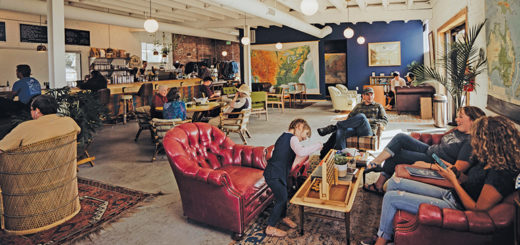
While the towers rose, Wakeley often snapped pictures of a brick building across the street that he liked; where, by chance, future fellow-Sandpointian Tim Henney worked at the same time. Now the two sit together reminiscing with friends at Marigold Bistro.
“When I met Tim, we were talking about New York and it was just a coincidence we were there at the same time,” Wakeley said. “I lived in SoHo and he lived in the Village.”
“When Frank was leading VIP tours around the campus of the early under-construction original WTC, I was in a corner office of the AT&T headquarters building just across the street editing the Bell telephone magazine and watching and reporting on the daily progress of the job, including some dude leading tours of big shots around just below me,” Henney told the Reader.
“Equipping the original WTC with communications was our largest commercial — non-military — job ever. … Frank is a terrific addition to the Boisterous Bistro Buffoons even if he is smarter than anyone else at the table except me,” Henney said.
When the North Tower was finished in December 1970, it stood 1,368 feet tall, with a broadcast antenna on top that added 360 feet more. The South Tower, completed six months later, stood 1,362 feet tall. Each tower had 110 floors, and the entire WTC complex contained almost 10 million square feet of rentable office space.
Wakeley wasn’t around for the completion of the project, though.
“You had to work for a whole year without any time off, and then you were awarded with a week vacation,” he said. “They said, ‘But if you stay with us for five years, then you get two weeks vacation.’”
Wakeley said he would watch his peers racing out of work to catch a subway to Penn Station where they’d get a train to suburbia just to spend a little time with their family.
“They didn’t seem that happy, so I quit,” he said. “It was funny, I would have meetings with subcontractors and high-up people who said, ‘Who got to you? Who hired you from us?’ and I just said, ‘Nobody, I just quit.’”
Wakeley said he spoke with a girlfriend from college who lived in Ketchum. She told him he’d love it out there.
“I was a skier and I fell in love with it,” he said. “I sublet my loft in New York, went out to Ketchum, met a girl and fell in love with her. We went back in 1971 to New York and I sold my place to move out West.”
Fast forward three decades later in North Idaho, Wakeley remembers waking early to a ringing phone and someone on the other end telling him to turn on the TV. He watched in horror as the buildings he’d worked on for more than two years billowed ominous smoke into the air after two jetliners crashed, one into each tower. An hour later, the South Tower collapsed and, 40 minutes after that, the North Tower also fell. All the years of work, along with thousands of lives, were reduced to a pile of rubble in Lower Manhattan.
“I told my kids, we might have just witnessed 20,000 people die,” he said. “We didn’t know how many people got out, it happened so fast. It’s amazing that only 3,000 people died and so many of them were firemen. I have a lot of respect for that.”
Wakeley said he has argued with conspiracy theorists over the years who claim there is no way the towers could fall like that.
“Yes, there is a way and I can explain it to you,” he said. “It was total luck on Osama Bin Laden’s part. They didn’t expect it would collapse. Buildings have been hit by small airplanes in the past. The thing is, the power of the crash didn’t knock the building over, it was the fire that melted some of the less heavy-duty parts of the structure.”
Wakeley said the exterior walls made up the structure of the towers and the very center was a core of steel and concrete.
“They attach these trusses from core to exterior walls with these small tubular platforms and poured four inches of concrete on top of them,” he said. “Those things are not made out of high-strength steel.”
He said when the fires grew so hot, a floor would collapse on top of the one below it, which was attached to the exterior walls. That caused the chain reaction that led to the buildings falling in place, not toppling over.
“It’s incalculable what the force was like,” he said.
Wakeley returned to the site in 2002 after the majority of cleanup had been completed.
“Ken Jackson, he was a pilot and he got chosen to be Idaho’s representative on the flight across America one year after the Trade Center was crashed,” he said. “He invited me to be his navigator and we flew back East. It was a celebration of our skies opening now after a year of shutdown.”
It was during the trip in 2002 when Wakeley witnessed the final piece of steel removed from the crash site.
“It was pretty emotional to see that last piece of steel removed,” he said.
Looking back on 9/11, Wakeley said it was a “big moment for America. When I was working there, it was Vietnam. I was a draft-dodging liberal hippie and I hated it. I protested in New York and got tear-gassed. We rented a bus to protest in D.C. when Kent State happened. That’s what it was like then. Now I say to myself, ‘I have to do this again? I have to go protest?’ I’m still protesting. It’s a sad situation.”
Want to support independent local journalism?
The Sandpoint Reader is our town's local, independent weekly newspaper. "Independent" means that the Reader is locally owned and operated by people who were born and raised in Sandpoint. The Reader is owned by Publisher Ben Olson, Editor-in-Chief Zach Hagadone and Senior Writer Soncirey Mitchell. Sandpoint Reader LLC is a completely independent business unit; no big newspaper group or corporate conglomerate or billionaire owner dictates our editorial policy. And we want the news, opinion and lifestyle stories we report to be freely available to all interested readers - so unlike many other newspapers and media websites, we have NO PAYWALL on our website. The Reader relies wholly on the support of our valued advertisers, as well as readers who voluntarily contribute. Want to ensure that local, independent journalism survives in our town? You can help support the Reader for as little as $1.
TIMBER WARS: Six-part series, February-November 2022. GO READ IT»
WHERE ARE THE WORKERS?: Five-part series, September-October 2021. GO READ IT»
THE AMERICAN REDOUBT: Seven-part series, November-December 2017. GO READ IT»
STANDOFF AT RUBY RIDGE: 25 Years Later. Five-part series, August-September 2017. GO READ IT»
Curious about what media the locals use? Check our 2018 Local Media Survey. GO SEE »
Sandpoint in Pictures
Filmmaker Jimmy Matlosz of the Idaho Film Company has made a series of mini documentaries about influential Sandpoint locals, including the late Dann Hall and Erik Daarstad as well as icons Diane Michaels and Dan Shook. He is currently working on a series of interviews connected to the history of the Panida Theater. Jimmy is a 30-year veteran filmmaker who's work can be seen at dpmatlosz.com.
Meet the Reader
Ever wonder who makes the Reader happen? Here's a behind-the-scenes look pieced together by summer 2017 intern McCalee Cain in which Ben, Cameron and Lyndsie explain what exactly about the Reader keeps them coming back to their shabby (but well-loved) office each week.